
Lieferung heute & morgen

Qualitätsgarantie

Willkommens-Angebote freischalten: KOSTENLOSE Lieferung | Bis zu 80 % RABATT | Kostenlose 30-Tage-JoyPlus-Testphase
App herunterladen
Freezer bags make it easier to portion, label and freeze food while saving space. However, many poor purchases are not caused by the price, but by an unsuitable size, weak film or a closure that does not hold reliably when used with liquids. If you only look at large packs or advertising claims such as “extra strong”, you may end up with lots of bags that are unsuitable for your intended use.
This buying guide explains which features matter before you buy and which models suit different households, meal-prep routines and storage quantities.
A freezer bag with a capacity of 1 litre is not automatically suitable for one litre of food. When filling the bag, you need to leave room for sealing and, where applicable, for frozen liquids to expand. That is why the stated dimensions, such as 16 × 25 cm for 1-litre bags, are just as important as the capacity in litres.
For individual portions and leftovers, 1L freezer bags are usually sufficient. Medium-sized portions for two people or meal prep are better suited to 2L freezer bags. For poultry, loaves of bread or larger quantities of vegetables, 4L freezer bags, 6L freezer bags or 10L freezer bags are more suitable.
The description extra-strong freezer bags should be supported by specific product details. Relevant factors include multi-layer film, the stated dimensions and temperature resistance. Several pely models specify 3-layer film and flexibility down to -40 °C according to the product details.
Even robust film cannot prevent damage caused by bones, sharp edges or overfilling. Wherever possible, these foods should be cushioned or placed in a suitable container before freezing.
A simple knot or clip may be sufficient for dry ingredients. Soups, sauces and marinades, however, place greater demands on the closure. Freezer bags with a zip closure are convenient to open and close. Freezer bags with a double closure have two sealing lines and may be designed for liquids according to the product description.
When freezing liquids, it is advisable to place the bag upright in a bowl first, carefully press out the air and close the seal fully. The bag should also not be filled right to the top.
| Use | Suitable guide | |---|---| | Herbs, berries, small leftovers, individual portions | 1L freezer bags | | Portions for one or two people, vegetables, baked goods | 2L freezer bags | | Family portions, poultry, large loaves of bread | 4L freezer bags | | Large roasts, fish, harvests and stored supplies | 6L or 10L freezer bags |
The sizes are guidelines. What matters is whether the food is to be frozen flat, compactly or in a bulky form. Portions filled flat can usually be stacked more efficiently in the freezer and thaw more evenly.
For regular food storage, tear-resistant, food-safe films are practical. A labelling panel allows you to note the contents and freezing date directly on the bag. This makes it easier to use older portions first.
If you are specifically looking for BPA-free freezer bags, look for clear material information in the product description or on the packaging. The pely models mentioned state that they use BPA-free film. The designation Made in Germany is also stated for these products; it refers to the manufacturer’s information about pely-Plastic in Wahlstedt.
A press seal or zip closure is practical when food is to be removed in portions. For delicate liquids, a double closure can provide greater security when sealing. Disposable freezer bags should not be reused after contact with raw meat, fish or very fatty foods unless the manufacturer has clearly approved reuse. Damaged or leaking bags should no longer be used for food storage.
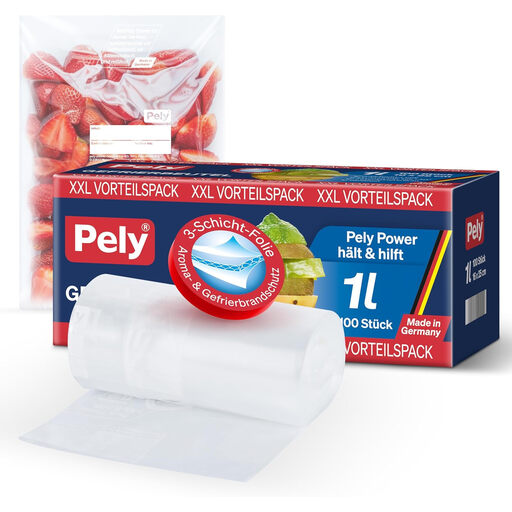
Why this product suits this profile: The 1-litre size is suitable for everyday individual portions and leftovers. With 100 bags, the pack is aimed at households that regularly freeze food and want to keep an eye on the price per bag.
The 16 × 25 cm dimensions and labelling panel make actual use more predictable than a capacity stated only in litres. The 3-layer film is specified as BPA-free and flexible down to -40 °C.
100 bags per pack, 1-litre format, 3-layer film and labelling panel according to the product details.
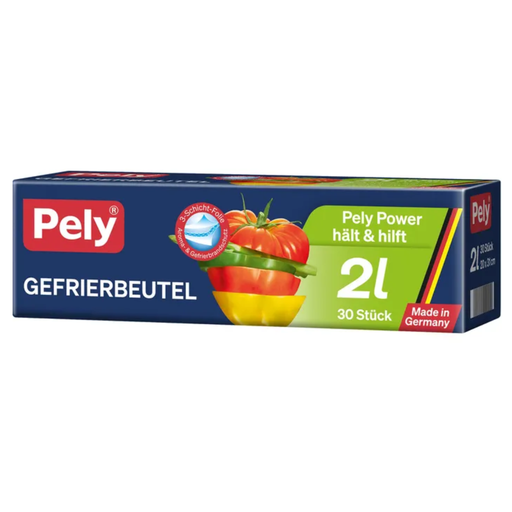
Why this product suits this profile: The medium-sized 20 × 31 cm format is designed for meal prep, vegetables and portions for two people. The pack of 30 remains manageable for households with regular but non-commercial needs.
The clear size specification prevents medium-sized portions from being overfilled in bags that are too small. The product description states that it has BPA-free 3-layer film, a writing panel and is made in Germany.
2-litre capacity, 20 × 31 cm, 30 bags and stated flexibility down to -40 °C.
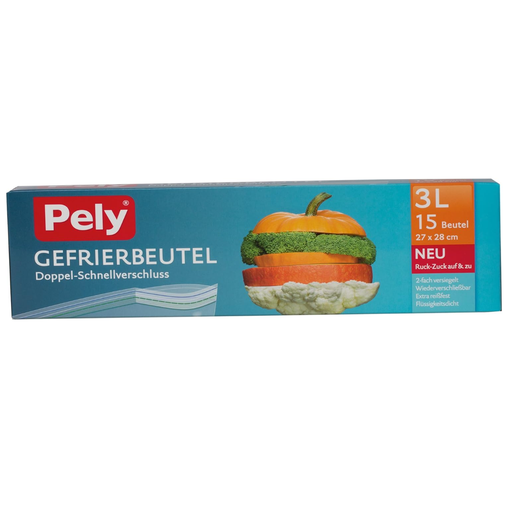
Why this product suits this profile: The 3-litre bag with double closure is designed for soups, stock, marinades and larger portions. The closure can be used again after opening.
Two sealing lines address the risk of the bag not being closed completely. Even so, the bag should be kept upright in a container while freezing.
Double press seal, 3-litre format, 15 bags and labelling panel according to the product details.
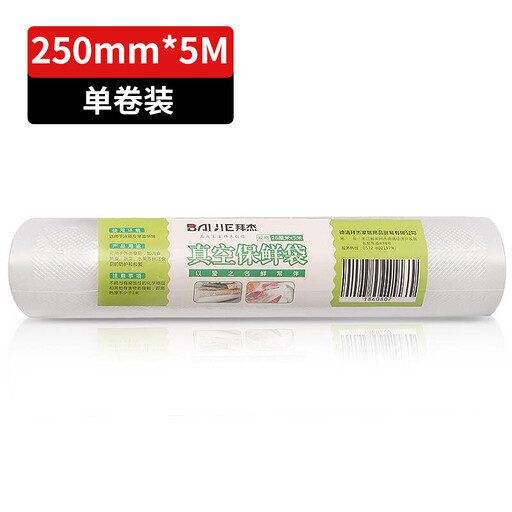
Why this product suits this profile: The roll can be cut to the required length and is aimed at users with vacuum sealers, high-volume users and small catering or meal-prep households.
The adjustable length avoids unsuitable standard sizes. Before buying, however, you should check whether the roll is compatible with your vacuum sealer.
250 mm width, 5 m roll length and, according to the product description, suitability for standard vacuum sealers.
We have put together a complete, regularly updated list of products that fully meet these strict selection criteria and the safety regulations applicable in the EU.
Freezer burn is mainly caused by contact with air and dried-out surfaces. It cannot be ruled out simply by choosing a particular type of bag. The following steps can help:
For small individual portions, berries, herbs and leftovers, a 1L freezer bag is often sufficient. For meals for two people or larger quantities of ingredients, a 2-litre bag offers greater flexibility. Bulky foods generally require 4 litres or more.
A zip can make sealing easier. For liquids, models with a double closure offer an additional sealing line according to the product details. In practice, fully leakproof freezer bags are only possible when the bag is filled correctly, the film is undamaged and the closure is completely sealed. When freezing, the bag should also be placed in a bowl.
This depends on the material, the manufacturer’s instructions and what the bag previously contained. Reuse may be possible in some circumstances with dry, clean foods. After raw meat, fish, marinades or liquids, disposable bags should be thrown away for hygiene reasons. Vacuum-sealing bags are generally intended for single use too, unless the manufacturer states otherwise.