People who freeze bananas occasionally
If you only want to freeze the occasional portion of banana, first check whether your existing four-star freezer compartment has enough clear space to freeze the slices separately.


If you only freeze the occasional portion of banana, first check whether your existing four-star freezer compartment has enough space. According to the Federal Centre for Nutrition, it is suitable for freezing fresh food. A small chest freezer may be a better option if you regularly freeze larger quantities or other foods. In that case, compare the usable capacity, the space it needs including ventilation clearance, and the stated annual energy consumption of the specific appliance. First freeze the slices separately, then pack them into individual portions so they’re easier to take out one at a time.
If you only want to freeze the occasional portion of banana, first check whether your existing four-star freezer compartment has enough clear space to freeze the slices separately.
If you regularly freeze other foods as well as bananas, extra freezer space could come in handy. Choose a capacity that suits the amount of food you actually store.
If you need extra freezer space but have limited room, check the appliance dimensions as well as the required clearance from walls, the route for getting it into place and the space needed to open the lid.
A good fit if: you occasionally freeze small portions of banana and have a clear surface for the slices.
Bear in mind: a tray or other stored food may limit the space available.
A good fit if: your existing compartment isn’t big enough for bananas and other food you freeze regularly, and you have a suitable place for it.
Bear in mind: a chest freezer takes up floor space and runs continuously, so check that its usable capacity suits your actual needs.
A good fit if: you want to store larger quantities of food regularly, as well as bananas.
Bear in mind: greater capacity also means taking up more floor space, so weigh it against the amount of food you store.
| What matters | What to check before buying | Who it matters most to |
|---|---|---|
| Do you need an extra appliance? | Check the rating of your existing compartment, the clear space available for freezing slices separately and how often you freeze food. | If I only freeze a few slices occasionally, I want to check whether my existing compartment is enough first. Around 36% of shoppers say whether they need an extra appliance is their main concern. |
| Ongoing electricity use | Compare the stated kWh/year for the specific model. You can estimate your own costs using your electricity tariff. | If an appliance will be running all the time, I want to weigh its stated energy use against the extra freezer space. Around 29% of shoppers are particularly concerned about ongoing electricity use. |
| Fit and placement | Check the model’s width, height and depth, including the required clearance, the route for getting it into place and its specified ambient temperature range. | If space is limited, the appliance must fit in its intended location, with the required clearance. Around 21% of shoppers say available space is their main concern. |
| Taking out individual portions | Check that there’s room for a single layer of slices to freeze separately and that baskets or freezer containers will keep the finished portions accessible. | If I want to take out small portions one at a time, I look for enough space to freeze the slices separately and suitable storage. Around 14% of shoppers prioritise being able to take out individual portions. |
A suitable existing freezer compartment may be enough for small quantities. An extra appliance takes up space and runs continuously.
First check the rating and usable space in your existing compartment. Then consider how often you freeze other food as well.
An extra appliance takes up space and adds to your ongoing electricity use.
For the Exquisit GT100-050E white, the stated appliance depth differs from the depth with wall clearance: the manufacturer gives measurements of 48 cm and 58 cm respectively.
Check the installation instructions for the exact model, the required clearance, the route for getting it into place and the space needed to open the lid.
The star rating indicates what the compartment is suitable for; its freezing capacity for fresh food is stated separately in kg per 24 hours.
If you regularly freeze larger quantities at once, compare the stated freezing capacity of each model.
According to the manufacturer, the GT100-050E white is a 99-l chest freezer that can switch between cooling and freezing modes.
According to the manufacturer, the GT 7355 white is a chest freezer with 100 l of usable capacity and a removable basket.
According to the manufacturer, the GT 311 105 W offers 99 l of usable capacity.
According to Beko, the HSM10440 is a freestanding chest freezer with a capacity of 104 l.
The appliances below offer extra freezer space and include both chest freezers and upright freezers. If you only freeze a few banana slices occasionally, first check whether your existing freezer compartment is enough.
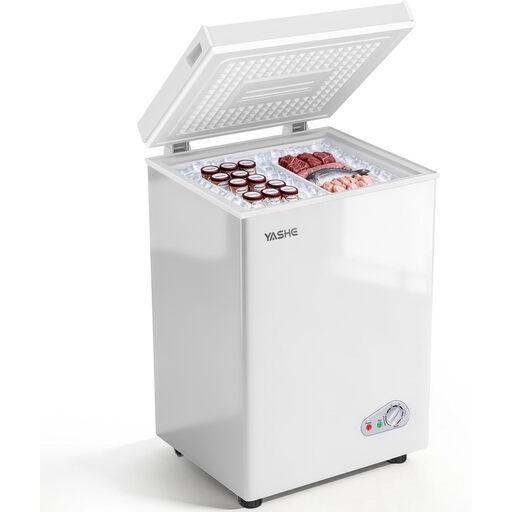 No image available
For extra freezer space if you regularly freeze other food as well as bananas.
100 l; two removable baskets; six temperature settings.
 No image available
For extra freezer space if your existing compartment isn’t big enough for fresh food or other supplies.
99 l; four-star freezing; energy efficiency rating E; wire shelf.
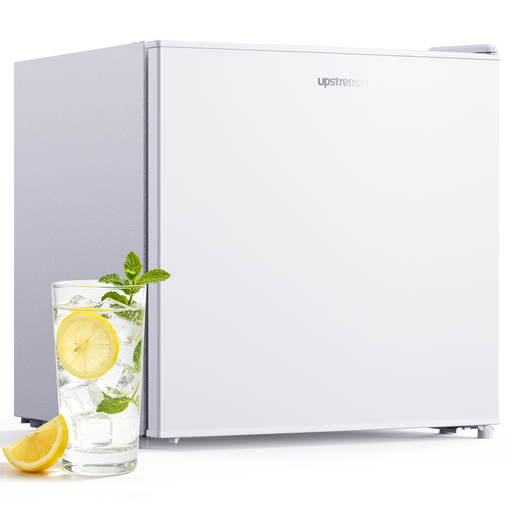 No image available
For a smaller extra freezing capacity if you’re looking for an upright freezer rather than a chest freezer.
35 l; four-star freezing function; reversible door.
 No image available
For a little extra freezer space if an upright mini freezer is a better fit for your available space than a chest freezer.
31 l; four-star freezing function; 147 kWh/year; energy efficiency rating E; reversible door.
 No image available
For extra freezer space with separate compartments if you prefer an upright freezer to a chest freezer.
60 l; three storage compartments; reversible door.
No. The Federal Centre for Nutrition explains that a four-star compartment is suitable for freezing fresh food, while a three-star compartment is designed for long-term storage of food that’s already frozen. Check the rating of your existing compartment.
Arrange the slices in a single layer with space between them. Once they’re frozen, pack them into individual portions in suitable freezer bags or containers. The Federal Centre for Nutrition describes this method for prepared fruit, and Chiquita specifically recommends it for banana slices.
Compare the kWh/year shown on the EU energy label for the specific appliance. To estimate your own costs, multiply this figure by your electricity price per kWh. The Federal Environment Agency recommends −18 °C, keeping the door open for as little time as possible, using suitable packaging and defrosting when ice builds up.
Freezers are covered by EU energy labelling; according to the Federal Environment Agency, the scale in use since 2021 runs from A to G. The Federal Ministry for the Environment says old appliances must be taken to an authorised collection or take-back point, not put in household waste. Before ordering, check with the retailer how a particular return will be handled. Take-back obligations depend, among other things, on the retailer’s size and whether you’re buying a new appliance.