House share with limited kitchen space
If you have limited floor space, make sure the external dimensions, the clearance needed to open the lid and the capacity you actually need all work together.


If there’s always room in your existing freezer compartment for individually portioned bread rolls, and you only need to freeze small quantities, it will usually be enough; a separate chest freezer isn’t automatically necessary. If you regularly store larger quantities for everyone to share, a compact chest freezer may be a better option. A larger model is only worth considering if you’ll be storing other food as well as bread rolls and have enough floor space, including room to open the lid. The Verbraucherzentrale (consumer advice centre) points out that a freezer that’s too large for your needs can use electricity unnecessarily.
If you have limited floor space, make sure the external dimensions, the clearance needed to open the lid and the capacity you actually need all work together.
When several people share a freezer, portioning food appropriately, labelling it clearly and having easy-to-reach baskets can help keep bread rolls organised. The Federal Centre for Nutrition recommends labelling frozen food.
If you regularly freeze other food or larger quantities as well as bread rolls, check the capacity and freezing capacity of the specific model.
Suitable if: you regularly freeze only small portions of bread rolls and there’s room in your existing appliance.
The trade-off: you won’t need another appliance, but you’ll have to share the space with your other frozen food.
Suitable if: several people regularly freeze bread rolls and there’s not much floor space in the kitchen.
The trade-off: even with a small footprint, you’ll need to make sure the lid can open, the baskets are arranged well and the annual energy consumption suits the location.
Suitable if: you regularly freeze larger quantities of food to share, as well as bread rolls, and have a suitable place for the appliance.
The trade-off: greater capacity takes up more space, and an appliance that’s too large for your needs can use electricity unnecessarily.
| Priority | What to check before buying | Who is this important to? |
|---|---|---|
| Storage capacity and space | Check the usable capacity, external dimensions and clearance needed to open the lid at the intended location. | If space is limited, I want enough room for our bread rolls without blocking walkways or access to the lid. Around 33% of consumers prioritise having suitable storage capacity and space for the appliance. |
| Organisation and access | Check the number and position of the baskets; package and label portions of bread rolls appropriately. | If several people use the same chest freezer, I want to be able to find portions quickly and know who they belong to. Organisation and easy access are the main priorities for around 27% of consumers. |
| Energy consumption and noise | Compare kWh/year and dB(A) for appliances with a suitable capacity. | If the chest freezer is in a shared kitchen, I want to take its energy consumption and operating noise into account. Around 20% of consumers base their choice primarily on these factors. |
| Freezing capacity and food storage | For larger quantities, check the freezing capacity in kg/24 h and allow for a storage temperature of −18 °C. | If I regularly freeze larger quantities or other food, I need the right capacity and a suitable freezing capacity. Around 20% of consumers prioritise freezing quantities and food storage. |
You don’t automatically need a large capacity for a small supply of bread rolls. According to the Verbraucherzentrale, a freezer that’s too large can use electricity unnecessarily.
First work out how much food you usually store for everyone to share, then compare suitable capacities and annual energy consumption in kWh.
A chest freezer may fit on the floor but be difficult to access under a shelf. The external dimensions shown can also vary from one product page to another.
Before buying, check the specific external dimensions, the route for bringing it in and the clearance needed to open the lid. Ask the retailer to confirm any conflicting measurements.
When food is shared, it’s harder to tell whose portions are whose and take out exactly what you need.
Freeze appropriately sized portions in suitable bags or containers and label them. You could also agree with everyone on a system for assigning food to people or baskets.
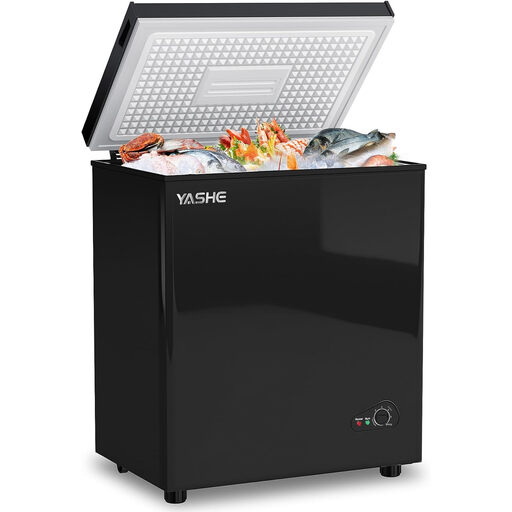
The black GT100-050E is an example of a compact chest freezer for kitchens where space is limited.
The HSM10440 and HSM14550 chest freezers offer different usable capacities.
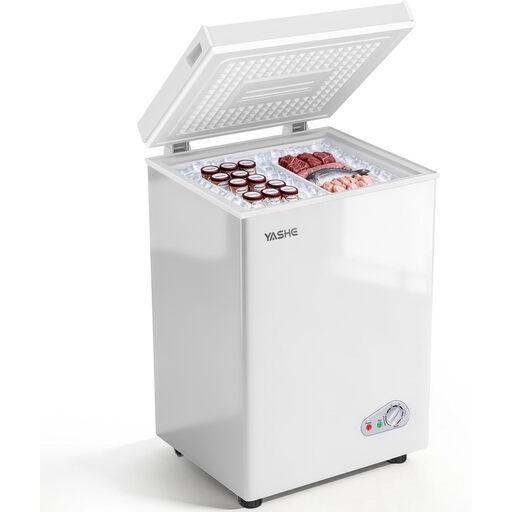
The GT 311 105 W is a compact 99-l example from the brand’s chest freezer range.
According to Severin, the GT 8849 is a 200-l chest freezer for larger food supplies.
With a capacity of 248 l, the CFd 2085 Plus is an example of a larger chest freezer for storing other food alongside bread rolls.
The range includes chest freezers with a usable capacity of 95 to 197 l for shared supplies of bread rolls and additional freezing needs; baskets and energy consumption vary by model.
 No image available
With a usable capacity of 150 l and two removable baskets, this model offers space for bread rolls you regularly store for everyone to share.
It also has six temperature settings and a stated annual energy consumption of 157 kWh/year.
 No image available
With a usable capacity of 100 l and two removable baskets, this model is designed for portions of bread rolls in a smaller kitchen.
It has six temperature settings, with stated annual energy consumption of 185 kWh.
 No image available
With a usable capacity of 95 l and one removable basket, this model is suited to smaller shared food supplies.
Other specifications include switchable fridge and freezer modes, seven temperature settings, energy efficiency class E, 165 kWh/year and 38 dB.
 No image available
With a usable capacity of 197 l and one removable basket, this model is suited to larger shared food supplies.
It switches between fridge and freezer modes and has digital temperature control with five settings. The listed energy efficiency class is E, and annual energy consumption is 197 kWh.
 No image available
With a usable capacity of 141 l and a wire basket, this model offers space for shared food supplies.
Specifications include a freezing capacity of 8 kg/24 h, energy efficiency class E, 182 kWh/year and 37 dB.
Yes, as long as there’s always enough room for the portions you need. The Federal Centre for Nutrition recommends using suitable bags or containers and labelling them. The Verbraucherzentrale also lists a fridge-freezer as a possible alternative to a separate chest freezer if you don’t need much freezer space.
Measure the space where it will go and the route you’ll use to bring it in, and allow enough clearance to open the lid. Check the specific model’s external dimensions, usable capacity, annual energy consumption in kWh and noise level in dB(A). Actual energy consumption also depends on how and where the appliance is used.
Freeze suitably sized portions in suitable bags or containers and label them with the contents and date. Everyone who uses the freezer can agree whether to add names or assign portions to particular baskets.
The Verbraucherzentrale recommends −18 °C as the optimum temperature for freezers. Check the setting on your specific appliance and store food accordingly.
Freezers must meet EU energy labelling and ecodesign requirements, as explained by the European Commission. Old appliances must not be put in household waste. The Federal Environment Agency says that when you buy a new appliance of the same type, you can return an equivalent large appliance, including when you buy online and have it delivered. If you’re supplying food commercially, check the hygiene requirements that apply to your specific business separately.