Regular dough preparers
If you regularly freeze several portions of pizza dough for get-togethers, consider not just your largest fresh batch but also the rest of your frozen supplies.


If you only freeze a few portions of dough now and then, a suitable freezer compartment you already own may be enough, provided there’s room and it’s suitable for freezing fresh food. For longer-term frozen storage, a temperature of at least −18 °C is required, according to the German Federal Centre for Nutrition. A separate chest freezer may be worth considering if you regularly need space for larger quantities of dough and other supplies at the same time. Compare usable capacity, freezing capacity, dimensions and annual energy consumption.
If you regularly freeze several portions of pizza dough for get-togethers, consider not just your largest fresh batch but also the rest of your frozen supplies.
If you need extra freezer space but have little room, compare the external dimensions and clearance needed to open the lid with the annual energy consumption of the specific model.
If you only prepare dough now and then, first check whether a suitable freezer compartment you already own has enough room.
A good fit if: you only freeze a few portions occasionally and have enough suitable freezer space available.
Consider: the available space and freezing capacity limit how much fresh dough you can freeze.
A good fit if: you regularly need extra room for dough portions and a few other supplies.
Consider: less capacity limits how much you can store; the size alone doesn’t tell you how much energy it uses.
A good fit if: you often freeze larger batches or store substantial amounts of other food alongside the dough.
Consider: extra capacity takes up more floor space, so make sure it suits your actual needs.
| What you’re considering | What to check before buying | Who it matters to |
|---|---|---|
| Do I need a second appliance? | Check the available space, whether the compartment is suitable for freezing fresh food and how often you prepare batches of dough. | If I only freeze a few portions now and then, I’d like to make use of the space in my existing compartment first. Around 30% of consumers put the question of whether they need a second appliance first. |
| Room for batches and other supplies | Work out the largest batch of dough you’ll freeze at one time and your other supplies separately; compare usable capacity and freezing capacity. | If I regularly freeze larger quantities of dough, I also want room for other food, without underestimating how much capacity I need. Around 30% of consumers focus above all on space for batches and other supplies. |
| Where to put it and the surroundings | Measure the external dimensions, including clearance for the lid; if it will be in a cold location, check that the specific model is approved for it. | If space is limited or the area is unheated, the freezer needs to be suitable for installation and use there. Around 20% of consumers say where to put it and the surroundings are their main concern. |
| Energy use and maintenance | Compare the annual energy consumption in kWh and the noise rating on the energy label; check the defrosting method and basket configuration. | If you’re choosing an appliance that will run all the time, you’ll want to understand its energy use and ongoing maintenance. Around 20% of consumers focus on running costs and ease of use. |
According to the German Federal Centre for Nutrition, a four-star freezer compartment is suitable for freezing fresh food. For longer-term frozen storage, a temperature of at least −18 °C is required. Usable capacity tells you how much food you can store at once, while freezing capacity indicates how much fresh food an appliance can freeze in 24 hours.
What matters is the largest amount of dough you’ll freeze at once and your other supplies, not just the number of people at your pizza night.
Before buying, work out your largest regular batch and your additional freezer needs separately. Then compare usable capacity and freezing capacity.
An appliance that’s consistently too large takes up floor space and may use more energy than necessary.
The energy rating doesn’t replace comparing annual energy consumption or taking usage and installation location into account.
For each specific model, compare the annual energy consumption in kWh on the energy label. To work out the cost, you’ll also need to factor in your electricity tariff.
The permitted ambient temperature varies by model. Liebherr says the CFc 1875 Plus with FrostProtect can operate at temperatures down to −15 °C; Exquisit specifies a room temperature of at least 10 °C for its chest freezers.
If you plan to use a cold cellar or garage, check that the temperature there is within the permitted range for the specific model.
Features such as SmartFrost, StopFrost or MinFrost don’t mean that manual defrosting is no longer necessary.
Check the defrosting method and care instructions for the full model name.
The GT 311 105 W is a compact model for spaces where room is limited.
The HCE200C is a 196 l chest freezer for storing a larger quantity at once.
The CFc 1875 Plus offers 192 l and, according to the manufacturer, is designed for use in colder locations too.
With a capacity of 284 l, the HSA29540N is designed for storing larger quantities of frozen food over time.
The GT100-E-040E weiss is a compact option with a capacity of 98 l.
The Joybuy models below include compact and larger chest freezers, offering extra room for dough portions and other supplies.
 No image available
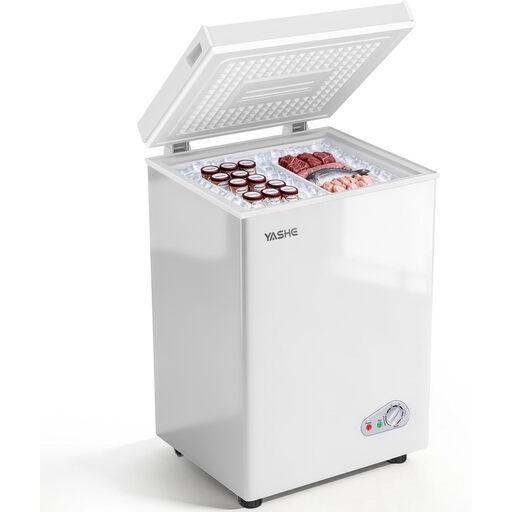
A good choice if you’re looking for extra freezer space without much floor space to spare.
The product title lists a freestanding model with a capacity of 100 l, two removable baskets and six temperature settings.
 No image available
A good choice if you’re looking to make extra room for dough portions and other supplies.
The product title lists a capacity of 141 l, a switchable fridge and freezer function, energy class E, a removable basket and a defrost water drain.
 No image available
A good choice if you want to store a smaller amount of extra food.
The product title lists a capacity of 95 l, a switchable fridge and freezer function, energy class E, a removable basket and a defrost water drain.
 No image available
A good choice if you need to store larger quantities at once.
The product title lists a capacity of 291 l, a switchable fridge and freezer function, energy class E, interior lighting, a removable basket and a defrost water drain.
 No image available
A good choice if you need extra room for dough portions and other supplies.
The product title lists a capacity of 197 l, a switchable fridge and freezer function, energy class E, five temperature settings, a removable basket and a defrost water drain.
No. A four-star freezer compartment is suitable for freezing fresh food. The German Federal Centre for Nutrition recommends a temperature of at least −18 °C for longer-term frozen storage; according to the organisation, one- and two-star compartments are only suitable for shorter-term storage.
Compare the annual energy consumption in kWh on the energy label for each appliance. The German consumer advice centre points out that energy use at home depends on how the appliance is used and where it’s installed. You’ll need to factor in your electricity tariff to work out the running costs.
No. These names don’t mean that manual defrosting is no longer necessary. Liebherr describes SmartFrost and StopFrost on the CFc 1875 Plus as features that reduce frost build-up; Beko describes MinFrost on the HSA29540N as reducing ice build-up.
EU requirements state that refrigeration and freezer appliances which need an energy label must display it visibly, including when sold online. The German Environment Agency lists free return options for old electrical appliances. When buying a large appliance of the same type, you can also return your old one in connection with an online purchase and delivery; check the arrangements for your order.