People who cook in portions
If meals are eaten at different times, measured and labelled portions make it easier to take out only what you need. The Federal Centre for Nutrition points out that larger frozen quantities are harder to divide.


First, check that your existing freezer has enough space for the portions you plan to store and is suitable for freezing fresh food. For small quantities, buying an additional appliance isn’t automatically worthwhile. If you often take out individual portions, a tall freezer with drawers can make it easier to stay organised, while a chest freezer may suit larger seasonal supplies. When freezing fresh batches, compare the usable capacity with the stated freezing capacity in kg per 24 hours.
If meals are eaten at different times, measured and labelled portions make it easier to take out only what you need. The Federal Centre for Nutrition points out that larger frozen quantities are harder to divide.
If you only freeze small quantities, weigh up the extra space required and ongoing electricity costs against the benefits of another appliance. The consumer advice centre recommends choosing an appliance that’s no bigger than necessary.
If you process larger quantities of rhubarb at once, you’ll need enough storage space and should check that the appliance’s freezing capacity suits the fresh batch.
The Federal Centre for Nutrition explains that larger frozen quantities are harder to divide than measured portions. The percentages in the table show how consumers can rank their main priority.
A good fit if: you only need space for a few extra portions and the compartment is suitable for freezing fresh food.
What to consider: Check the available capacity before buying another appliance.
A good fit if: you regularly want to take out individual, labelled portions and need extra space to store them.
What to consider: Compare the usable capacity and annual energy consumption with your actual needs.
A good fit if: you regularly store larger seasonal quantities as well as individual portions, and have enough floor space.
What to consider: Think about how you’ll organise and find packages in the appliance you choose.
| Priority | What to look for when buying | Who it matters most to |
|---|---|---|
| Taking out individual portions | Check the internal layout and ease of access; measure out portions before freezing and label them with the contents, quantity and date. | If I need individual portions for meals at different times, I want to find the right packages quickly. Around 36% of consumers prioritise being able to take out portions easily. |
| Freezing larger quantities of fresh food | Compare the usable capacity and stated freezing capacity in kg per 24 hours with the batch you plan to freeze. | If I’m processing a larger harvest at once, I consider both the storage space and the freezing capacity for fresh food. Around 29% of consumers prioritise freezing larger quantities. |
| Ongoing electricity consumption | Compare the annual consumption in kWh of suitable appliances and choose a usable capacity that meets your actual needs. | If another appliance is going to run all the time, I want to consider its annual energy consumption before buying. Around 21% of consumers put ongoing electricity costs first. |
| Floor space and location | Check the external dimensions and clearance needed; for unheated rooms, check the permitted ambient temperature for the specific model. | If there’s limited space where I plan to put the appliance, or it’s going in an unheated area, I check the fit and the manufacturer’s guidance on where it can be installed. Around 14% of consumers prioritise the available floor space. |
The consumer advice centre points out that a mini freezer can use more electricity than a larger, well-insulated appliance. Its small size alone doesn’t tell you how much energy it will use each year.
Compare the stated consumption in kWh per year, and first check whether your existing freezer compartment is large enough.
Capacity in litres describes the storage space, not how much can be frozen in 24 hours. When freezing a large fresh harvest, both figures may be important when choosing an appliance.
Compare the freezing capacity in kg per 24 hours with the quantity you plan to freeze.
According to the manufacturer, SmartFrost on the Liebherr CFc 1875 Plus reduces frost build-up, so defrosting is needed less often. This isn’t the same as the NoFrost function on the Severin GS 8868.
Check the defrosting technology on the exact model rather than assuming similar feature names mean the same thing.
The models range from the compact GB 8886 freezer to the GS 8868 tall freezer with drawers.
The freestanding GSN36VWEP is a tall freezer with pull-out drawers for neatly organised supplies.
The CFc 1875 Plus is a chest freezer for larger supplies; its location specifications are particularly relevant if you’re placing it in an unheated room.
The GS36NVICG is a high-capacity tall freezer, suitable if you want to store other frozen food alongside your rhubarb.
This selection includes tall freezers with drawers for storing portions separately, as well as chest freezers with a removable basket for supplies.
 No image available
The listed drawers and compartments offer a way to store portions separately.
204 L; NoFrost; Super Freeze; 39 dB; silver; energy class E. This model is listed as having six drawers and compartments.
 No image available
The removable basket can help you keep portions organised inside the chest freezer.
95 L; switches between fridge and freezer modes; removable basket; 7-setting thermostat; energy class E.
 No image available
The removable basket gives you a way to organise packages inside the chest freezer.
291 L; switches between fridge and freezer modes; removable basket; 5-setting digital temperature control; interior light; energy class E.
 No image available
A removable basket is listed to help keep portions neatly organised.
197 L; switches between fridge and freezer modes; removable basket; 5-setting digital temperature control; energy class E.
 No image available
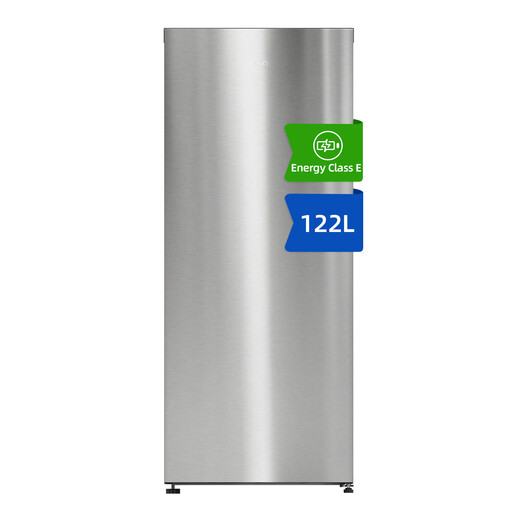
Several drawers and compartments are listed for storing portions separately.
122 L; 4-Star; No-Frost; Multi-Airflow; inverter compressor; 39 dB; energy class E; switches between fridge and freezer modes.
Blanching is one option, but it isn’t essential. The Federal Centre for Nutrition describes cutting rhubarb into pieces and freezing it. Divide it into portions so you only need to take out the amount you need later.
Use the stalks and remove the leaves and the bases of the leaves. The Federal Centre for Nutrition points out that these contain high levels of oxalic acid; freezing doesn’t remove the need to prepare rhubarb this way.
The consumer advice centre recommends −18 °C as the ideal temperature for a tall freezer or chest freezer. This is storage advice, not a statutory minimum temperature that applies to every purchase.
The label includes information such as the energy efficiency class, standardised annual consumption in kWh and capacity. The consumer advice centre points out that energy use in your home can vary depending on how and where the appliance is used.