
Lieferung heute & morgen

Qualitätsgarantie

Willkommens-Angebote freischalten: KOSTENLOSE Lieferung | Bis zu 80 % RABATT | Kostenlose 30-Tage-JoyPlus-Testphase
App herunterladen
A French press coffee maker lets you prepare coffee manually, without capsules, paper filters or a power connection. The method is practical for many households, offices and travellers: add coffee grounds and hot water, leave to brew, slowly press down the plunger and pour.
However, important differences are easily overlooked when buying one. A large coffee press is not automatically suitable for everyday use, and an appealing design says little about cleaning, break resistance or filter quality. The following criteria help you distinguish marketing claims from product specifications that genuinely matter.
The description ‘8 cups’ sounds clear, but it is often based on small manufacturer-defined portions. A model with a 1-litre capacity is frequently described as an 8-cup French press. For large mugs, however, this amount may only be enough for four or five servings.
So check the volume in millilitres first:
Borosilicate glass is often used for a glass coffee maker because it offers comparatively good resistance to changes in temperature. Nevertheless, glass remains fragile. The pot should be placed on a level, non-slip and heat-resistant surface. Further use is not advisable if there are visible cracks or damaged filter components.
With stainless steel or aluminium bodies, the pot is generally better protected against knocks. However, this does not automatically mean that it is dishwasher-safe. Information such as ‘not dishwasher-safe’ must be taken into account before buying.
A French press normally uses a reusable metal mesh. Coffee grounds that are too finely ground can clog the sieve and increase resistance when pressing down. For classic preparation, coarsely ground coffee is a suitable starting point.
Look for:
Choosing between a 350 ml French press, a 600 ml model and a 1-litre French press depends on your actual consumption. Smaller models are easier to transport and require less water. A 1-litre pot, on the other hand, does not need to be refilled several times when several people are drinking coffee.
For camping, hiking or travelling, a compact French press for use on the go can be a sensible choice. With outdoor models, check the weight, body material and how securely the glass chamber can be stored.
Glass lets you see the brewing process and does not affect the flavour, but it requires careful handling. Stainless steel can be an appealing option for travelling and frequent use. With double-walled models, heat retention is the main focus. However, the term ‘double-walled’ should not be taken to mean that the coffee will stay hot indefinitely.
The handle and lid also deserve attention. A secure handle makes pouring easier, while a well-fitting lid can help reduce splashing when pressing.
A reusable filter means no regular costs for paper filters or capsules. After each use, coffee grounds and oils should be removed to prevent residues or odours from building up.
A dishwasher-safe French press can reduce the effort required for cleaning. Check whether this applies to the complete pot or only to individual components. For example, the Bialetti Preziosa is stated to be dishwasher-safe, while the Bialetti COFFEE PRESS SMART 0.35 l is explicitly not intended for dishwasher use.
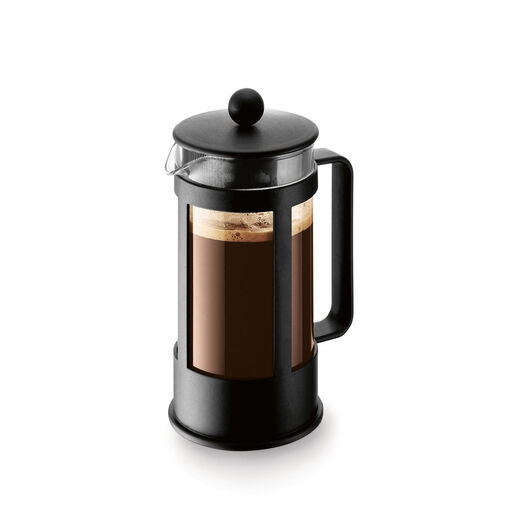
Why this product suits the profile: With a manageable 350 ml capacity, it is suitable for individuals or small servings in the office.
The specific volume prevents the cup count from being mistaken for a large-mug capacity.
Borosilicate glass, a black frame and a three-part filter according to the product description.
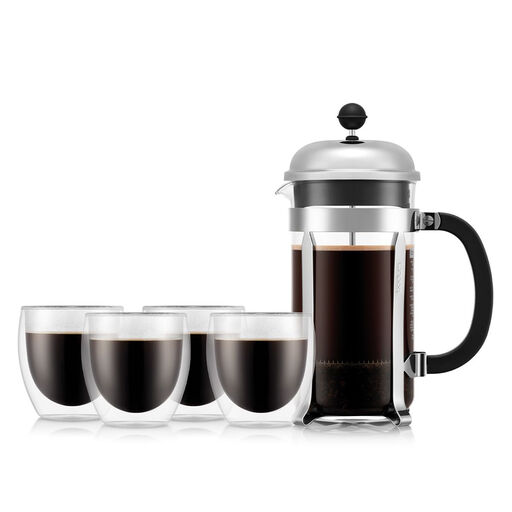
Why this product suits the profile: The set combines a 1-litre pot with four drinking glasses, making it suitable for households with several coffee drinkers.
The product description lists the capacity, filter construction and included glasses separately, providing a clearer basis for making a decision.
1-litre capacity, three-part stainless steel filter and four PAVINA glasses with a capacity of 250 ml.
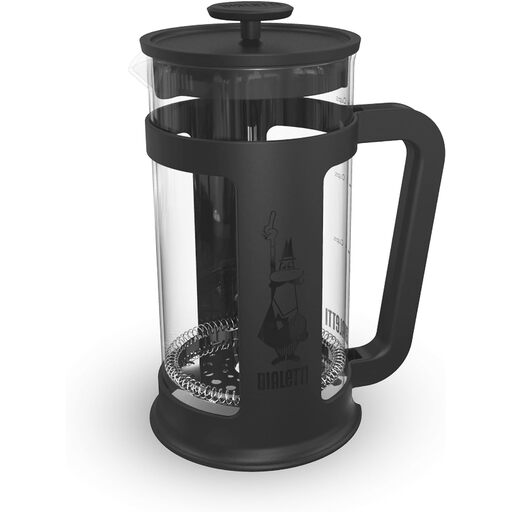
Why this product suits the profile: According to the product information, this compact model is designed for outdoor activities, camping, travelling and hiking.
The stainless steel body addresses the fragility of an all-glass model. However, its lack of dishwasher suitability should still be taken into account.
350 ml capacity, manual operation, reusable filter and stainless steel construction.
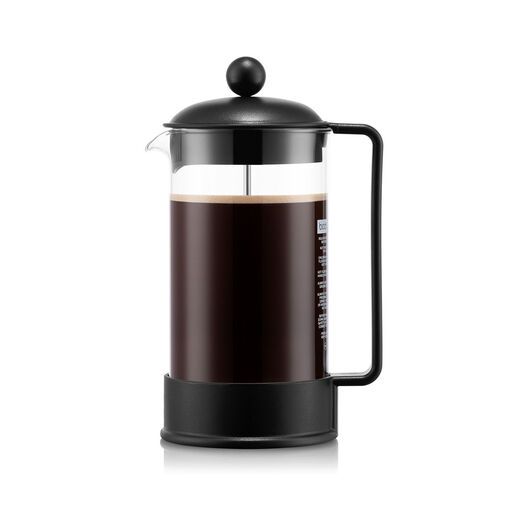
Why this product suits the profile: The 1-litre size is suitable for several servings, while its stated dishwasher suitability can make cleaning easier.
Cleaning is assessed not just by the material, but by the manufacturer’s specific information about dishwasher suitability.
1-litre capacity, heat-resistant glass chamber and three-part stainless steel filter according to the product description.
We have put together a complete, regularly updated list of products that fully meet these strict selection criteria and the safety regulations applicable in the EU.
For consistently good results, follow this basic process:
If the plunger is difficult to press, do not force it. Carefully lift it slightly and try again. Before using the press for the first time, thorough cleaning of all removable parts is recommended.
As a starting point, use around 60 grams of coffee grounds per litre of water. The actual amount depends on the grind size, beans and desired strength. For 350 ml, this works out at approximately 20 grams. You can then adjust the ratio gradually.
Its lifespan depends primarily on the material, filter care and how it is handled. A glass container can break if knocked, while stainless steel bodies may be more resilient during everyday transport. Filters and seals should be checked regularly and replaced if damaged, provided suitable spare parts are available.
The coffee press itself does not require electricity and uses a reusable filter. Ongoing costs therefore mainly relate to coffee beans or ground coffee. With a manual French press, there is also no need for paper filters or coffee capsules, unless an additional filter system is used.