
Lieferung heute & morgen

Qualitätsgarantie

Willkommens-Angebote freischalten: KOSTENLOSE Lieferung | Bis zu 80 % RABATT | Kostenlose 30-Tage-JoyPlus-Testphase
App herunterladen
A French Press coffee maker needs neither capsules nor paper filters and can be used without electricity. However, the wide choice of models, colours and capacities does not automatically make it easy to find the right coffee press. Specific details about volume, material, filter and cleaning are more important than vague design claims used in advertising.
Manufacturers often calculate French Press capacities using small cups. An 8-cup French Press often holds around 1 litre. Depending on your preferred serving size, this equates to around four to six larger mugs. A 3-cup French Press with a capacity of 350 ml is more suitable for one or two standard servings.
Before buying, you should therefore use the capacity in millilitres or litres as your guide:
The filter unit and plunger mechanism of a coffee press are used every day. A reusable stainless-steel filter avoids the ongoing need for paper filters. At the same time, the filter should be easy to remove so that coffee residue does not build up permanently in the mesh or lid.
The claim “dishwasher-safe French Press” should also be checked carefully. On some models, the glass jug and filter can go in the dishwasher, while plastic parts or coated outer surfaces should be washed by hand. The manufacturer’s instructions always apply to the specific model.
Borosilicate glass is used in many French Press coffee makers. It is designed to come into contact with hot water, but the jug should not be placed on a direct heat source or exposed to sudden changes in temperature. The Bialetti Preziosa, for example, has a stated maximum temperature of 120 °C.
Coarsely ground beans are recommended for preparation. Coffee that is ground too finely can clog the filter and increase resistance when pressing the plunger down. The plunger should always be moved slowly and with even pressure.
The size of the model should match your actual drinking habits. A large cafetière is not automatically more economical if you regularly prepare just one serving. Conversely, a 350-ml coffee press may be too small for an office or households with several coffee drinkers.
A 1-litre French Press is a good choice for families, office kitchens or serving guests. If you drink coffee alone, 350 ml or 0.5 litres may make it easier to prepare the right amount. BODUM and Bialetti products are available in several sizes, including 350-ml, 0.5-litre and 1-litre versions.
Glass jugs let you see the brewing time and fill level. An outer casing made from stainless steel or plastic can provide additional support when pouring. Stainless-steel models are also worth considering if the coffee press needs to be transported regularly.
The Bialetti Coffee Press Smart 0.35 l is described as having a black stainless-steel casing. The model is designed for ground coffee, operates manually and has a reusable filter. According to the product details, it is not dishwasher-safe.
A three-part stainless-steel filter is specified for several BODUM Caffettiera models. After brewing, remove the plunger and filter and clean them with warm water. The Bialetti Preziosa has a jug and casing made from borosilicate glass and stainless steel; the 1-litre and 350-ml versions are described as dishwasher-safe.
For glass models, a non-slip, heat-resistant surface is recommended. Before first use, the jug, lid and filter should be cleaned thoroughly.
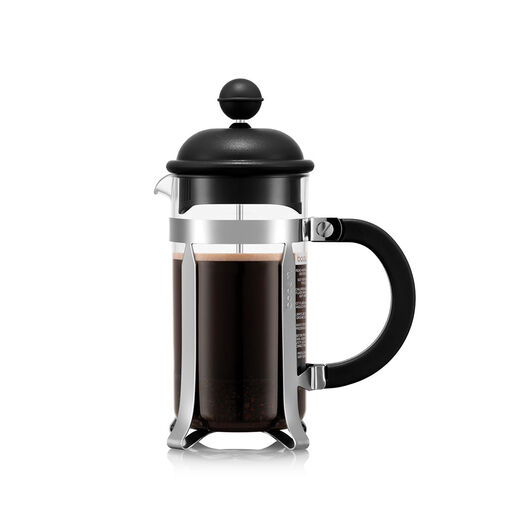
Why this product suits this profile: The compact 350-ml capacity is suitable for individuals, small kitchens and quick brewing routines. This manual coffee maker needs neither capsules nor paper filters.
The clear capacity specification prevents a supposed 3-cup size from being mistaken for three large mugs. The filter system is reusable.
350-ml capacity, borosilicate glass and stainless-steel filter according to the product description.
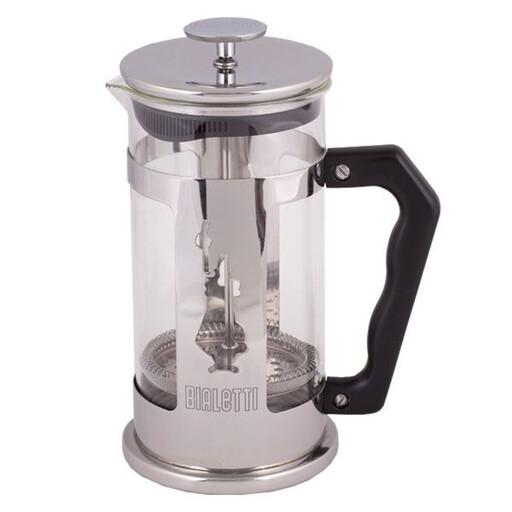
Why this product suits this profile: This 1-litre cafetière is designed for households, offices and anyone who wants to brew several servings at once.
The product details specify the maximum capacity of 1 litre and a temperature limit of 120 °C. This makes it easier to assess how to use the product safely.
18/10 stainless steel, borosilicate glass and dishwasher-safe construction according to the product description.
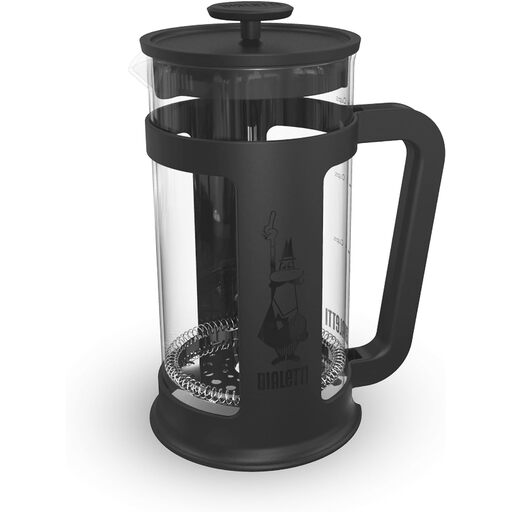
Why this product suits this profile: According to the product details, this compact model is intended for outdoor activities, camping, travel and hiking.
The small size makes it easier to transport. The “not dishwasher-safe” specification is clearly stated and should be considered when making your purchase.
350-ml capacity, stainless-steel casing and manual operation with a reusable filter.
For four smaller servings, the BODUM KEYNA 0.5 Litre is another possible size option. If you are looking for a 1-litre BODUM model, you will find versions of the Caffettiera, Kenya, Brazil and Chambord in a range of designs and colours.
We have put together a complete, regularly updated list of products that fully meet these strict selection criteria and the safety regulations applicable in the EU.
The following method can be used for consistent results:
The exact dosage and brewing time can be adjusted depending on the grind size, type of beans and desired strength. For outdoor use, pay particular attention to a stable surface, a secure grip and the weight.
As a starting point, allow around 60 to 70 grams of coarsely ground coffee per litre of water. For 350 ml, this is approximately 21 to 25 grams. You can adjust the amount to taste. It is important to use a coarse grind so that the filter does not become clogged.
Its lifespan depends on the glass, casing, filter and frequency of daily use. Stainless-steel filters and plungers can last a long time with careful cleaning. The glass remains a delicate component: avoid knocks, sudden temperature changes and placing it on unsuitable surfaces. Replacement parts should be checked separately according to the brand and model.
It operates manually and needs neither capsules nor paper filters. Ongoing costs mainly come from coffee and water. A reusable filter can reduce the use of disposable filters. Warm water and a suitable washing-up liquid are generally sufficient for cleaning; for dishwasher-safe models, follow the relevant manufacturer’s instructions.