
Lieferung heute & morgen

Qualitätsgarantie

Willkommens-Angebote freischalten: KOSTENLOSE Lieferung | Bis zu 80 % RABATT | Kostenlose 30-Tage-JoyPlus-Testphase
App herunterladen
A fridge freezer needs to do more than simply cool and freeze food in everyday use. It should fit into your kitchen, hold your groceries in an organised way and operate reliably at an acceptable noise level. However, some marketing claims can quickly lead to the wrong purchase.
A large fridge can look impressive from the outside, but may not offer the same amount of usable storage space inside. What matters is the net capacity of the fridge and freezer compartments, not just the total volume or gross capacity. Thick insulation, ice build-up and poorly arranged drawers can also reduce the space actually available.
Descriptions such as “whisper-quiet” are no substitute for technical specifications. Compare the noise level in dB(A) and the airborne acoustical noise emission class. For an open-plan kitchen or a flat, a quiet fridge producing around 35 to 40 dB(A) may be more comfortable than a significantly louder model.
A No Frost fridge reduces the need for manual defrosting. This is convenient, but may come with a higher purchase price or additional technology. Depending on the design, a fridge with a water or ice dispenser may require a water tank or a fixed water connection. Before buying, check the installation requirements, cleaning needs and ongoing costs.
For a small flat, a compact fridge with around 200 to 260 litres may be sufficient. Households with several people will generally benefit from around 300 to 500 litres. Larger households should also pay attention to the layout: a larger freezer compartment makes sense if you regularly store frozen food.
A fridge freezer with the freezer compartment at the bottom often makes it easier to access fresh food. With a side-by-side fridge, the fridge and freezer compartments are positioned vertically next to each other. A French-door fridge usually offers wide fridge compartments at the top and drawers below. Multi-door fridges can provide more differentiated organisation through several doors and flexible zones.
The EU energy label ranges from A to G. In addition to the class, you should consider the stated annual consumption in kWh. A larger model may consume more than a compact fridge, so it is most useful to compare appliances of a similar size and design.
Also look out for functions such as holiday mode, rapid cooling and rapid freezing. An inverter compressor adjusts its output to meet demand. Actual running costs nevertheless depend on the room temperature, how fully the appliance is loaded, how often the door is opened and regular maintenance.
Measure not only the intended space, but also doors, staircases and the route to the installation location. Check the following:
A freestanding fridge freezer requires sufficient ventilation. The specific clearances are provided in the relevant operating instructions.
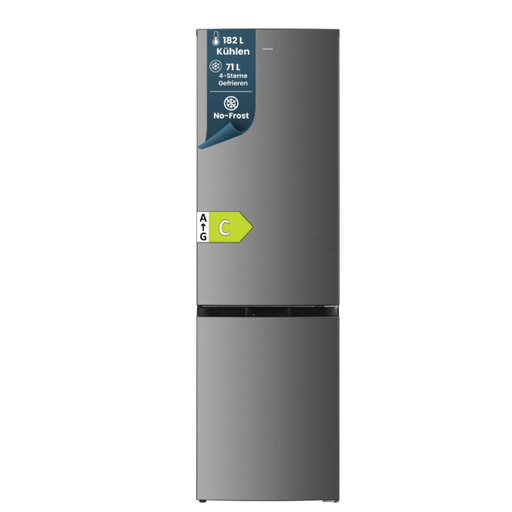
Why this product suits this profile: With 253 litres of usable capacity, including 182 litres of fridge space and 71 litres of freezer space, this model is suitable for smaller households and everyday shopping.
The technical specifications clearly state the usable capacity, annual consumption and noise level: 253 litres, 141 kWh per year and 39 dB(A).
No Frost, energy efficiency class C, reversible door hinge and Super Freeze function.
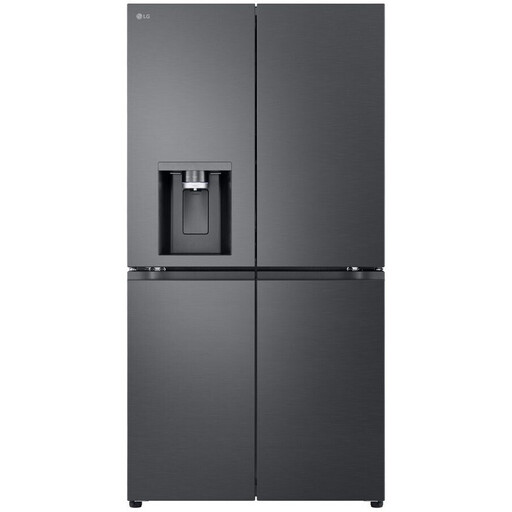
Why this product suits this profile: This multi-door fridge is designed for families and larger households that need plenty of fridge and freezer space.
Alongside its large capacity, the specifications state 34 dB(A), annual consumption of 230 kWh and the external dimensions. This makes it easier to assess the space required realistically.
645 litres of total volume, No Frost, inverter compressor, water and ice dispenser, plus app compatibility.
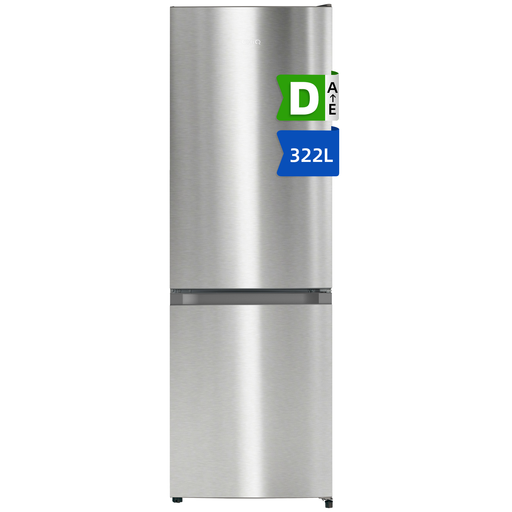
Why this product suits this profile: This model combines medium capacity with suitability for ambient temperatures from 10 to 43 °C, making it potentially suitable for certain utility rooms.
The dimensions of 59,5 × 185,5 × 63,5 cm are clearly stated. This helps you take into account that the appliance may be deeper than a standard kitchen worktop.
322 litres, Total No Frost, 37 dB(A), energy efficiency class D and rapid freezing function.
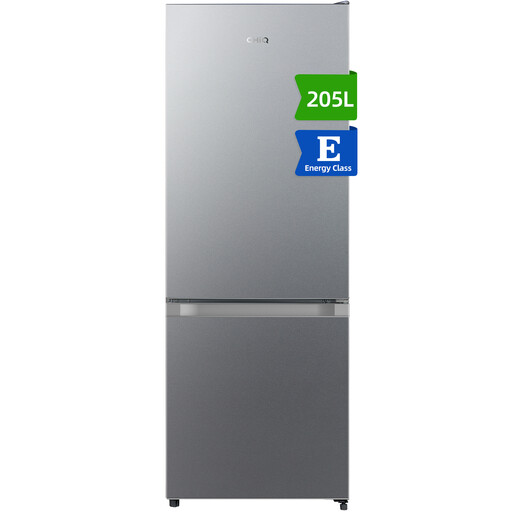
Why this product suits this profile: Measuring 54 cm wide and 144 cm high, this freestanding fridge freezer is designed for smaller kitchens, flats or use as an additional appliance.
The compact design is complemented by specific dimensions and a reversible door hinge. This makes it easier to adapt the appliance to different kitchen layouts.
153 litres of fridge space, 52 litres of freezer space, Low Frost technology and a stated noise level of 39 dB.
We have put together a complete, regularly updated list of products that fully meet these strict selection criteria and the safety regulations applicable in the EU.
Do not place the appliance directly next to a cooker or radiator, or in direct sunlight. Allow hot food to cool before storing it. An organised layout allows air to circulate more effectively; do not cover the ventilation openings inside the appliance. Check the door seals and clean the interior and drainage channel regularly.
With a No Frost fridge, manual defrosting is generally unnecessary. Low Frost models, on the other hand, need defrosting occasionally. Keep the doors open for as short a time as possible and set the temperature according to the operating instructions. The fridge compartment is often recommended to be kept at around 3 to 5 °C, and the freezer compartment at around −18 °C.
This depends on your shopping habits and freezer requirements. Around 200 to 300 litres may be enough for two people. Families with several members will often need 300 to 500 litres. If you freeze a lot of food or shop less frequently, you should pay particular attention to the freezer compartment.
Its service life depends on the compressor, usage, location, maintenance and build quality. There is no exact guarantee of how long an appliance will actually last. Check the warranty terms, availability of spare parts and the manufacturer’s instructions. A clean heat exchanger and adequate ventilation can help support reliable operation.
Multiply the stated annual consumption in kWh by your electricity price per kWh. Example: with annual consumption of 200 kWh and a price of 0,35 euros per kWh, the calculated cost is around 70 euros per year. The actual amount may vary depending on room temperature, usage and your electricity tariff.