
Lieferung heute & morgen

Qualitätsgarantie

Willkommens-Angebote freischalten: KOSTENLOSE Lieferung | Bis zu 80 % RABATT | Kostenlose 30-Tage-JoyPlus-Testphase
App herunterladen
Finding a new fridge-freezer can be a challenge. The market is filled with a wide variety of models that differ in size, energy consumption, and features. The goal of this article is to provide you with clear, objective guidance. As a Joybuy Product Recommendation Officer, I have compiled information to help you make an informed decision that suits your household and your needs.
Before you buy a new freestanding fridge with a freezer compartment, there are several technical features to consider. These three aspects are particularly relevant for most households.
Since 2021, a new EU energy label has been in effect, with classes from A (very efficient) to G (less efficient). A fridge-freezer with an energy efficiency class of C is now considered a good standard, offering significant reductions in electricity consumption compared to older appliances.
The noise level, measured in decibels (dB), is an equally important factor, especially in open-plan kitchens. A fridge-freezer that is quiet significantly contributes to your home's comfort. Appliances with a rating around 40 dB are considered normal, while models below 35 dB are classified as exceptionally quiet.
The required net capacity depends on the size of your household and your shopping habits. The following values can serve as a guide:
Also, pay attention to the ratio of fridge to freezer space. If you frequently store fresh food, a larger fridge section is practical. Those who like to buy in bulk and freeze food will benefit from a generous freezer compartment.
No Frost technology is one of the most practical developments in recent years. A circulating air system removes moisture from the freezer compartment, preventing the build-up of ice and frost. A fridge-freezer with No Frost saves you the regular and tedious task of manually defrosting the freezer, while also ensuring consistent cooling performance and energy efficiency.
Here is a selection of models that cover different requirements in terms of size, features, and price.
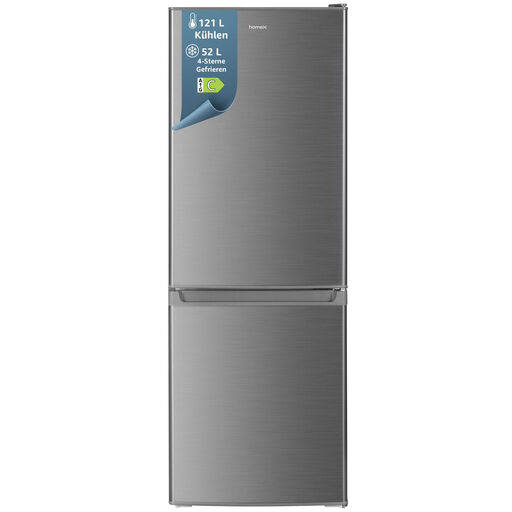
Why it stands out: This model from homeX is a compact and functional solution for smaller households. It focuses on essential features and offers excellent value for money.
Pros:
Who is it for? Ideal for individuals, couples, or as a secondary appliance. This model fits well in smaller kitchens or flats where a reliable fridge with a freezer compartment is needed without complex extra features.
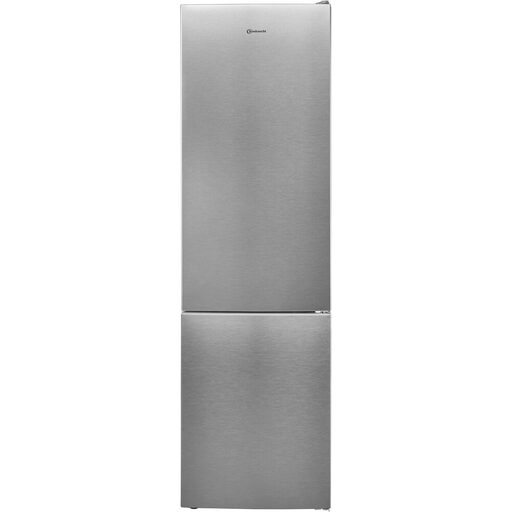
Why it stands out: The Bauknecht model offers a very large net capacity and advanced technologies like NoFrost and a Multi-Zone function. Its inverter compressor ensures exceptionally quiet and efficient operation.
Pros:
Who is it for? Perfect for families or shared homes with high capacity needs. Anyone who values very quiet operation, high energy efficiency, and flexible storage options will find this appliance to be an excellent match.
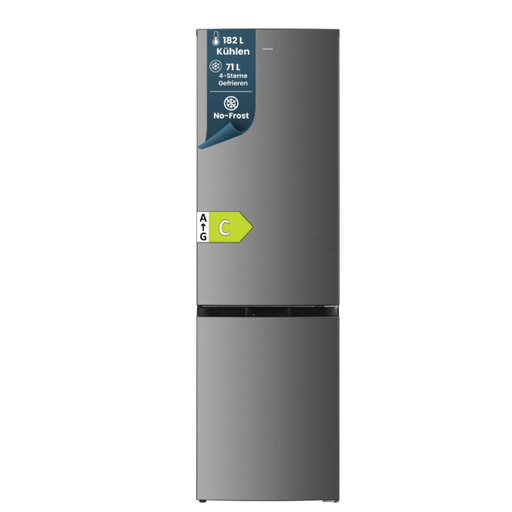
Why it stands out: This model combines the popular No Frost technology with a solid capacity and good energy efficiency. It's a well-balanced all-rounder for modern daily life.
Pros:
Who is it for? A great choice for small to medium-sized families who appreciate the convenience of No Frost and are looking for a modern, freestanding fridge-freezer in silver that offers a good balance between capacity, features, and running costs.
If the models presented here don't exactly meet your requirements, or if you're looking for specialised freezing appliances, you can find more options to expand your storage capacity in our category for freezer drawers and similar products.
1. What does No Frost mean in a fridge-freezer? No Frost is a technical system that uses air circulation to remove moisture from the freezer compartment. This prevents ice from building up on the interior walls and on frozen goods. The main advantage is that manually defrosting the appliance is no longer necessary.
2. How loud should a fridge-freezer be? The noise level is measured in decibels (dB). A value around 40 dB is equivalent to a quiet conversation and is not considered disruptive by most people. Appliances rated at 35 dB or less are considered exceptionally quiet and are ideal for open-plan kitchens or studio apartments.
3. Which energy efficiency class is recommended for a refrigerator? With the introduction of the new EU energy label in 2021, the classes were rescaled (A to G). Appliances that were previously in class A+++ are now often found in classes C or D. Therefore, an energy efficiency class of C is a good and efficient standard for a new appliance. Models in classes A and B offer the highest efficiency but are often associated with a higher purchase price.