Anyone cooking several portions of soup
If you want to chill leftovers for a meal with others, check whether several shallow containers will fit in the fridge compartment with enough space between them.


For chilled leftover soup, what matters most is whether several shallow, covered portions will fit in the fridge compartment and can be kept sufficiently cold. If you don’t need extra freezer space, a fridge without a freezer compartment may suit you. If you want to freeze supplies, compare the fridge and freezer capacities separately when choosing a fridge-freezer. The German Federal Institute for Risk Assessment (BfR) recommends cooling hot food promptly – an appliance feature such as NoFrost does not replace these food-safety steps.
If you want to chill leftovers for a meal with others, check whether several shallow containers will fit in the fridge compartment with enough space between them.
If you also want to freeze portions, compare the fridge and freezer capacities separately rather than judging by the total capacity alone.
If space is tight in your kitchen, check the external dimensions and usable fridge capacity together – the litre figure alone won’t tell you whether your containers will fit.
The German Federal Institute for Risk Assessment (BfR) recommends storing perishable food at between 2 °C and 7 °C. Hot food should be cooled to below 7 °C within a few hours. The German consumer advice centre recommends factoring in energy use when comparing sizes; among other details, the EU energy label shows annual consumption in kWh and fridge and freezer capacities.
| What matters | What to check when buying | Who is this especially important for? |
|---|---|---|
| Safe chilling | Check whether you can set the fridge to a suitable temperature and fit several shallow, covered containers inside. | If you want to cool and store soup for a meal with others, temperature control and suitable shelf space are important. Around 36% of consumers prioritise safe chilling. |
| Space for portions | Compare fridge capacity, shelf spacing and the dimensions of your containers. | If you need to chill several portions at once, usable fridge space matters more than the total capacity in litres. Around 29% of consumers prioritise space for portions. |
| Energy use | Compare the stated annual consumption in kWh for appliances of a similar size, and factor in your own electricity tariff. | If you’re choosing an appliance for continuous use, you’ll want to take its stated energy consumption into account. Around 21% of consumers place particular importance on running costs. |
| Freezer space | Check the freezer capacity separately from the fridge capacity. | If you want to freeze supplies or portions as well as soup, you’ll need to consider the freezer compartment separately. Around 14% of consumers prioritise freezer space. |
These terms describe appliance features. They don’t prove that a large pot of hot soup will cool down quickly and safely.
Divide the soup into suitable shallow portions and take care to chill the food properly. The BfR recommends keeping perishable food at between 2 °C and 7 °C, and cooling hot food promptly to below 7 °C.
Freezer capacity isn’t available for storing chilled leftover soup. The total capacity also won’t tell you whether your containers will fit on the shelves.
Compare fridge and freezer capacities separately, and measure the available space, shelf gaps and your containers.
The purchase price alone doesn’t show how energy use will affect running costs.
For appliances of a suitable size, compare the stated annual consumption in kWh and calculate costs using your own electricity tariff.
The Bosch KSV36VWEP is a freestanding fridge without a freezer compartment. Bosch states that it has 346 l of fridge capacity and seven shelves.
According to Beko, the freestanding B3RCNO256XB fridge-freezer is 54 cm wide and suits households that also need freezer space.
The freestanding Liebherr CUe 2831 is a 55 cm-wide fridge-freezer with a total capacity of 265 l, according to the manufacturer.
The 185 cm-tall Samsung RB34C605CB1/EF is a fridge-freezer with a total capacity of 344 l and No Frost+, according to the manufacturer.
The models below include compact fridges and fridge-freezers. What matters is whether the fridge compartment in each model suits your containers and whether you also need freezer space.
 No image available
Could suit you if you’re looking for a fridge-freezer and its stated fridge capacity is suitable for your containers.
220 l fridge compartment and 113 l freezer compartment, with a total capacity of 333 l; three safety glass shelves; 597 × 1860 × 674 mm; 169 kWh per year; energy class C; Total No Frost.
 No image available
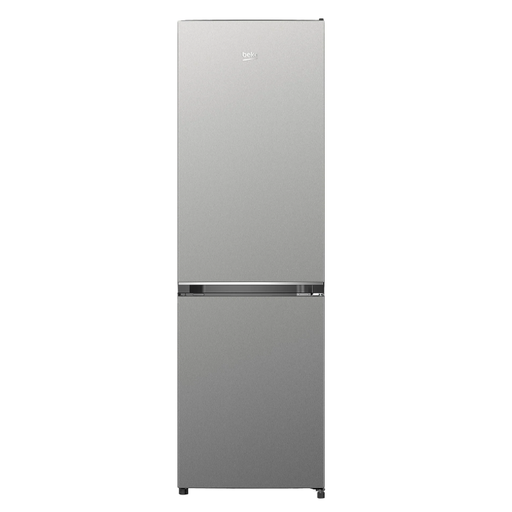
Could suit you if you’re looking for a slim fridge-freezer and its shelves have enough room for your containers.
187 l fridge compartment and 75 l freezer compartment; four glass shelves, three of which are height-adjustable; 54 cm wide and 55 cm deep; energy class E; 215 kWh per year. The stated fridge temperature range is 2 °C to 8 °C. As the BfR recommends a maximum of 7 °C for perishable food, you should be able to check the actual storage temperature.
 No image available
Could suit you if you’re looking for a slim fridge-freezer with adjustable shelves and its fridge compartment has enough room for your containers.
180 l fridge compartment and 70 l freezer compartment; three height-adjustable shelves; 540 × 1800 × 576 mm; reversible door; 140 kWh per year; energy class C. The stated fridge temperature range is 2 °C to 8 °C. As the BfR recommends a maximum of 7 °C for perishable food, you should be able to check the actual storage temperature.
 No image available
Could suit you if you’re looking for a compact fridge and your containers fit in the available space.
90 l total capacity; three glass shelves; adjustable shelves and feet; separate chiller compartment; 449 × 485 × 842 mm; energy class E. The stated fridge temperature range is 0 °C to 10 °C. As the BfR recommends a maximum of 7 °C for perishable food, you should be able to check the actual storage temperature.
 No image available
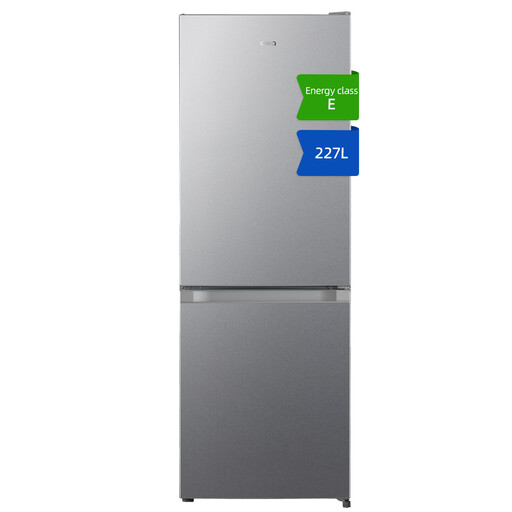
Could suit you if you’re looking for a compact fridge-freezer and the 153 l fridge compartment can accommodate your containers.
153 l fridge compartment and 74 l freezer compartment; adjustable shelves; 54 cm wide and 55 cm deep; reversible door; Low Frost; energy class E. According to the product description, the freezer compartment needs to be manually defrosted around once or twice a year.
The BfR recommends cooling hot food to below 7 °C within a few hours if you plan to store it for longer, and keeping perishable food between 2 °C and 7 °C. For larger quantities, use several shallow dishes; cover the leftovers and store them separately from raw food. The BfR advises eating leftovers within two to three days. A rapid-cooling function doesn’t prove that a large pot of hot soup will cool down safely.
The BfR recommends heating food to at least 70 °C throughout for at least two minutes when reheating. Take extra care to heat larger portions and food reheated in a microwave evenly. Reheating won’t make soup safe to eat if it was stored incorrectly beforehand.
Compare fridge capacity, external dimensions and the annual consumption in kWh shown on the EU energy label. For a fridge-freezer, freezer capacity matters too. The German consumer advice centre recommends considering energy use when choosing an appliance. To estimate your own running costs, multiply the difference in annual kWh figures by your electricity price per kWh.