
Lieferung heute & morgen

Qualitätsgarantie

Willkommens-Angebote freischalten: KOSTENLOSE Lieferung | Bis zu 80 % RABATT | Kostenlose 30-Tage-JoyPlus-Testphase
App herunterladen
A front and rear dash cam provides seamless recording of traffic events in front of and behind your vehicle. These dual-channel systems increase the likelihood of having visual evidence to clarify events in ambiguous traffic situations, hit-and-run accidents, or parking incidents. The German Federal Court of Justice (BGH) ruled (VI ZR 233/17) that dash cam footage can be admissible as evidence in a third-party liability case, provided data protection regulations are observed. This highlights the importance of selecting and using a car camera correctly.
Choosing a suitable dash cam is based on objective technical parameters. The following criteria are essential for making an informed decision.
Video resolution is crucial for the level of detail in your recordings. A 4K dash cam (3840 x 2160 pixels) offers four times the pixel density of Full HD (1920 x 1080 pixels). This makes it possible to clearly identify important details like license plates or road signs, even from a distance or at high speeds. Night-time image quality is primarily determined by the image sensor (e.g., Sony STARVIS) and the aperture (e.g., f/1.8). Technologies like HDR (High Dynamic Range) or WDR (Wide Dynamic Range) optimise exposure in challenging lighting conditions, such as strong backlighting or at dusk, and enhance the dash cam's night vision capabilities.
A dash cam with parking mode helps secure your parked vehicle. There are several ways it can function:
For continuous parking surveillance, a hardwire kit is typically required. This connects the dash cam directly to the vehicle's battery and includes a feature to prevent battery drain.
Modern dash cams offer advanced connectivity options that enhance their practical usability.
Based on an analysis of technical specifications and feature sets, we present a few select models here.
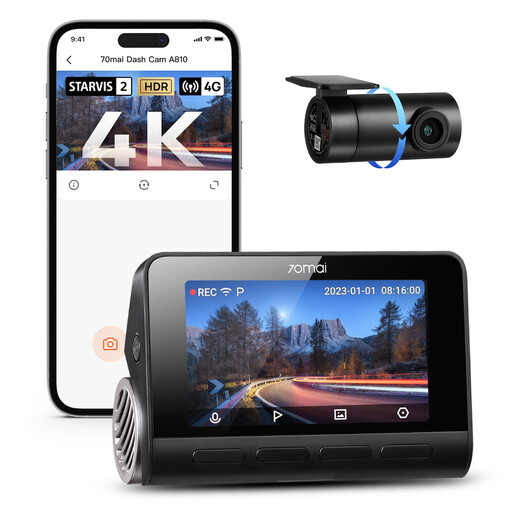
Why we recommend this product The A810-2 model combines a true 4K front camera with a Sony STARVIS 2 IMX678 sensor. This combination is designed for high image sharpness and colour accuracy, both day and night. The dual-HDR function for the front and rear cameras ensures balanced exposure in high-contrast scenes. The AI-powered parking mode enables targeted surveillance for suspicious movements. According to 70mai, the model received the "Technology Innovation Award" from Futures in 2024 and was rated "Good" by the magazines Autobild.de and Computerbild.de.
Pros:
Who it's for: Drivers who place the highest value on image quality and detail, especially for identifying license plates day and night.
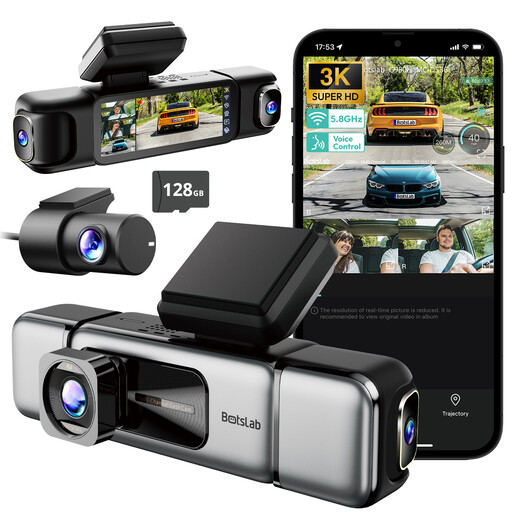
Why we recommend this product This system offers comprehensive surveillance through four recording channels: a 3K front camera, two side cameras, and a rear camera. The resulting 560° all-round view is designed to minimise blind spots. Simultaneous recording from all channels provides a complete picture of the vehicle's surroundings. It is operated via a 3.18-inch touchscreen that allows for a quad split-screen view. Power is supplied by a supercapacitor instead of a battery, which increases thermal resistance and longevity.
Pros:
Who it's for: Professional drivers (e.g., taxi, ride-sharing) and security-conscious users who require maximum coverage of the vehicle's surroundings for complete documentation.
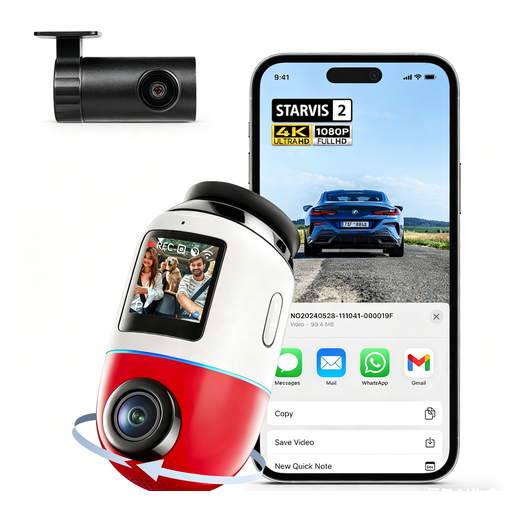
Why we recommend this product The X800 model is distinguished by its motorised 360° rotating front camera, which allows for flexible orientation to capture events in front of, inside, or next to the vehicle. Combined with the 1080p rear camera, it provides comprehensive surveillance. The front camera also uses the Sony STARVIS 2 IMX678 sensor for 4K recordings. A standout feature is the optional 4G LTE connectivity (requires a hardwire kit), which enables remote access to live footage and vehicle location via an app.
Pros:
Who it's for: Tech-savvy users and fleet managers who need advanced features like remote access, cabin monitoring, and flexible camera orientation.
The car camera market is diverse, offering solutions for various needs and vehicle types. For a broader selection of specialised models, you can visit our main category for Dash Cameras.
1. Are front and rear dash cams legal in Germany? Yes, the use of a dash cam is generally permitted in Germany. However, recording must be brief and event-triggered. Permanent, non-event-triggered recording of public spaces violates the General Data Protection Regulation (GDPR). Many cameras solve this issue with a loop function, which continuously overwrites old footage and only permanently saves the relevant sequence in the event of an incident (e.g., triggered by the G-sensor).
2. What are the most important features of a good dash cam? A good dash cam should offer high resolution (at least Full HD, preferably 4K) for detailed images. Reliable night vision, a wide-angle lens (approx. 140-170 degrees), a G-sensor for automatic saving upon collision, and a stable loop recording function are essential. Additional features like a parking mode, GPS, and Wi-Fi connectivity significantly increase its practical utility.
3. How does parking mode work on a dash cam? Parking mode activates the camera when the vehicle is parked. Depending on the model, recording starts when motion is detected (motion detection) or an impact is registered (G-sensor). To avoid draining the vehicle's battery, this feature usually requires a hardwire kit. This provides a constant power supply and includes a low-voltage cutoff that shuts off the camera before the car battery's voltage drops to a critical level.