
Lieferung heute & morgen

Qualitätsgarantie

Willkommens-Angebote freischalten: KOSTENLOSE Lieferung | Bis zu 80 % RABATT | Kostenlose 30-Tage-JoyPlus-Testphase
App herunterladen
Investing in a 4K front and rear dash cam is a wise measure for on-road security. However, the market is crowded and full of technical promises that aren't always kept. Many drivers invest in a device only to later find that the recordings are unusable or that crucial features fail at the critical moment. As your Joybuy Product Recommendation Officer, I'll help you identify the common pitfalls and make an informed decision.
Before we dive into the important features, let's highlight the most widespread issues that can lead to a poor purchase.
To avoid these traps, you should check three core technical areas before buying. These determine the reliability and practical utility of your front and rear car camera.
Video quality is primarily determined by the image sensor, not just the resolution figure. A dual 4K dash cam should feature a high-quality CMOS sensor. Models with sensors like the Sony STARVIS 2 offer demonstrably higher light sensitivity and a wider dynamic range (HDR). This ensures that details in very bright and very dark areas of the image remain visible simultaneously—essential when driving through tunnels or with a low sun. Look for native 4K resolution (3840x2160 pixels) to ensure you are not getting upscaled footage.
A functional parking mode requires a stable and intelligent power supply. Most cameras need a separate hardwire kit for this, which is connected directly to the vehicle's fuse box. This kit not only ensures power is supplied when the ignition is off but also includes a battery monitor that shuts down the dash cam before the car battery's voltage reaches a critical level.
Furthermore, the type of energy storage in the camera is relevant. Supercapacitors are significantly more resistant to temperature extremes and more durable than conventional lithium-ion batteries. They can withstand hot summer days and cold winter nights in the vehicle without performance loss or safety risks.
A dash cam with GPS and Wi-Fi offers significant added value.
Based on the criteria mentioned, we have identified a few models that are suitable for different requirements and user profiles.

Why it's a good fit: Ideal for drivers looking for a reliable dual-camera solution with all the essential features. The screenless design is discreet and non-distracting while driving, with convenient control via the app.
Offers true 4K resolution for the front camera and WDR (Wide Dynamic Range) technology, which improves image quality in difficult lighting conditions and bypasses the "useless night vision" trap.
Integrated 5-GHz Wi-Fi and GPS are a solid feature set in this price range. App-based control is practical and modern.
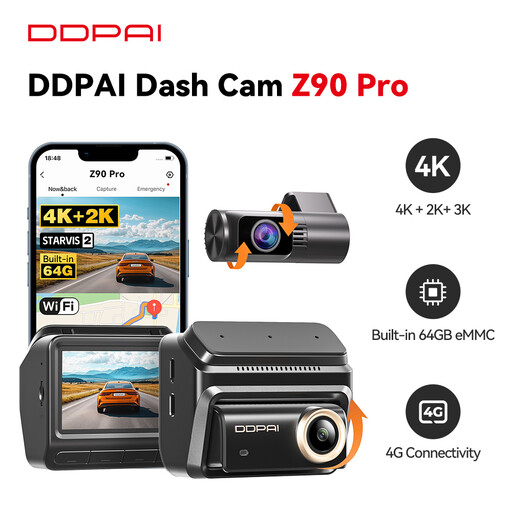
Why it's a good fit: For users who value the highest image quality and future-proof technology. This model combines a 4K front camera with a 2K rear camera and offers optional 4G connectivity for remote access.
Uses a Sony STARVIS 2 IMX678 sensor, which ensures excellent, native 4K resolution and outstanding night vision performance. This effectively avoids the "Fake 4K" trap.
The combination of a 4K front and 2K rear camera delivers a very high level of detail. The supercapacitor and optional 4G connectivity offer a high degree of reliability and functionality.

Why it's a good fit: For daily commuters and high-mileage drivers for whom recording reliability is the top priority. The dual storage solution provides an extra layer of security against data loss.
The D?save 2.0 technology, with internal eMMC storage and a microSD card slot, prevents the loss of important recordings in case of a memory card error—a common problem with cheaper models.
Dual Sony STARVIS sensors for the front and rear ensure consistently high image quality. The supercapacitor also guarantees high reliability in extreme temperatures.
We've compiled a complete, up-to-date list of products that fully meet these strict selection criteria and comply with German regulations.
Yes, using a dash cam is generally permitted in Germany, but it is subject to the strict requirements of the General Data Protection Regulation (GDPR). Continuous, indiscriminate filming of public space is not allowed. Modern dash cams solve this problem with a loop recording function: the device records in short loops and automatically overwrites the oldest data. Only in the event of an incident (e.g., a collision detected by the G-sensor) is the relevant video sequence saved as a write-protected file. These recordings may then be used as evidence in legal proceedings.
A supercapacitor is an energy storage device specifically designed for in-car requirements. Unlike a lithium-ion battery, it is much less sensitive to extreme temperatures. It functions reliably in intense summer heat and freezing winter temperatures, whereas batteries can lose performance or even be damaged under such conditions. Supercapacitors also have a significantly longer lifespan, making them the more reliable choice for dash cams.
For uninterrupted surveillance, such as time-lapse or motion-activated parking mode, a hardwire kit is necessary. It connects to the vehicle's fuse box and supplies the camera with power even when the ignition is off. An integrated voltage monitor prevents the car battery from being drained. Without such a kit, the dash cam can only rely on its internal storage (supercapacitor or small battery), which is only sufficient to record a directly detected impact for a few seconds and does not allow for continuous monitoring.