
Lieferung heute & morgen

Qualitätsgarantie

Willkommens-Angebote freischalten: KOSTENLOSE Lieferung | Bis zu 80 % RABATT | Kostenlose 30-Tage-JoyPlus-Testphase
App herunterladen
Investing in a dash cam is a considered decision to enhance your vehicle's security. A system that captures the area both in front of and behind your vehicle provides a comprehensive record of driving events. This can be invaluable for clarifying the circumstances of an accident or deterring parking damage.
This article serves as your guide. It explains key technical features and presents a selection of models with different specialisations to provide you with a solid basis for an informed decision.
Choosing the right system depends on your individual needs. Three key criteria will help guide your selection.
Resolution is crucial for the level of detail in your recordings. A 4K dash cam (3840 x 2160 pixels) at the front delivers high image sharpness, making it easier to read license plates or street signs, even from a distance. For the rear camera, a resolution of 1080p (Full HD) is sufficient in most cases.
Also, look for technologies like HDR (High Dynamic Range) or WDR (Wide Dynamic Range). These optimise exposure in difficult lighting conditions, such as during night drives, in tunnels, or against strong backlight, and reduce glare from the headlights of other vehicles.
Modern dash cams offer much more than just basic video recording.
The market offers various form factors. A classic car camera kit consists of two separate, discreet cameras for the front and rear. Alternatively, there are multifunctional devices that, for example, combine a CarPlay display with a dash cam. Such solutions are particularly suitable for cost-effectively retrofitting older vehicles with modern infotainment technology and safety features like a reversing camera.
Here is a selection of models that cover different use cases—from multifunctional retrofit solutions to specialised camera systems.
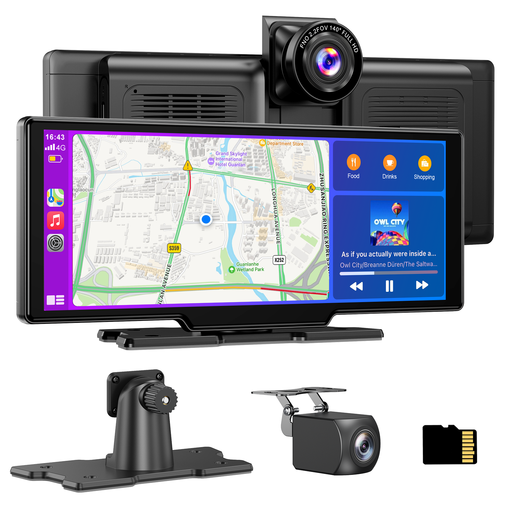
Why it stands out: This device is a 2-in-1 solution that combines a modern infotainment system with a fully-featured dual dash cam. It retrofits vehicles without a built-in display with wireless Apple CarPlay and Android Auto, while also providing high-resolution video surveillance.
Pros:
Who it's for: Drivers of vehicles without a modern infotainment system who are looking for a straightforward all-in-one solution to add navigation, smartphone integration, and a front and rear dash cam in one step.
View the ESSGOO 10.26" CarPlay Display

Why it stands out: The DDPAI Z50 Pro focuses on high video quality and advanced connectivity. With its 4K front camera, AI-powered night vision, and Wi-Fi 6, it offers a powerful technical foundation for demanding users.
Pros:
Who it's for: Tech-savvy drivers who prioritise excellent image quality by day and night, fast data transfer via an app, and advanced safety features like GPS tracking and driver assistance.
View the DDPAI Z50 Pro Dash Cam
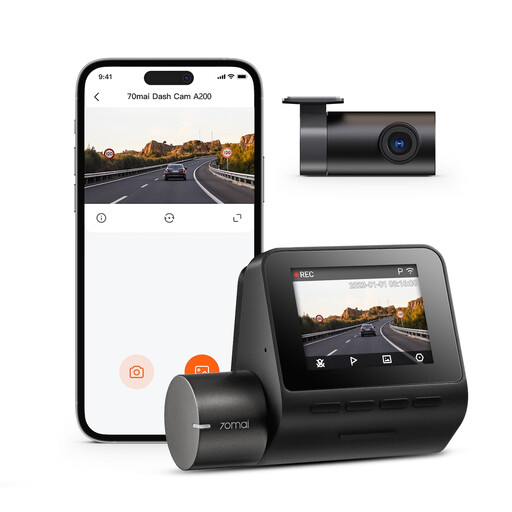
Why it stands out: This kit from 70mai is a solid and reliable solution that focuses on the core functions of a dual dash cam. A standout feature is the front camera's high frame rate, which ensures exceptionally smooth recordings.
Pros:
Who it's for: Drivers looking for a reliable and attractively priced car camera kit for comprehensive journey documentation, who also value smooth video recordings and easy app-based operation.
View the 70mai Dash Cam A200-1
The models presented here cover common use cases. However, if you are looking for more specific features, different form factors, or other alternatives, you can find a wider selection in our main category.
Explore Our Full Range of Car Camera Recorders
Yes, the use of a dash cam is generally permitted in Germany. However, the requirements of the General Data Protection Regulation (GDPR) must be observed. Permanent, non-event-based recording of public spaces is not allowed. For this reason, all common models use loop recording, where old data is continuously overwritten. Only in the event of an incident (e.g., triggered by the G-sensor) is the relevant sequence saved permanently. Courts may admit dash cam recordings as evidence, but this is decided on a case-by-case basis.
A dual dash cam captures events both in front of and behind the vehicle. This is particularly advantageous in rear-end collisions, one of the most common types of accidents. The rear camera documents the incident from the crucial perspective and can help to clearly establish fault. It also serves as a visual aid and documentation tool for parking and manoeuvring.
Yes, in most cases. To use the parking mode, the dash cam needs a constant power supply, even when the ignition is off. This is achieved with a hardwire kit, which connects directly to the vehicle's fuse box. These kits have a built-in voltage monitor that cuts off power before the car battery's voltage drops to a critical level, preventing it from being drained.