
Lieferung heute & morgen

Qualitätsgarantie

Willkommens-Angebote freischalten: KOSTENLOSE Lieferung | Bis zu 80 % RABATT | Kostenlose 30-Tage-JoyPlus-Testphase
App herunterladen
A front and rear mirror dash cam offers a discreet way to seamlessly document traffic events in front of and behind your vehicle. In the event of an accident or a disputed situation, such a recording can help clarify what happened. Unlike conventional dash cams, it is mounted directly over the existing rearview mirror, integrating seamlessly into the vehicle's interior.
This article serves as a guide. It explains the most important technical features to look for when making your choice and presents a selection of different models to help you decide.
Choosing the right model depends on your individual requirements for image quality, features, and ease of use. The following points are particularly relevant to your decision.
Resolution determines the level of detail in the recordings. A higher resolution makes it easier to identify license plates or other important details, especially in low-light conditions or from a greater distance.
Modern dash cams often offer more than just basic video recording. Features like GPS and Wi-Fi significantly expand their utility.
The rearview mirror camera is typically attached to the existing interior mirror with rubber straps. The size of the integrated display varies. Larger screens (10 to 12 inches) can use the entire mirror as a display and facilitate operation via touchscreen. Smaller displays (approx. 4.5 inches) are more discreet and show the camera image in a section of the mirror.
Here is a selection of three models that cover different needs and budgets.
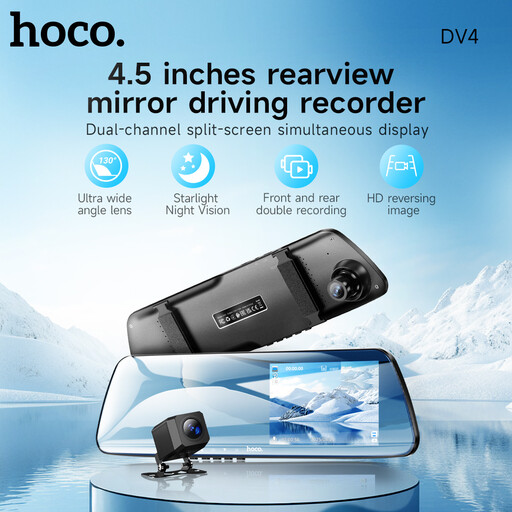
Why it stands out: The HOCO DV4 is a solid entry-level model that reliably performs the core functions of a front and rear car camera. It focuses on simple operation and straightforward installation.
Pros:
Who is it for? This model is suitable for drivers who want basic and reliable documentation of their journeys without focusing on advanced technical features like GPS or app connectivity.
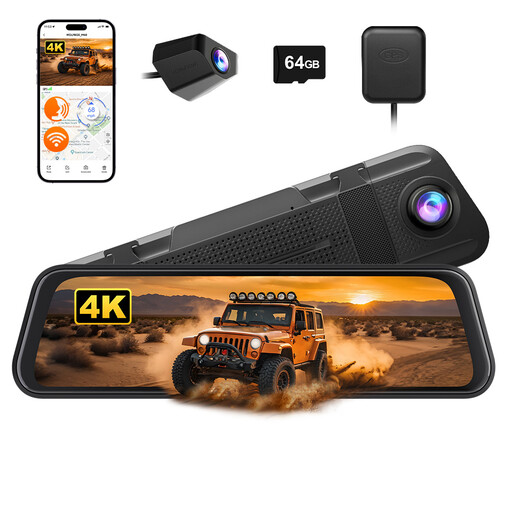
Why it stands out: The WOLFBOX M40 combines a high 4K resolution for the front camera with a large touchscreen and modern assistance systems. It functions as a full-fledged digital rearview mirror.
Pros:
Who is it for? Ideal for tech-savvy drivers who value excellent image quality, a large display, and additional safety features. The voice control enhances user convenience while driving.
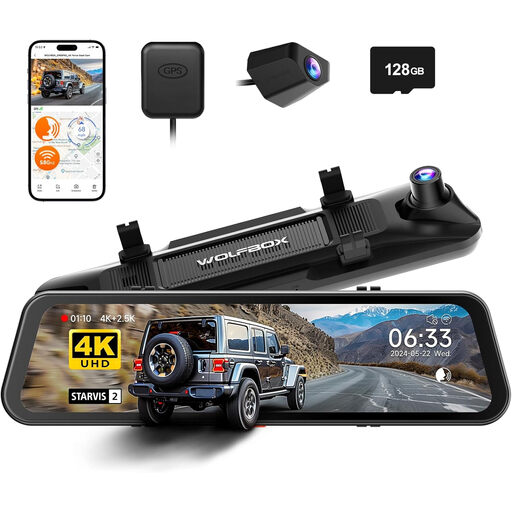
Why it stands out: The G900 PRO focuses on maximum image quality by using a high-end image sensor and high resolution for both cameras. This model is aimed at users with the highest demands for recording quality, especially at night.
Pros:
Who is it for? This model is the choice for drivers who refuse to compromise on video quality. The high-end sensor and the high resolution of both cameras make it a powerful car driving recorder for demanding users and professional drivers.
The models presented here cover various use cases. If you want to compare more cameras or are looking for specific mounts and accessories, you can find a wider selection of products in our rearview mirror accessories category.
The use of dash cams is generally permitted in Germany. However, it is important to comply with the General Data Protection Regulation (GDPR). Continuous, indiscriminate filming of public spaces is not allowed. For this reason, modern dash cams use a loop recording feature that automatically overwrites old data. Recordings may only be permanently saved on an event-driven basis, such as after an accident. Whether a recording is admissible as evidence in court is decided by the judge on a case-by-case basis.
Installation is usually straightforward. The main unit is attached to the existing rearview mirror with elastic straps. Power is supplied via the 12V socket (cigarette lighter). The cable for the dash cam with rear camera is routed from the rear of the vehicle to the main unit, typically hidden under the headliner and pillar trim.
Loop recording is a standard feature on dash cams. The camera records video in short segments (e.g., 1, 3, or 5 minutes). Once the memory card is full, the oldest, unprotected recording is automatically deleted to make space for new ones. An integrated G-sensor (accelerometer) detects sudden events like heavy braking or an impact and locks the current recording to prevent it from being overwritten.