What should you look for when buying?
Solid trays
Best for: If you want to spread purée without using a separate dehydrator sheet, look for a solid tray specifically designed for this purpose.
Things to consider: Design and features vary between models. The solid trays on the Rommelsbacher DA 750 don’t indicate what other appliances include, and the manufacturer no longer sells this model.
Compact appliance with a suitable liner
Best for: If saving worktop space matters more than making a large batch, a compact appliance with a suitably sized fruit leather liner may be a good option.
Things to consider: The silicone mould listed for the WMF KÜCHENminis Snack to go is described in the instructions as a cereal bar mould. There’s no evidence that it’s a full-size fruit leather liner.
Tray-style appliance with several drying surfaces
Best for: If you regularly process larger quantities and have enough room to use and store the appliance, a larger overall drying area may give you more options.
Things to consider: Open racks need suitable liners for liquid purée. A silicone mat listed for the Graef DA506 Multi-Set isn’t automatically included with every DA506 offer.
First compare the surface available for your purée, then consider the space needed and how easy it is to clean. The timer and the accessories actually included will also affect how well the appliance fits into a shared kitchen.
| What matters when buying |
What to check |
Who should pay particular attention |
| Purée liner and what’s included |
A solid drying surface or suitable liner; dimensions and suitability for food contact. |
If I want to spread purée on an open rack, I need a suitable liner and to know whether it’s included. Around 36% of consumers who prioritise this are looking for the same thing. |
| Space and cleaning |
External dimensions, where it can be placed, removable food-contact surfaces and cleaning instructions. |
If I share a worktop and sink, I want to be able to fit the appliance in and clean the used surfaces thoroughly. Around 29% of consumers prioritise space and cleaning. |
| Running time and scheduling |
Adjustable timer, automatic shut-off and operating instructions; check that the fruit leather is dry when the cycle ends. |
If the kitchen is shared, I want to be able to schedule the drying cycle and plan for when it finishes. Around 21% of consumers prioritise running time and planning. |
| Usable area for larger quantities |
Usable drying area, number of liners that can be used at once and the actual contents of the set. |
If I regularly process larger quantities of fruit, what matters is how many surfaces can actually be used with suitable liners. Around 14% of consumers prioritise capacity and drying area. |
Dehydrators at Joybuy
The dehydrators listed here have timers and drying-area features that may be useful when planning around a shared kitchen. For fruit purée, you’ll also need to check whether there’s a suitable solid surface or liner.
 No image available
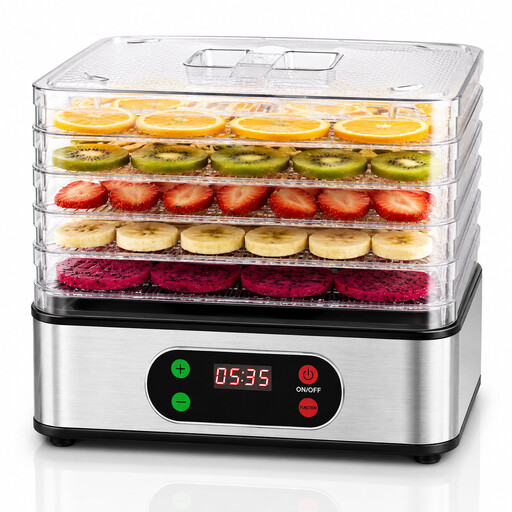
Dehydrator with LED display, 35–70 °C
The adjustable timer can help you plan a drying cycle; for fruit purée, check that there’s a suitable drying surface or liner.
Temperature range: 35–70 °C. Timer: 0,5–72 hours in 30-minute increments. Power: 350 W.
View at Joybuy
 No image available
Havenwell stainless steel dehydrator, 10 trays
The ten trays provide several drying surfaces; check which ones can be used for fruit leather with a suitable liner.
Timer: 48 hours. Variable temperature setting. Power: 850 W. The product title lists ten stainless steel trays and ten programmes.
View at Joybuy
 No image available
Havenwell dehydrator with 8 stainless steel drying racks
The timer can help you plan a drying cycle; for fruit leather, you’ll also need to check the liner and its suitability for food contact.
Temperature range: 35–85 °C. Timer: 48 hours. Power: 650 W. The listing specifies eight stainless steel drying racks.
View at Joybuy
 No image available
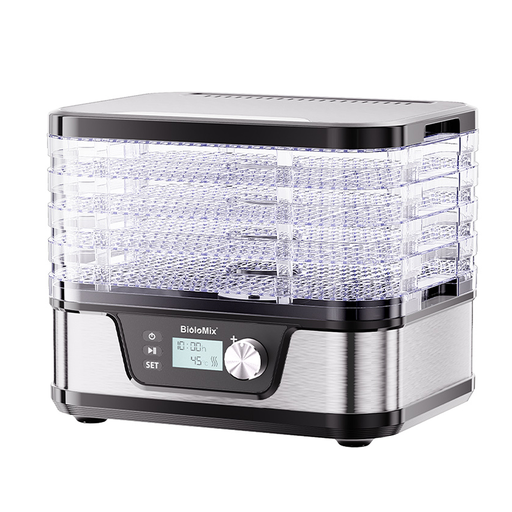
BioloMix BFD1300, 5 trays
The adjustable timer is useful for planning when the appliance will run; before using it with fruit purée, check whether a suitable liner is included or needs to be bought separately.
Temperature range: 35–75 °C. Timer: 24 hours. The listing specifies five trays and 360° hot air circulation.
View at Joybuy
Frequently asked questions
Can I put fruit purée directly on any drying rack?
No. For open racks, you need a suitable liner approved for food contact that will hold the purée. If the appliance has solid trays specifically designed for this purpose, you may not need a separate dehydrator sheet.
How can I tell when fruit leather is fully dry?
Pay particular attention to the centre and follow the recipe instructions. The National Center for Home Food Preservation suggests around 6–8 hours at 140 °F, around 60 °C, as a guide for fruit leather made in a dehydrator; the purée and appliance will affect the actual drying time.
What should I bear in mind when using a dehydrator in a shared kitchen?
Thoroughly clean your hands, work surfaces and utensils before preparing food and between each stage. The Verbraucherzentrale recommends cleaning kitchen utensils and washing your hands. You should also agree on when to use the appliance and follow its instructions.
Is a manufacturer’s guarantee the same as your statutory rights?
No. The Verbraucherzentrale distinguishes statutory rights for faulty goods from an additional, voluntary guarantee, which has its own terms and conditions. Check the guarantee offered with the specific product and whether suitable liners or replacement parts are available.
What regulations apply to dehydrators in Germany?
Electrical appliances sold in the EU must comply with the applicable EU product regulations. The CE mark is a declaration made by the manufacturer, not an independent quality mark. Drying surfaces and liners that come into contact with food must also meet the applicable EU rules for food-contact materials. Check the labelling and information for the accessories actually being used.


