Food photographers working with a dark set
If you want to bring out the texture of seasonal produce without unnecessarily brightening the dark background, the position of the light and control over shadows are key.


You don’t necessarily need an LED panel: if the light from your window is right, you can start with side lighting and a reflector. For repeatable shots regardless of daylight and weather, a dimmable panel is a good option. Choose one based on how you can shape the light, the space it takes up, its white-light settings and its power supply, rather than looking at wattage or CRI figures alone.
If you want to bring out the texture of seasonal produce without unnecessarily brightening the dark background, the position of the light and control over shadows are key.
For a series featuring fruit and vegetables in different colours, adjustable white light and a consistent shooting setup can make all the difference.
If you often set up and pack away your kit, or shoot in different locations, consider the panel’s size, mounting options and power supply.
A good fit if: you shoot in suitable daylight and want to see whether side lighting helps your subject stand out against a dark background.
The trade-off: You need less equipment, but you’ll depend on the window, the weather and the time of day. Canon Europe describes dark backgrounds as a creative option, while Nikon USA recommends directional light from the side or behind for food photography.
A good fit if: you want to position the light consistently regardless of daylight and direct it precisely at your subject.
The trade-off: The space, mount, light modifiers and power supply need to suit your setup. You can’t tell whether a panel is the right size or has the right features from its name alone.
| What you need | What to look for | Who it matters to |
|---|---|---|
| Control light and shadows | Check whether you can position the panel to the side and dim it, and whether a diffuser or grid is included with the specific version. Test the lighting with your subject and background in their actual positions. | If I want to show the texture of vegetables while keeping the background dark, carefully directed light matters. Around 36% of consumers put shadow control first. |
| Show product colours consistently | Compare the white-light range of the exact model variant and take test shots of products in several colours using your planned camera settings. | If I’m photographing fruit and vegetables in different colours for a series, I want to keep the lighting and white balance as consistent as possible. Around 29% of consumers prioritise consistent product colours. |
| Position the panel on your set | Check its dimensions, mounting options and the space it needs. Also find out whether the specific version can run from mains power or a battery. | If there’s limited room on my photography table or I often move my set, the light and its mount need to fit. Around 21% of consumers prioritise space requirements or portability. |
| Plan what’s included | Compare the contents of the specific variant with the tripod, power adapter and accessories you want to use. Check which batteries you’ll need for your planned setup, too. | If I want to add the panel to my setup without buying extra parts, what’s included needs to work with the accessories I already have. Around 14% of consumers pay particular attention to having everything they need for a complete setup. |
Godox gives illuminance figures for the LEDP260C at 0.5 m; Aputure’s figures for the P60x include a reading at 1 m and 5600 K. Readings taken at different distances can’t be compared directly for brightness.
Only compare figures measured under the same conditions and with clearly stated settings. Then test the lighting with your own subject and setup.
A quoted CRI value is a manufacturer’s specification for the light. On its own, it doesn’t tell you how the finished photo will look with your ambient light and camera white balance.
Keep your lighting and camera settings as consistent as possible across a series, and assess test shots of products in different colours.
For the NEEWER NL660, the manufacturer lists versions with and without a tripod. Godox says the LEDP260C requires two NP-F970 batteries, which must be bought separately, for battery operation; NP-F batteries are not included with the NL660, according to its manufacturer.
Compare the contents of the specific offer with your planned mains or battery setup and any mounts you already have.
Godox describes the LEDP260C as a bi-colour panel suitable for uses including macro and product photography. The P260C Pro is a separate model with a different stated white-light range.
The NL660 is a larger bi-colour panel for a dedicated photography table. It is available as a panel on its own or in a version with a tripod.
The P60x is a directional bi-colour panel for setups where you can choose exactly where to position the light.
The PavoSlim 60B is designed for setups offering several options for shaping the light and supplying power.
The VIJIM VL120 Bi-Color LED Video Light 2029 is described as a compact fill light for small setups that are moved around frequently.
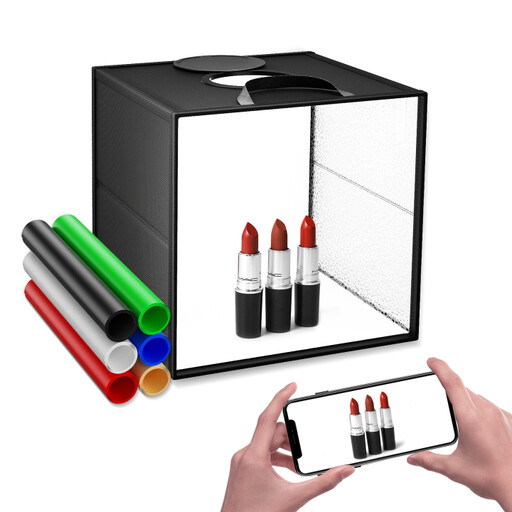
This selection at Joybuy includes a compact light box for product photography against a dark background. It’s an alternative to a separately positionable LED panel.
 No image available
For small product shots when space is limited; this light box is not a separately positionable LED panel.
The stated size is 30 × 30 cm. The product title specifies six coloured backgrounds, dimmable lighting and a foldable design.
The description also lists a diffuser and openings at the front and top. Check which EU requirements apply to the specific version; any required CE marking is not an independent quality test.
No. If you have suitable light from a window, you can start with side lighting and use a white card to brighten the shadows if needed. A panel is worth considering if you want to control the position of the light regardless of the time of day or weather.
Try lighting from the side or slightly from behind, then check the reflections and shadows in the actual image. A diffuser can soften the light, while a reflector on the opposite side will change the strength of the shadows. The effect depends on the surface and your setup.
It depends on the model and package variant. The NEEWER NL660 is available in a version with a tripod, but the manufacturer says NP-F batteries are not included. For battery operation of the Godox LEDP260C, Godox specifies two NP-F970 batteries, which must be bought separately. Check the contents of the specific offer.
Follow the instructions for your chosen model and keep the light and electrical connections away from splashes. Godox warns against high humidity and contact with water for the LEDP260C; Nanlite requires the PavoSlim 60B to be used in a dry, ventilated area with clear air vents.
No. According to the European Commission, the CE marking is the manufacturer’s declaration that the product meets the relevant EU requirements, where applicable rules require the marking. CE does not tell you how well a panel will light your particular scene.