Fruit salad in a shared fridge
You use a shared fridge and want to check whether you can keep a sealed container in a separate spot that’s cold enough. The Federal Institute for Risk Assessment recommends storing cut fruit chilled and covered.


You don’t need your own fridge for fruit salad if you can keep a sealed container separate in the shared fridge and the storage area is cold enough. The Federal Institute for Risk Assessment recommends storing perishable foods at between 2 °C and 7 °C. If there’s no suitable space, choose an appliance based on the fridge space you need, the room available and its annual energy consumption. A freezer compartment is only useful if you also want to store frozen food.
You use a shared fridge and want to check whether you can keep a sealed container in a separate spot that’s cold enough. The Federal Institute for Risk Assessment recommends storing cut fruit chilled and covered.
You need your own space for fruit salad and a few other foods. The consumer advice centre recommends considering the size of appliance you need, so make sure the available floor space and usable fridge capacity are a good fit.
You regularly store other food and need shelf space you can keep separate. Make sure there’s enough room for your containers. A freezer compartment is only relevant if you actually want to store frozen food.
The Federal Institute for Risk Assessment recommends storing cut fruit chilled at between 2 °C and 7 °C, in a sealed or covered container. What matters is the temperature where the food is actually stored, not just the setting on the appliance.
A good fit if: There’s a separate spot for a sealed container and it’s cold enough.
The trade-off: You won’t need an extra appliance, but the space and temperature depend on how the fridge is shared.
A good fit if: You need your own fridge space and have a suitable place to put it.
The trade-off: The appliance takes up space and uses electricity. Compare its external dimensions, fridge capacity and kWh/year.
A good fit if: You regularly chill several containers and other fresh food as well as fruit salad.
The trade-off: More fridge space usually takes up more room. Check the dimensions and energy consumption of the specific model.
A good fit if: You want to store frozen food as well as fruit salad.
The trade-off: The freezer compartment doesn’t provide extra space for fresh fruit salad. Compare the fridge and freezer capacities separately.
| What matters | What to check when buying | Who is it important to? |
|---|---|---|
| Chilled, hygienic storage | A separate spot for a sealed container; check the temperature where it will be stored. | If I’m sharing fruit salad with other foods, I need to be able to keep the container separate and cold enough. Around 36% of consumers put this type of storage first. |
| Kitchen space | Measure the available floor space and door clearance; compare fridge capacity and interior layout. | Even with limited space, my container still needs to fit and the door needs to open freely. Around 29% of consumers prioritise having their own space-saving fridge. |
| Energy consumption | Compare the specific model’s kWh/year and take your electricity tariff into account. | If I’m running an extra appliance, I want to compare its annual energy consumption with my tariff and avoid choosing a model that’s bigger than I need. Around 21% of consumers put running costs first. |
| Additional freezer compartment | Check the fridge and freezer capacities separately; consider the effort involved in defrosting. | If I also store frozen food, I need both functions without losing sight of the space available for fresh food. Around 14% of consumers prioritise having an additional freezer function. |
Cut fruit still needs to be kept cold enough in your own fridge and stored in a sealed or covered container.
First check whether the shared fridge has a separate spot at a suitable temperature. Only buy a second appliance if there really isn’t enough space or it isn’t cold enough.
An extra appliance takes up space and uses electricity.
Of the Exquisit KS16-4-E-040E’s 109 l total capacity, 95 l is fridge space and 14 l is freezer space. Manual defrosting is specified.
Compare the fridge and freezer capacities separately, and only choose a freezer compartment if you need one.
The specific annual energy consumption and the size of appliance you need also affect running costs.
Compare the models’ kWh/year figures and don’t choose more fridge space than you actually need.
The details below relate to the specific models and manufacturer information mentioned. They are not based on independent performance tests.
The TS190030N is a slim freestanding fridge for spaces where room is limited.
The Re 1000 Pure is a low table-top fridge for spaces with limited height.
The KTR15NWEB is a table-top fridge without a freezer compartment, with space for several containers and other fresh food.
The KS16-4-E-040E is an option if you need space for frozen as well as chilled food.
This selection features compact fridges, with and without freezer compartments, for storing fruit salad and other food.
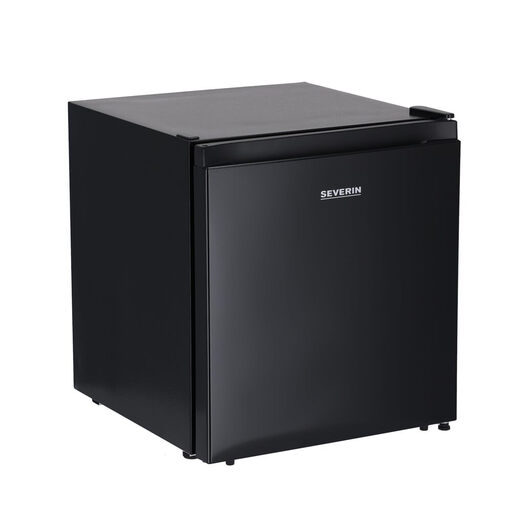 No image available
A compact fridge of your own, with a small freezer compartment for extra convenience.
45 l total capacity, including a 5 l freezer compartment; compressor cooling and an adjustable thermostat.
Two shelves, one of which is removable; automatic defrosting. Dimensions: 41,8 × 44,8 × 47,8 cm.
 No image available
For several chilled containers and other fresh food, with extra freezer space when you need it.
173 l total usable capacity: 121 l fridge space and a 52 l freezer compartment; 124 kWh/year according to the product details.
Three glass shelves and LED lighting; listed width: 49,5 cm.
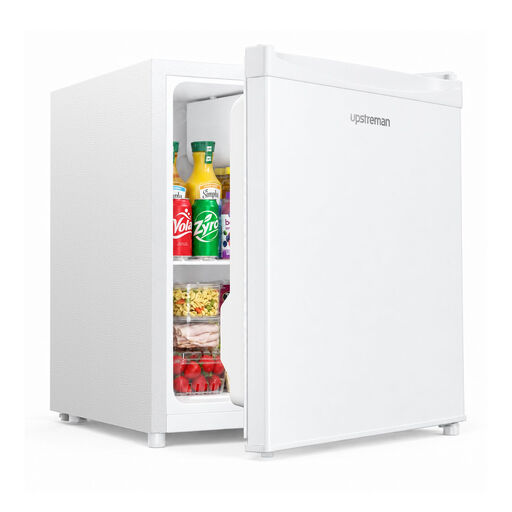 No image available
A compact fridge of your own. Check the temperature where it will actually be used to make sure it’s suitable for your needs.
Five-level temperature control from 0 to 12 °C; listed noise level: 41 dB.
Approximately 0,22 kWh daily consumption according to the product description; reversible door and adjustable feet.
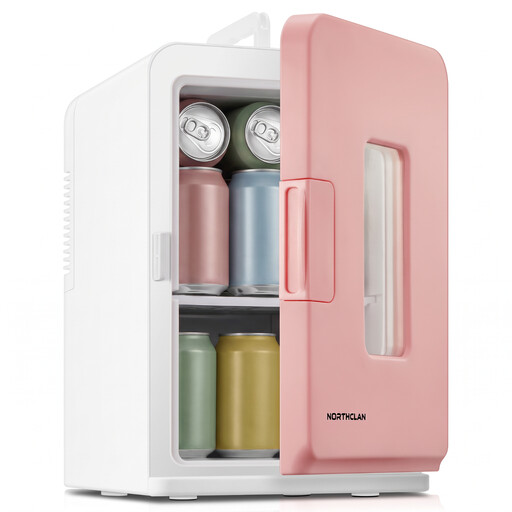 No image available
For smaller quantities and use in different locations. Before using it, check that the cooling at your chosen location reaches the temperature range you need.
The product description lists a cooling function that brings the temperature below ambient, as well as a warming function.
Removable shelves and 12-V and 240-V power supplies are listed.
 No image available
For your own fridge space if you want to store other fresh food alongside fruit salad.
82 l usable capacity and a salad drawer; E energy efficiency rating and 84 kWh/year according to the product description.
Mechanical temperature control, adjustable glass shelves and door racks; listed noise level: 40 dB.
Yes. The Federal Institute for Risk Assessment recommends keeping cut fruit chilled until you eat it, and storing food in the fridge covered and separately. A sealed container helps you do this.
The Federal Institute for Risk Assessment recommends a temperature of between 2 °C and 7 °C for perishable foods in the fridge. Check the temperature where the food is actually stored, not just the appliance setting.
The European Commission’s energy label includes details such as annual energy consumption in kWh, fridge and freezer capacities, and noise emissions. Also compare the external dimensions with the space available and consider how much fridge space your containers need.
Not if there’s a separate spot for a sealed container in the shared fridge and it’s cold enough. If there isn’t, having your own appliance could be a good option. Choose one based on the space available, the fridge capacity you need and its annual energy consumption. You only need a freezer compartment if you also want to store frozen food.