
Lieferung heute & morgen

Qualitätsgarantie

Willkommens-Angebote freischalten: KOSTENLOSE Lieferung | Bis zu 80 % RABATT | Kostenlose 30-Tage-JoyPlus-Testphase
App herunterladen
A fruit slicer can portion apples, remove stones from avocados or prepare pineapples. However, kitchen tools vary considerably in terms of cutting results, cleaning, safety and intended use. If you focus only on low prices or eye-catching marketing claims, you can easily end up with a tool that becomes impractical after a short time.
A fruit slicer with several functions is practical when its design is clearly coordinated. Some models, however, contain small additional blades or mechanisms that are difficult to access and awkward to clean. So check whether every function suits your everyday needs: do you need a fruit slicer with a stone remover, an apple slicer, or more of a tool for peeling and removing the flesh?
A fruit divider can only produce evenly sized pieces if the diameter and shape of the fruit match the tool. Small fruit slicers can reach their limits with large apples, pears or melons. Details such as diameter, number of segments and recommended types of fruit are therefore more important than general terms such as “professional” or “perfect”.
“High quality” is hardly meaningful without precise material details. With a stainless steel fruit slicer, buyers should check whether the blades are made from stainless steel, or whether the handle is too. Plastic can be useful for certain designs, for example to keep the tool lightweight or provide a non-slip grip. What matters is the precise material composition, stability and care instructions.
For frequent slicing, stainless steel blades are suitable, provided they are sturdily made and adequately protected against corrosion. Stainless steel is easy to care for and is used in many apple slicers, pineapple slicers and fruit slicers. Ceramic blades require a little more care: they are hard, but can break or chip if dropped or subjected to lateral pressure.
For products that explicitly state their suitability for food contact, the manufacturer's information should be observed. The Joseph Joseph GoAvocado, for example, is stated to be suitable for food contact in accordance with EU Regulation (EC) No. 1935/2004. This is a specific compliance statement and more informative than a general marketing claim.
Pay attention to the size of the cutting head and the shape of the fruit. An apple slicer with a diameter of 90 mm is designed for larger apples and pears. An avocado slicer, on the other hand, has an elongated, curved shape and is not intended for hard fruit or other materials.
These questions can help you decide:
Cutting edges must point away from your fingers during use. Particularly when using a fruit slicer with a stone remover, the fruit should be placed on a stable chopping board. Children should not use sharp blades and corers without supervision.
Smooth surfaces and few hard-to-reach gaps are advantageous when it comes to cleaning. Some models are dishwasher-safe, while hand-washing is recommended for others. The manufacturer's care instructions are the deciding factor. With folding mechanisms, moving parts should be dried completely after washing to prevent moisture from collecting inside.
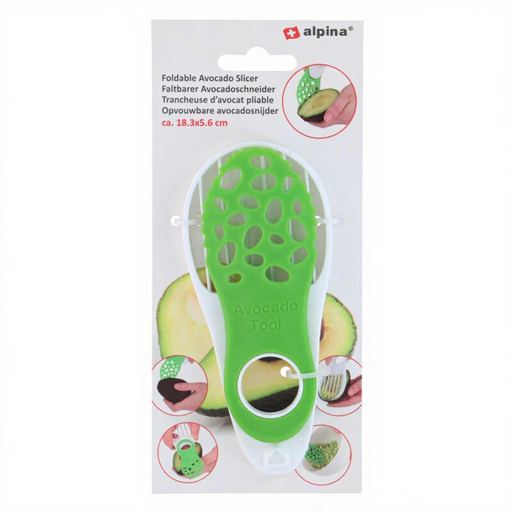
Why this product suits the profile: This compact kitchen tool combines slicing, stone removal and peeling avocados in one utensil. Measuring 12,5 × 5,6 × 1 cm and weighing 22 g, it is suitable for small kitchens and occasional use.
The three functions are clearly described and limited to one type of fruit. This avoids unclear additional functions that may be unsuitable for other fruit.
Lightweight PP plastic, compact dimensions and three clearly assigned steps.
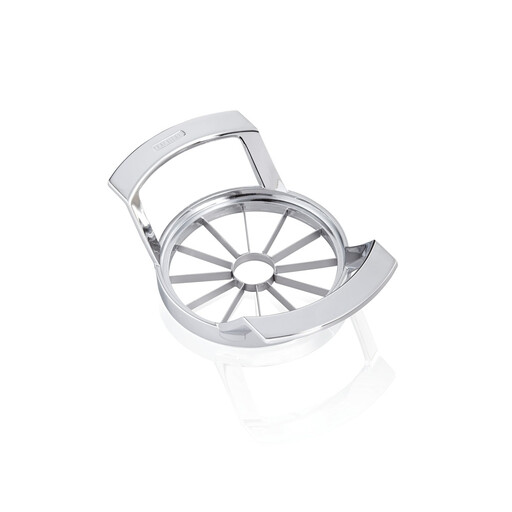
Why this product suits the profile: This apple slicer divides apples and pears into 12 segments while removing the core at the same time. The 90 mm diameter cutting head is also designed for larger fruit.
The number of segments and the diameter are specified precisely. This makes it easier for buyers to check whether the model is suitable for their preferred fruit size.
Stainless steel blades, chrome-plated metal, 12 evenly sized pieces and stated dishwasher suitability.
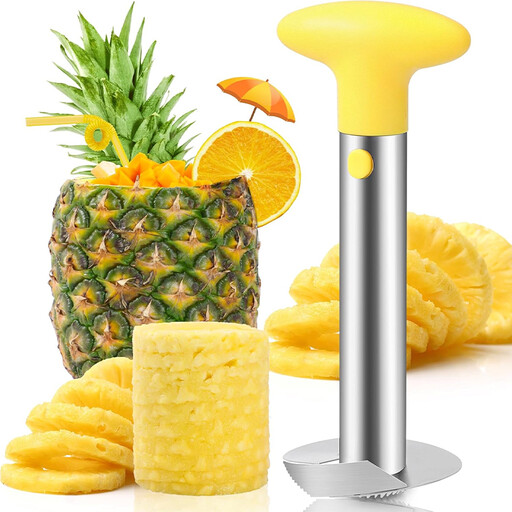
Why this product suits the profile: This pineapple slicer is designed to remove the core and portion pineapple. It is a good fit for households that prepare this fruit regularly.
Its specialist design prevents unrealistic expectations of a universal fruit slicer. The tool is used for its intended purpose.
Explicitly described as a pineapple corer and slicer; stainless steel is specified as the material.
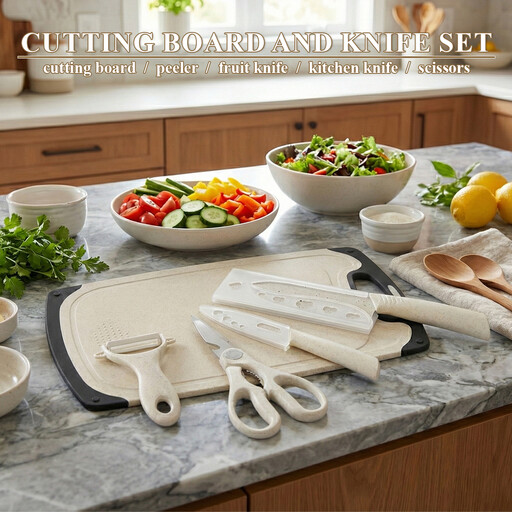
Why this product suits the profile: The set includes a chopping board, kitchen knife with protective cover, fruit knife, safety scissors and Y-peeler. It can be used to prepare soft fruit and small portions for family meals.
The contents are listed clearly. Protective covers and a non-slip underside are described as product features rather than being promoted with vague safety claims.
Five coordinated kitchen tools, a compact chopping board and materials made from wheat straw fibre and PP, according to the product description.
We have put together a complete, regularly updated list of products that fully meet these strict selection criteria and the safety regulations applicable in the EU.
For apples, an apple slicer with an integrated core remover and a suitable diameter is a sensible choice. According to the product information, a model with a 90 mm diameter and 12 segments is designed for apples and pears, including larger fruit. For particularly small or very large fruit, check the size specifications before buying.
A fruit slicer set is particularly worthwhile if several steps are regularly involved: slicing, peeling, removing stones and chopping. If you only portion apples, you will generally not need an extensive set of accessories. For families or preparing different types of fruit, however, a set can replace several individual kitchen tools.
First, follow the manufacturer's instructions. Dishwasher-safe models can be cleaned accordingly; others should be washed by hand with warm water and mild washing-up liquid. With an avocado slicer featuring a joint, in particular, all moving areas should then be dried completely. Keep sharp cutting edges away from your fingers while washing.