
Lieferung heute & morgen

Qualitätsgarantie

Willkommens-Angebote freischalten: KOSTENLOSE Lieferung | Bis zu 80 % RABATT | Kostenlose 30-Tage-JoyPlus-Testphase
App herunterladen
The right frying pan should heat evenly for everyday cooking, work safely on your hob and be easy to clean. Yet product descriptions and marketing claims can often lead to the wrong choice. There are three common pitfalls in particular: a coating is described as especially durable, even though the care instructions say to hand-wash only; a pan is advertised as suitable for all uses, even though its oven or hob compatibility is limited; and the stated size refers to the outside diameter rather than the usable cooking surface.
That’s why it’s worth checking the technical details before buying a frying pan. Material, diameter, coating, hob compatibility and cleaning have a greater impact on how practical a pan is for everyday use than decorative finishes or general marketing claims.
Aluminium heats up relatively quickly and is often used in coated pans. Cast or forged versions can be sturdier than models with very thin sides. Stainless steel pans are available with or without a coating. A stainless steel frying pan with an aluminium core, such as a three-ply construction, combines a heat-conducting middle layer with stainless steel on the inside and outside.
With an uncoated stainless steel pan, it’s important to control the temperature. Preheating over a medium heat and adding a little oil can help prevent food from sticking. This type of pan isn’t automatically non-stick. If you often cook eggs, pancakes or delicate fish, an induction non-stick frying pan is usually easier to use.
A coated frying pan makes it easier to release food and can reduce the amount of oil needed for frying. However, the type of coating should be clearly specified:
A ceramic frying pan isn’t automatically designed for very high temperatures or prolonged heating while empty. Check the maximum temperature and recommended utensils when comparing products.
An induction-compatible frying pan needs a magnetic base. The phrase “suitable for all hob types” should explicitly include induction, gas, electric and ceramic hobs. Halogen or specialist infrared hobs may require an additional check.
Common sizes suit different needs:
A lid makes the pan more versatile for braising and reducing sauces. Check whether the lid is included and whether it’s oven-safe and dishwasher-safe. Many products have lower temperature limits for the lid than for the pan.
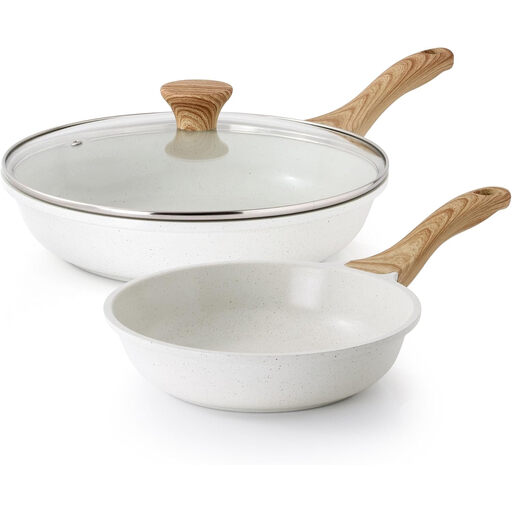
Why this product suits this profile: The set caters for smaller and larger quantities, and the product description says it’s suitable for induction, gas and electric hobs. The larger pan comes with a glass lid.
The product description specifies a ceramic coating made without intentionally added PFAS or PTFE. It also explicitly recommends hand-washing rather than using a dishwasher.
Two diameters, a magnetic stainless steel base and a glass lid; the stated maximum oven temperature is 550 °F.
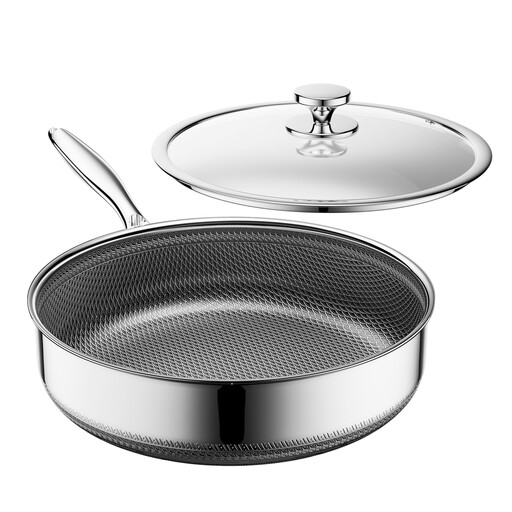
Why this product suits this profile: Its deep shape, glass lid and combination of stainless steel and ceramic coating make it a good fit for households that want to fry and braise.
The oven limits are listed separately: up to 260 °C for the pan and up to 148 °C for the glass lid. This makes it easier to plan how to use them.
Suitable for all the listed hob types, dishwasher-safe and, according to the product description, free from PFAS, PTFE and PFOA.
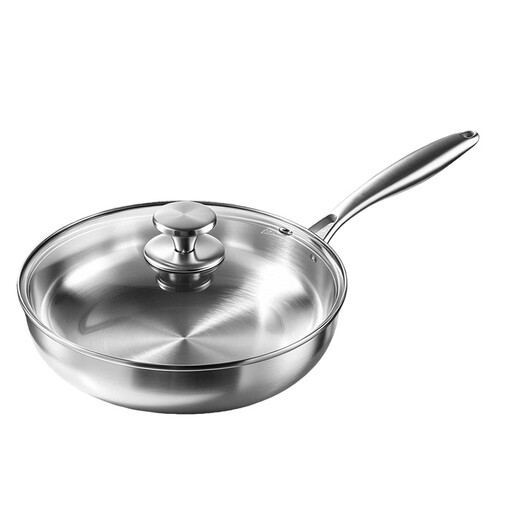
Why this product suits this profile: If you prefer an uncoated surface and are happy to pay attention to temperature control, this compact pan with a lid is well suited to everyday use.
The product description states that the surface is uncoated. This removes the need to choose a non-stick coating, but you’ll need to take account of how the pan performs when preheated over a medium heat.
Three-ply construction with stainless steel and an aluminium core, 22 cm diameter, glass lid and compatibility with induction, gas, electric, ceramic and halogen hobs.
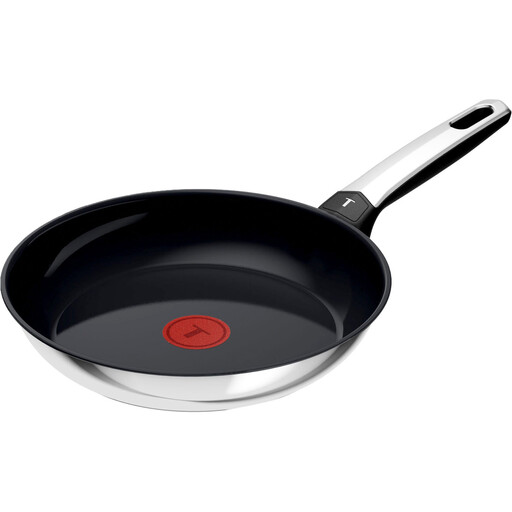
Why this product suits this profile: Its deep shape and 28 cm diameter provide plenty of room for larger portions. According to the product description, the pan is designed for induction, gas, electric and ceramic hobs.
The product details include specific dimensions, confirm that it has a ceramic coating and provide cleaning instructions. Hand-washing is recommended to protect the coating, despite the pan being dishwasher-safe.
18/10 stainless steel body, 28 cm diameter, deep shape, Thermo-Signal indicator and dishwasher-safe design.
Whatever the material, a few simple rules can help you get as much use as possible from your pan:
We’ve put together a complete, regularly updated list of products that meet these strict selection criteria and fully comply with the safety regulations in force in the EU.
A 20 cm frying pan is enough for small quantities and individual portions. A 24 cm frying pan gives you more flexibility for vegetables, eggs or two smaller pieces of meat. A 28 cm pan is more practical for larger meals, but it also needs a hob zone of a suitable size.
It depends on what you’ll use it for. Stainless steel pans are available without a coating and can be used with a range of kitchen utensils, but they require careful temperature control. A coated pan makes it easier to fry delicate foods and clean up afterwards, but you’ll need to take more care with heat and utensils.
There’s no reliable one-size-fits-all answer. It depends on the type of coating, temperature, cleaning and utensils used. Visible scratches, flaking or a noticeable decline in performance are all reasons to stop using the pan for its intended purpose.