
Lieferung heute & morgen

Qualitätsgarantie

Willkommens-Angebote freischalten: KOSTENLOSE Lieferung | Bis zu 80 % RABATT | Kostenlose 30-Tage-JoyPlus-Testphase
App herunterladen
A frying pan needs to do more in everyday use than simply heat food. It should work on your existing hob, suit the size of your household, be easy to clean properly and, when needed, allow you to move from the hob to the oven. However, many poor purchases are not caused by missing features, but by unclear product information and overblown marketing terms.
A non-stick frying pan can make it easier to release delicate foods. However, its surface will only stay in good condition for as long as possible if it is not overheated and is used with suitable kitchen utensils. Metal turners, abrasive scourers and sudden temperature changes can damage non-stick coatings.
Terms such as “granite” or “ceramic” do not automatically indicate a specific lifespan either. What matters is the actual type of coating, the care instructions and the permitted temperature.
A frying pan for induction requires a magnetically conductive base. Not every aluminium or copper pan is therefore automatically suitable. If your household is switching to induction, the manufacturer’s information should explicitly state “induction-compatible” or “suitable for all hob types”.
The size of the contact area also matters: a small base may work less efficiently on a large hob. Conversely, a large pan may not heat evenly on a small cooking zone.
With an ovenproof frying pan, you need to check whether the specification applies to the complete product. Handles made from Bakelite, wood or other materials may have a lower temperature limit than the pan body. For example, the SENSARTE pan is specified as suitable for oven use up to 400 °F; with the Maxcook Mini pan, particular attention should be paid to the heat resistance of the wooden handle.
A cast-iron frying pan retains heat for a long time and is suitable for searing food thoroughly and continuing to cook it slowly. Its greater weight can make everyday tossing inconvenient. Compared with untreated cast iron, enamelled cast iron does not require traditional seasoning, but it should still be protected from knocks and sudden temperature changes.
Aluminium generally heats up quickly and is lighter. With non-stick models, careful handling of the surface is the priority. A non-stick frying pan is therefore particularly well suited to eggs, pancakes, vegetables and foods that tend to stick easily.
The stated diameter often refers to the top rim. For hob performance, the base diameter is also relevant.
A dishwasher-safe frying pan may be placed in the dishwasher according to the product information. Nevertheless, several manufacturers recommend hand washing to protect the coating or enamel. For untreated cast iron, the dishwasher is generally unsuitable, as water and detergents can encourage rust.
You should also look for:
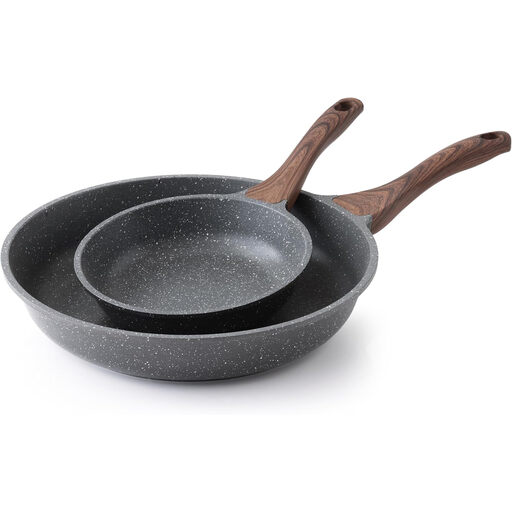
Why this product suits this profile: The set covers different household quantities with a smaller omelette pan and a large frying pan. According to the product information, the magnetic stainless-steel base is suitable for induction, gas and electric hobs.
Hob compatibility is clearly specified. Silicone, wooden or nylon utensils are also recommended for the coating; hand washing is intended to help protect the surface.
Two sizes, coated cast aluminium and a heat-insulating Bakelite handle. The specified oven limit is 400 °F.
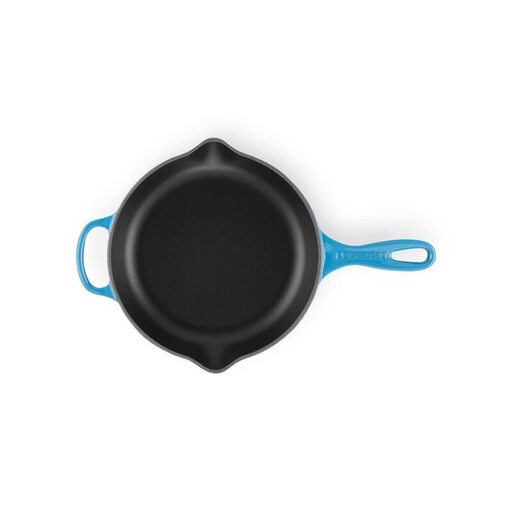
Why this product suits this profile: The enamelled cast-iron pan combines frying, slow cooking, baking and serving. Two pouring spouts and a helper handle make it easier to handle despite its weight of 1,93 kg.
Its suitability for all hob types, including induction, and for oven use is clearly stated. The enamel reduces the maintenance required compared with uncoated cast iron.
Excellent heat retention, an enamelled cooking surface and a stated oven temperature of up to 260 °C. According to the product information, the pan is dishwasher-safe; hand washing is recommended.
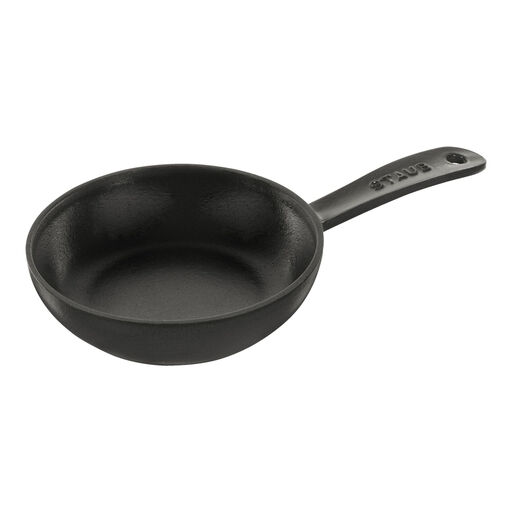
Why this product suits this profile: The compact pan is designed for individual portions, tapas and serving food directly. According to the product information, it is suitable for induction, oven and grill use.
The small size stops individual portions from spreading out in a large pan. Nevertheless, the matt enamel requires wooden or plastic utensils and careful cleaning.
0,60 l capacity, excellent heat retention and a stackable design. The stated heat resistance extends up to 260 °C.
We have put together a complete, regularly updated list of products that fully meet these strict selection criteria and the safety regulations applicable in the EU.
For delicate foods and straightforward cleaning, a non-stick frying pan is a good choice. If you often sear meat at high heat or finish dishes in the oven, enamelled cast iron may be the right option. A serving pan with a helper handle and pouring spouts is useful when you want to take a dish straight from the hob to the table.
For small portions, a 16 cm frying pan or a 12 cm frying pan takes up less space than a large model. A mini frying pan measuring 10 cm is better suited as an addition and does not replace a standard family-sized frying pan.
Models with a magnetic base or explicit manufacturer approval for induction are suitable. Cast iron is magnetic by nature; aluminium requires a suitable induction base. The technical details should state “all hob types”.
There is no reliable one-size-fits-all lifespan. It depends on the temperature, frequency of use, kitchen utensils and cleaning method. Use low to medium heat, avoid metal tools and replace the pan if the surface is visibly damaged or the coating has started to come away.
“Dishwasher-safe” means that the manufacturer permits cleaning in a dishwasher. Nevertheless, hand washing may be preferable for keeping the coating, enamel and handles in good condition for longer. Uncoated cast iron should be dried immediately and lightly oiled, as moisture can encourage rust.