
Lieferung heute & morgen

Qualitätsgarantie

Willkommens-Angebote freischalten: KOSTENLOSE Lieferung | Bis zu 80 % RABATT | Kostenlose 30-Tage-JoyPlus-Testphase
App herunterladen
A frying pan needs to do more than just look good in everyday use. It should heat evenly, work on your hob, be easy to clean and retain its properties for as long as possible with regular use. Yet vague marketing claims often lead to the wrong purchase.
The term non-stick pan initially describes only the fact that food is less likely to stick. It doesn’t tell you whether the pan has a PTFE, ceramic or hybrid coating. If you’re specifically looking for a PFAS-free frying pan, check the manufacturer’s material information. “PFOA-free” does not automatically mean “PFAS-free”.
For the products featured here, claims such as PFAS-free, PFOA-free or PTFE-free are based on the product information provided. This does not imply that the claims have been independently verified.
Not every aluminium frying pan works on an induction hob. A magnetic base, often made of stainless steel, is essential. A frying pan for induction should be explicitly approved for use on induction hobs. It’s also worth checking the base diameter: if it’s significantly smaller than the cooking zone, heat may be distributed less evenly in everyday use.
A dishwasher-safe frying pan may be suitable for the dishwasher according to the manufacturer, but high temperatures, alkaline detergents and mechanical wear can put more strain on coatings. For coated models, hand washing with a soft sponge is often gentler on the material. Uncoated stainless steel is generally less delicate to care for, but food may be more likely to stick when frying.
Multi-layer constructions combine different properties. Stainless steel is robust and retains its shape, while aluminium conducts heat quickly. A Tri-Ply frying pan often has an aluminium core between layers of stainless steel. This can help it heat more evenly.
An uncoated stainless steel frying pan is durable and suitable for high temperatures. However, it requires the right technique: preheat the pan, add oil afterwards and keep an eye on the heat. With a coated frying pan, it’s more important to use low to medium heat and suitable kitchen utensils.
A ceramic frying pan may be PTFE-free according to the product information. However, ceramic surfaces should not be heated strongly while empty for long periods. Metal turners, steel wool and sudden temperature changes can damage the surface.
Look for specific details about:
A 24 cm frying pan is often suitable for smaller portions, eggs, fish or side dishes. A 28 cm frying pan offers more room for several portions and family meals. The usable diameter may be smaller due to the shape of the sides.
For stews, sauces and one-pot recipes, a deep frying pan with a lid is more practical than a shallow model. High sides help reduce splashes and provide more capacity. Also check whether the lid is oven-safe and, if so, up to what temperature.
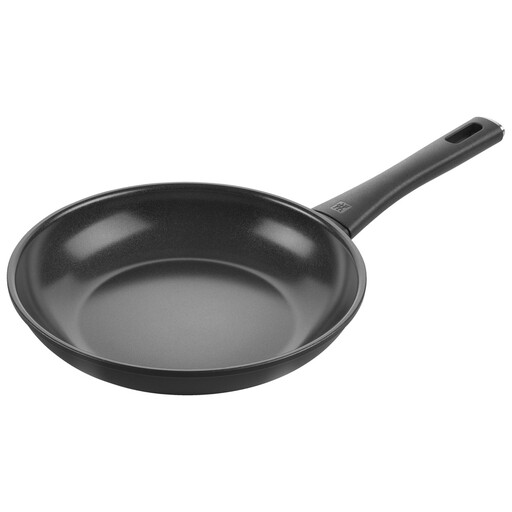
Why this product suits this profile: The 24 cm size is easy to handle for smaller households and everyday portions. According to the product information, the pan is suitable for gas, induction, ceramic and other hob types.
The material and hob information explicitly states that it has a PTFE- and PFOA-free CeraForce ceramic coating and is suitable for induction.
Forged aluminium, 24 cm diameter, oven-safe up to 250 °C according to the product information, and a stainless steel handle.
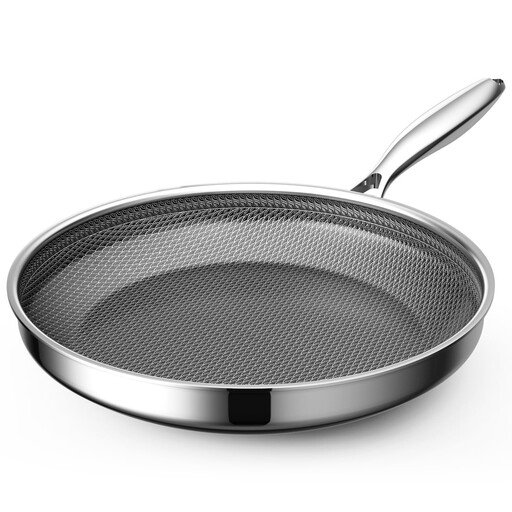
Why this product suits this profile: The Tri-Ply construction combines an aluminium core with stainless steel and is designed for all common hob types, including induction, according to the product information.
The product description specifies 304 stainless steel on the inside, an aluminium core and a PFAS-, PFOA- and PTFE-free ceramic coating.
20 cm diameter, oven-safe up to 260 °C and a stainless steel handle that is dishwasher-safe according to the product information.
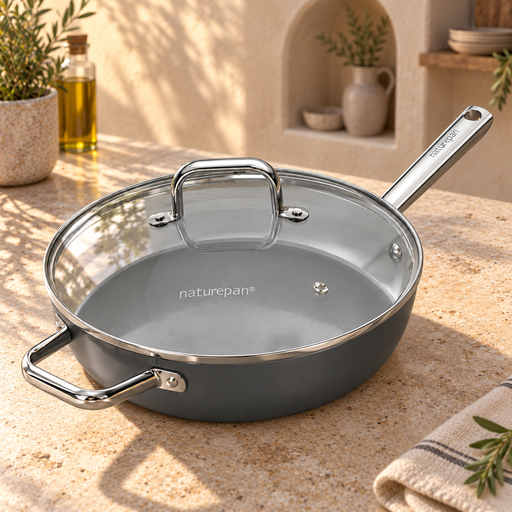
Why this product suits this profile: The high sides and glass lid make it suitable for sauces, stews and larger portions. According to the product information, this model is compatible with induction hobs.
The information explicitly lists the 28 cm size, deep design, lid, compatibility with several hob types and a PFAS-, PTFE- and PFOA-free ceramic coating.
7.5 cm body height, oven-safe up to 260 °C and dishwasher-safe according to the product description.
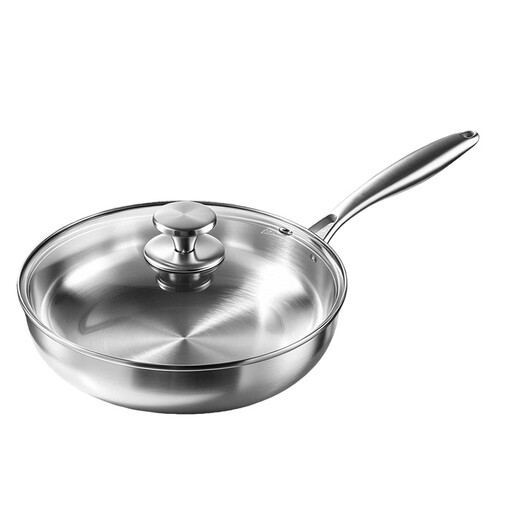
Why this product suits this profile: This uncoated stainless steel frying pan is designed for households looking to avoid a chemical non-stick coating and happy to manage the temperature carefully.
The product description says the surface is uncoated. This removes concerns about wear to a non-stick coating, but the right frying technique is still needed.
Tri-Ply construction with 304 stainless steel and an aluminium core, 22 cm diameter, induction compatibility and a glass lid.
We’ve put together a complete, regularly updated list of products that meet these strict selection criteria and fully comply with the safety regulations in force in the EU.
A 24 cm frying pan is often large enough for two smaller portions, eggs, vegetables or fish. If you regularly cook for several people, a 28 cm pan is usually a better choice. The size of your cooking zone and the storage space available also matter.
Look for models explicitly described as induction-compatible and with a magnetic base. Aluminium alone doesn’t guarantee induction compatibility. Claims such as “suitable for all hob types” should be supported by the technical product details.
Its lifespan depends on heat, kitchen utensils, cleaning and storage. Low to medium heat, hand washing and a protector between stacked pans can help preserve the coating. It’s not possible to give a reliable fixed lifespan without knowing how the pan will be used.