
Lieferung heute & morgen

Qualitätsgarantie

Willkommens-Angebote freischalten: KOSTENLOSE Lieferung | Bis zu 80 % RABATT | Kostenlose 30-Tage-JoyPlus-Testphase
App herunterladen
A frying pan needs to do more than simply heat food in everyday use. It should suit your hob, distribute heat as evenly as possible and be easy to clean. Models also vary considerably in their coatings, temperature limits, weight and care requirements.
If you focus only on a striking surface description or a low price, it’s easy to overlook important details. The criteria below will help you choose a suitable pan for an induction, gas or electric hob.
A non-stick frying pan can make it easier to lift out eggs, fish or pancakes. However, its durability depends on the specific coating, the temperature and the utensils you use. Metal turners, scouring pads and prolonged heating while empty can damage the surface.
Even a pan described as dishwasher-safe may be subject to more wear with frequent washing. For coated models, washing by hand with a soft sponge is often gentler on the material.
These terms describe different properties. A PFAS-free frying pan isn’t necessarily uncoated: it may, for example, have a ceramic non-stick coating. For claims such as PFAS-free, PTFE-free or PFOA-free, check whether the manufacturer says they apply to the entire coating or only to specific added substances.
For the products featured below, these are treated as manufacturer claims. They do not replace checking declarations of conformity or care instructions yourself.
A 28 cm frying pan is usually measured across the top rim. The usable base may be smaller. This is particularly relevant for induction hobs, as heat transfer depends on the diameter of the pan’s magnetic base and whether it matches the cooking zone.
Aluminium heats up relatively quickly and is used as the base material in many coated pans. An additional base plate or multi-layer construction can improve heat transfer across different types of hob.
An uncoated stainless steel frying pan is more resistant to scratches and suitable for high temperatures. However, it takes the right technique: preheat the pan, add the oil afterwards and keep an eye on the temperature. If the surface is too cool, foods rich in protein may be more likely to stick.
Multi-layer models, such as Tri-Ply designs, combine stainless steel with an aluminium core. When choosing one, look for specific details about the materials, base construction and hob compatibility.
A ceramic frying pan may be described as PFAS-free, PTFE-free or PFOA-free in the product details. This doesn’t mean you can heat it to any temperature or use metal utensils with it. Check the maximum temperature stated by the seller, along with any guidance on heating the pan empty and cleaning it.
For a coated frying pan, these points are also worth checking:
Pans measuring 20 to 24 cm are suitable for smaller portions, eggs or side dishes. Those measuring 26 to 28 cm offer more room for family portions, vegetables or several pieces of meat. A deep pan is more versatile if you also want to prepare sauces, slow-cooked dishes or larger quantities in it.
A frying pan with a lid can be useful for braising and reducing liquids. Before buying, though, check whether the lid is oven-safe and the maximum temperature it can withstand.
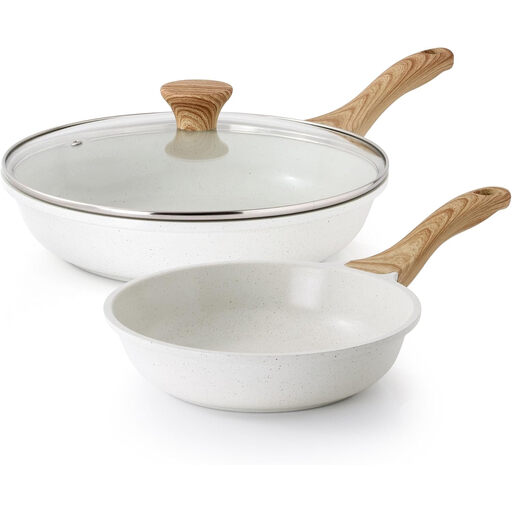
Why this product suits this profile: This two-pan set caters for both small and larger portions. According to the manufacturer, the pans have a ceramic coating with no intentionally added PFAS, PTFE, PFOA, PFOS, APEO, lead or cadmium.
The product details list induction, gas and electric hobs, as well as a maximum oven temperature of 550 °F. Hand washing is also recommended, making the limited dishwasher suitability clear.
Two pan sizes, a glass lid for the larger pan and a magnetic stainless steel base for use on different types of hob.
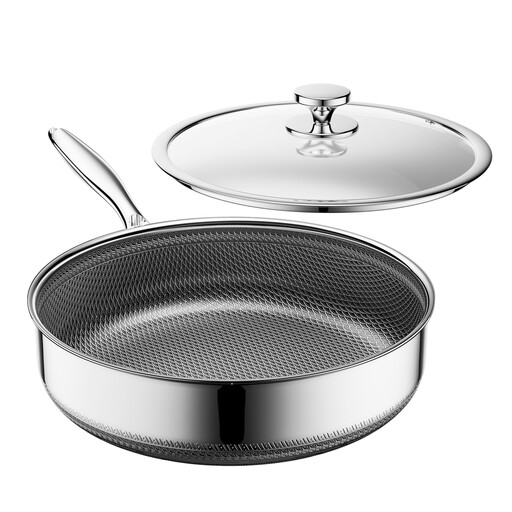
Why this product suits this profile: Its deep design combines stainless steel, a ceramic coating and an aluminium core. It’s a good option for households looking for a versatile pan with a lid that can also be used in the oven.
According to the manufacturer, the coating is free from PFAS, PTFE and PFOA. The product details also clearly distinguish between the pan’s oven limit of 260 °C and the lid’s limit of 148 °C.
Suitable for induction, gas, electric, ceramic and halogen hobs; described as dishwasher-safe in the product details and supplied with a glass lid.
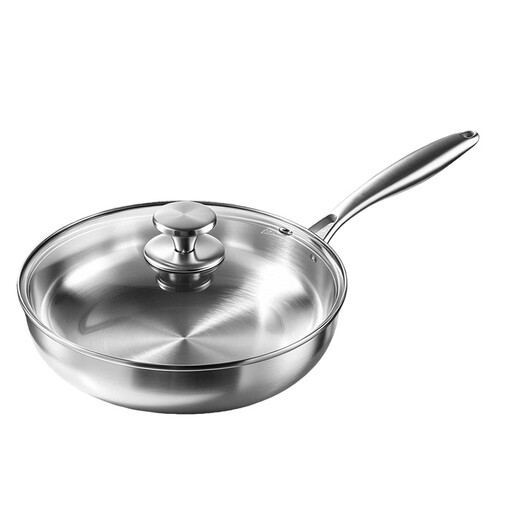
Why this product suits this profile: The uncoated stainless steel surface is for cooks who prefer to avoid ceramic or traditional non-stick coatings and are happy to use the right frying technique.
As the product details state that there is no coating, there’s no non-stick surface to suffer the usual coating damage. Preheating the pan, adding oil and cooking over a medium to low heat are recommended to reduce sticking.
Tri-Ply construction with 304 stainless steel and an aluminium core, suitable for induction and other types of hob, with a glass lid and described as dishwasher-safe in the product details.
We’ve put together a complete, regularly updated list of products that meet these strict selection criteria and fully comply with the safety regulations in force in the EU.
An induction frying pan needs a magnetic base. Stainless steel alone isn’t always enough. The product details should explicitly state ‘suitable for induction’ or confirm compatibility with induction hobs. The pan’s base should also match the size of the induction zone.
It depends on how you use and care for it. An uncoated stainless steel frying pan is more resistant to scratches and high temperatures, but food may stick more if the temperature isn’t right. A coated frying pan makes it easier to cook delicate foods, but needs gentle utensils and careful cleaning.
A 28 cm frying pan offers more room for several portions and vegetable dishes. For one or two people, 20 to 24 cm may be enough. If you cook different quantities, a set with a smaller and a larger pan gives you more flexibility.