
Lieferung heute & morgen

Qualitätsgarantie

Willkommens-Angebote freischalten: KOSTENLOSE Lieferung | Bis zu 80 % RABATT | Kostenlose 30-Tage-JoyPlus-Testphase
App herunterladen
A frying pan is a kitchen essential in almost every home. Yet unclear coating information, incompatibility with your hob or a handle that cannot withstand high temperatures can easily lead to the wrong purchase. So if you’re looking for a frying pan for induction, gas or electric hobs, don’t focus solely on the price or claims such as ‘non-stick’.
The following points will help you find the right pan or pan set for your home.
A coated frying pan can be made with a range of different materials. Alongside traditional synthetic coatings, there are ceramic and hybrid options. Terms such as ‘granite’, ‘stone’ or ‘titanium’ don’t automatically tell you exactly what the coating is made of.
If you’re looking for a PFAS-free pan, check for a clear statement from the manufacturer. PFAS, PFOA and PTFE are different terms and are not interchangeable. So a claim such as ‘PFOA-free’ doesn’t automatically tell you whether PFAS or PTFE are also excluded. Always check the specific product description.
An induction pan needs a magnetic base. Aluminium or ceramic pans often have a magnetic stainless steel plate built into the base. Without this layer, the pan won’t work, or may only work to a limited extent, on an induction hob.
So check that induction, gas and electric hobs are explicitly listed as compatible. This is particularly important if you’re moving house or changing your hob.
An oven-safe pan isn’t necessarily suitable for every temperature. The handle often limits the maximum temperature, and a glass lid may have a lower temperature limit than the pan itself.
The same applies to a dishwasher-safe pan: even if it can be cleaned in the dishwasher, regular machine washing may shorten the life of its coating. Hand-washing with a soft sponge is therefore recommended for many non-stick pans.
For one or two people, a diameter of 20 to 24 cm is often enough. A 26 to 28 cm frying pan gives you more room for vegetables, meat or several portions. Deeper pans are also suitable for braising, sautéing and cooking with liquid.
A shallow crêpe or pancake pan, on the other hand, has a low rim. This makes it easier to flip food, but less suitable for sauces or larger quantities. A pan with a lid is handy for cooking food through, keeping it warm or reducing liquids.
Coated pans should generally not be used with metal utensils or abrasive cleaning products. An uncoated stainless steel pan is less susceptible to damage, but food may stick more if it’s used at the wrong temperature.
Also check:
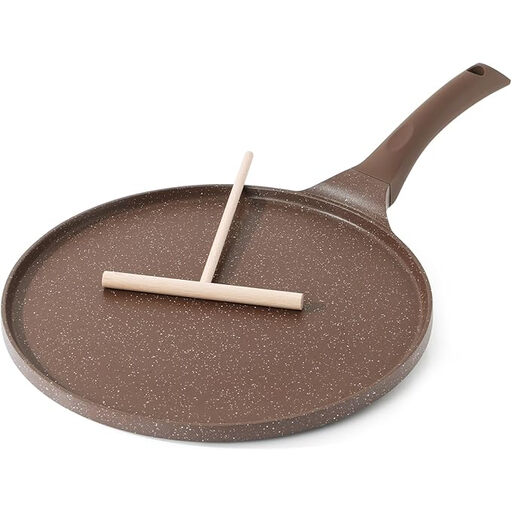
Why this product suits this profile: This shallow 10-inch pan is designed for crêpes, pancakes, tortillas and omelettes, making it a good fit for smaller households with a specific use in mind.
The product information lists compatibility with induction, gas and electric hobs, as well as a maximum oven temperature of 302 °F. It clearly states that the pan should be hand-washed.
Aluminium core, magnetic stainless steel base and Bakelite handle; according to the product information, made without intentionally added PFOA, lead or cadmium.
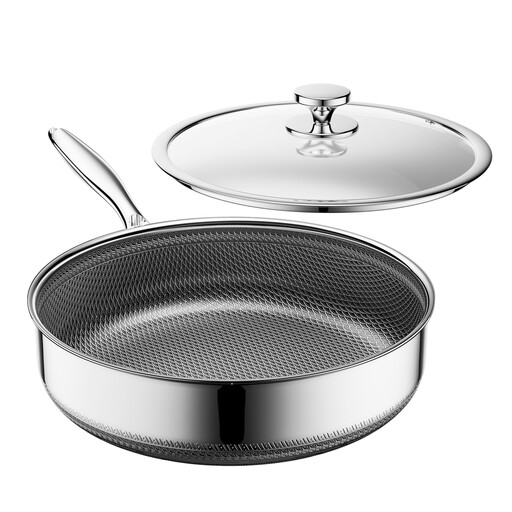
Why this product suits this profile: This model combines stainless steel, a ceramic coating, a lid and oven use up to 260 °C, making it a versatile choice for everyday cooking.
The product information gives separate temperature limits for the pan itself, up to 260 °C, and the glass lid, up to 148 °C. This makes it easier to plan how to use the pan in the oven.
According to the product information, the coating is free from PFAS, PTFE and PFOA. The pan is compatible with all standard hob types and is dishwasher-safe.
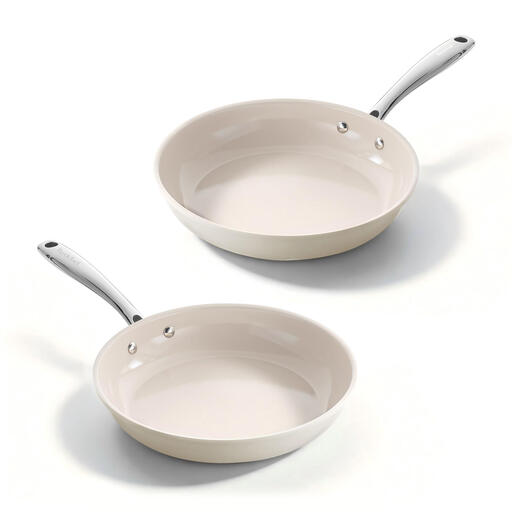
Why this product suits this profile: Two sizes cover smaller portions and everyday pan-fried dishes. This set is ideal if you often switch between different pan diameters.
The product description lists compatibility with induction, gas and electric hobs, as well as oven safety up to 842 °F. According to the product information, the pans can be cleaned in the dishwasher, although hand-washing is recommended to help protect them.
Forged aluminium body, ceramic non-stick coating, riveted stainless steel handles and two pan sizes; described as PFAS-free in the product information.
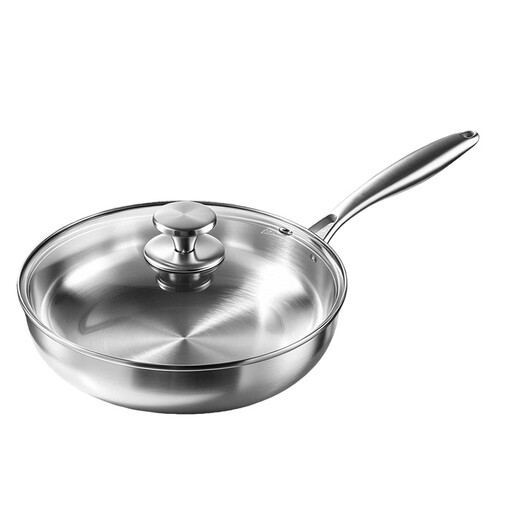
Why this product suits this profile: The uncoated surface is a good option if you’d rather avoid a non-stick coating and are happy to use the right preheating and oiling techniques.
The product information explicitly identifies the cooking surface as uncoated 304 stainless steel. There’s no ambiguity about it having a supposed non-stick coating.
Tri-Ply construction with stainless steel and an aluminium core, suitable for induction, gas, electric, ceramic and halogen hobs; listed as dishwasher-safe.
We’ve put together a comprehensive, regularly updated list of products that meet these strict selection criteria and fully comply with the safety regulations in force in the EU.
Choose a pan with a magnetic base. For coated aluminium models, the technical information should explicitly state that they’re ‘suitable for induction’. A small magnet can give you an initial indication when checking a pan you already own, but it’s no substitute for the manufacturer’s information.
Its lifespan depends on the temperature, how it’s cleaned and the utensils you use. Metal utensils, overheating an empty pan, sudden temperature changes and abrasive cleaning products can all damage the coating. Use wooden or silicone utensils where possible, don’t heat the pan when it’s empty and let it cool before washing.
Energy use depends more on the pan’s diameter, the type of hob and the temperature than on the material alone. A pan that distributes heat evenly can help you make better use of it. Stainless steel usually needs a little more attention when preheating, while a non-stick pan makes it easier to cook delicate foods. The right choice depends on whether easy cleaning, a coating-free surface or versatility matters most to you.