
Lieferung heute & morgen

Qualitätsgarantie

Willkommens-Angebote freischalten: KOSTENLOSE Lieferung | Bis zu 80 % RABATT | Kostenlose 30-Tage-JoyPlus-Testphase
App herunterladen
A new frying pan should heat evenly, suit your hob and avoid creating more work in everyday use than necessary. In practice, unclear product information, unsuitable coatings or choosing the wrong size can quickly lead to disappointing purchases. Three points are particularly often underestimated:
Checking these aspects before buying makes it easier to compare stainless steel pans, coated pans, cast-iron pans and other options.
A stainless steel pan without a coating is resistant to metal utensils and suitable for searing. Models with a multi-layer construction, such as stainless steel-aluminium-stainless steel, can distribute heat more evenly than simple single-layer versions. With uncoated surfaces, using the right technique is important: preheat the pan first, then add oil and control the temperature. Otherwise, food may stick more easily.
Stainless steel is also taste-neutral and generally practical for acidic ingredients. Nevertheless, information confirming suitability for food contact should be clearly documented in the product details. Labelling in accordance with EU Regulation (EC) No 1935/2004 is relevant for materials that come into contact with food.
A coated pan makes it easier to prepare eggs, pancakes and delicate foods. The smooth surface often requires less fat and can usually be cleaned with a soft sponge. At the same time, users should observe the temperature limits. A non-stick pan must not be heated empty on a high setting for an extended period.
For ceramic or mineral coatings, look for specific information such as PTFE-free or PFOA-free. Such statements refer to the individual product specification and should not be interpreted as indicating any medical effect. For a longer service life, use wooden or silicone turners. Whether a pan is dishwasher-safe must always be checked for the specific model.
A cast-iron pan retains heat for a long time and is suitable for vigorous searing and slow cooking. However, uncoated cast iron requires more care: after washing, the pan must be dried completely and often lightly oiled. Without seasoning, the surface may be more prone to sticking, and damp storage can cause rust.
Enameled cast iron is easier to care for than an uncoated cast-iron pan, but it remains heavy. On glass and ceramic hobs, the pan should be placed down carefully and never slid across the surface.
A 24 cm pan is suitable for smaller households, individual portions and compact hobs. A 26 cm pan offers a good balance between cooking surface and weight. A 28 cm pan is practical for several portions, but requires sufficient storage space and a suitably sized cooking zone.
Important: the stated diameter usually refers to the top rim, not the actual base of the pan. For even heat transfer, the base should match the cooking zone as closely as possible.
An induction pan requires a magnetic, flat-contact base. Gas, electric, ceramic and halogen hobs have different requirements, although many modern models are approved for all of these hob types. The specification “suitable for induction” should be stated explicitly in the technical details.
Oven suitability also does not depend solely on the material. Plastic or wooden handles may restrict use in the oven. Glass lids often have their own temperature limits. A frying pan with a lid is practical for braising and finishing dishes, but may be heavier and take up more storage space.
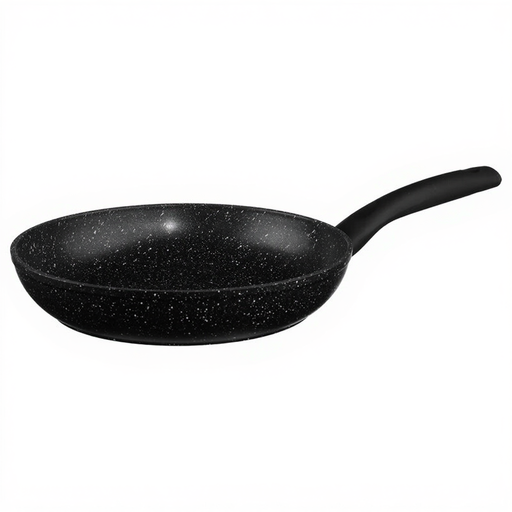
Why this product suits this profile: The 26 cm forged aluminium pan is designed for easy handling and, according to the product information, features a three-layer non-stick system and a stainless steel base.
The product details specify exact dimensions, a weight of 0.75 kg and a cool-touch Bakelite handle. This makes it easier to assess how practical it will be for everyday use before buying.
26 cm diameter, stainless steel base and low stated weight. Hand washing is recommended.
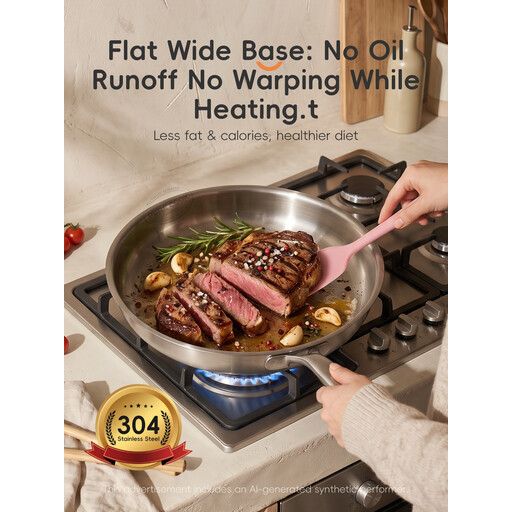
Why this product suits this profile: According to the product description, the uncoated stainless steel pan has a three-layer construction made from stainless steel and aluminium, and is suitable for gas, induction, ceramic and halogen hobs.
The material construction and hob compatibility are clearly specified. This product variant is supplied without a lid, preventing misunderstandings about the included features.
304 stainless steel, Tri-Ply construction and, according to the product information, dishwasher-safe. The stated oven limit is 220 °F; this specification should be checked before using the pan in the oven.
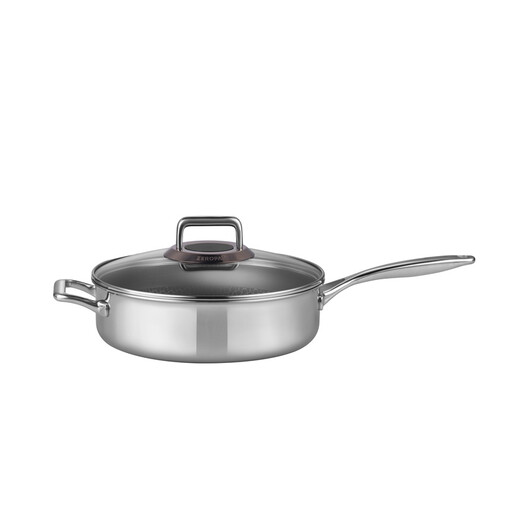
Why this product suits this profile: This deep 26 cm pan combines a stainless steel body with a honeycomb structure and, according to the product description, is suitable for frying, sautéing and dishes with a higher liquid content.
The specifications state clear limits: oven use up to 260 °C and compatibility with gas, electric, ceramic, halogen and induction hobs. Nevertheless, the coating should be treated in accordance with the care instructions.
Three-layer base with an aluminium core, deep design and, according to the product information, dishwasher-safe as well as PFAS-, PTFE- and PFOA-free.
We have put together a complete, regularly updated list of products that fully meet these strict selection criteria and the safety regulations applicable in the EU.
A 26 cm pan is often suitable for two to three portions. For smaller quantities or one or two people, a 24 cm pan may be sufficient. If you regularly cook larger quantities, choose a 28 cm pan and check that the cooking zone is large enough.
It requires a little more temperature control than a non-stick pan. Preheating, using enough fat and cooking over medium heat all help to reduce sticking. In return, the surface is more resistant to suitable metal utensils and does not require coating-specific care.
It is not possible to give a reliable general service life. This depends on the temperature, cleaning method, stacking and kitchen utensils used. If scratches become visible, the coating starts to come away or the pan’s cooking performance changes noticeably, it should be replaced.