
Lieferung heute & morgen

Qualitätsgarantie

Willkommens-Angebote freischalten: KOSTENLOSE Lieferung | Bis zu 80 % RABATT | Kostenlose 30-Tage-JoyPlus-Testphase
App herunterladen
A frying pan needs to suit your hob, cooking style and the level of maintenance you are prepared to handle at home. Focusing only on advertised non-stick performance or an especially high temperature rating can mean overlooking important details. A frying pan for induction, for example, requires a suitable ferromagnetic base, while a coated surface has different care requirements from stainless steel or carbon steel.
A coated frying pan makes it easier to prepare eggs, fish and pancakes. However, prolonged heating when empty, very high temperatures and metal turners can damage the surface. Terms such as ‘heat-resistant’ do not always apply to the entire construction either: the pan body may withstand higher temperatures than the handle or lid.
With a ceramic frying pan, you should therefore check whether it is actually made from ceramic or whether only an aluminium body has a ceramic coating. The latter is the case with many modern models.
A 24 cm frying pan is suitable for smaller portions, side dishes or households with limited space. However, the stated diameter usually refers to the top rim. The actual heated base may be smaller.
A 28 cm frying pan provides more room for several portions, but requires a sufficiently large hob and is usually heavier. This size can be more practical for sautéing, larger cuts of meat or family portions. A 32-cm pan, on the other hand, may not heat evenly on every hob.
A dishwasher-safe frying pan is convenient for everyday use, but manufacturers still recommend hand washing for many coated models to protect the surface over the long term. An uncoated frying pan made from carbon steel or cast iron, on the other hand, will generally need seasoning, immediate drying and an occasional thin coating of oil.
If you do not want to plan for this level of care, stainless steel or an easy-care coating may be the better choice.
With uncoated pans, ‘without a chemical non-stick coating’ does not mean ‘maintenance-free’. Stainless steel may initially be more prone to sticking, while carbon steel and cast iron require suitable preparation.
For a frying pan for induction, the product description must explicitly state that it is suitable for induction. You should also ensure that the base diameter matches the hob. A multi-layer construction made from stainless steel and aluminium can improve heat distribution. However, if the hob is too small, the area around the edge may remain cooler.
You should also check:
A frying pan with lid is practical for braising, sauces and finishing dishes. A deep frying pan offers more capacity and can sometimes be used as a sauté pan or braising pan. However, it is heavier and requires more storage space.
A glass lid allows you to monitor your food, while a permanently attached metal handle can make it easier to move the pan from the hob to the oven. Always check the lid’s separate temperature limit. With some models, the lid must be removed before using the pan in the oven.
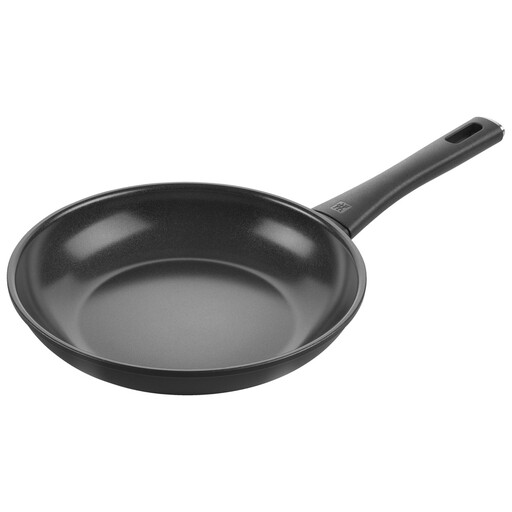
Why this product suits this profile: This 24-cm forged aluminium pan is designed for smaller households and everyday dishes. According to the product description, the CeraForce coating is PTFE- and PFOA-free and suitable for induction.
The product data specifies clear limits: use at low to medium heat, no prolonged heating when empty and no metal utensils. This makes the care requirements clear.
Fast heat conduction thanks to aluminium, induction compatibility and a stated oven-safe temperature of up to 250 °C.
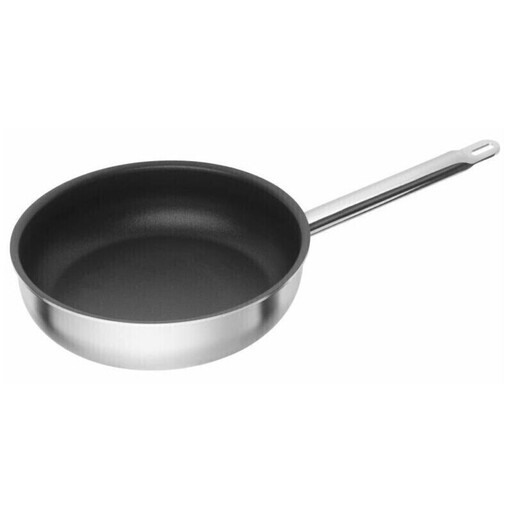
Why this product suits this profile: This 28-cm pan combines a three-layer SIGMA-Clad construction with an aluminium core and Duraslide Ultra PTFE coating. It is designed for induction and other common hob types.
The stated oven limit of 230 °C provides a clear guideline. Hand washing, soft sponges and heat-resistant plastic, wooden or silicone utensils are recommended.
Large cooking surface, even heat distribution thanks to the multi-layer construction and oven suitability up to 230 °C.
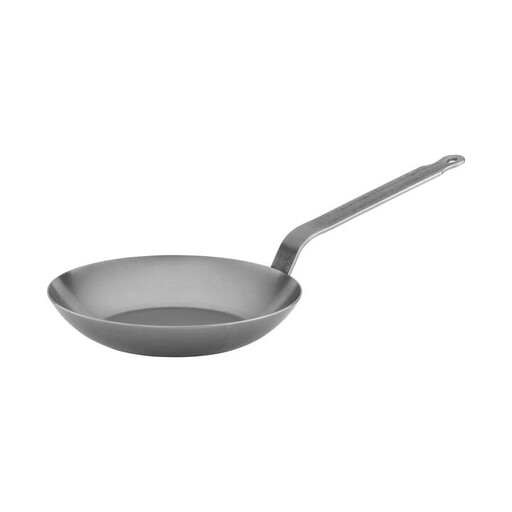
Why this product suits this profile: This uncoated carbon steel pan is designed for searing and high hob temperatures. With use, it can develop a patina that helps reduce sticking.
The product information explicitly recommends seasoning, immediate drying, oiling and avoiding the dishwasher. The maintenance required is therefore not hidden behind a coating.
Suitable for high temperatures, a steel handle for oven use and compatibility with induction, gas, ceramic hobs and open flames.
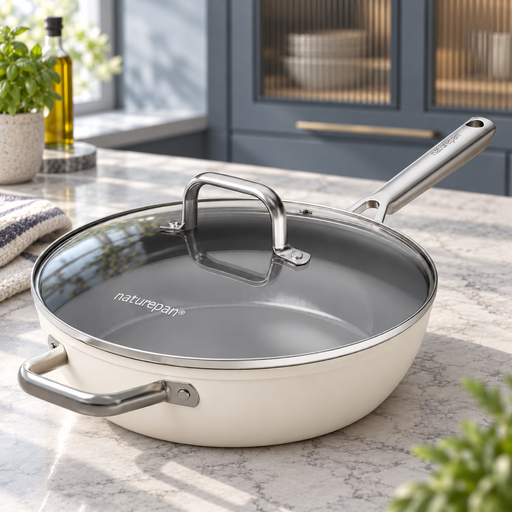
Why this product suits this profile: The 7.5-cm-high sides and supplied lid are ideal for sauces, vegetables, braising and dishes with a larger volume. According to the product data, it is designed for induction, gas, electric and ceramic hobs.
The pan is stated to be oven-safe up to 230 °C, but only without the lid. Low to medium heat, hand washing and soft kitchen utensils are also recommended.
Deep design, matching glass lid and suitability for several hob types.
We have put together a complete, regularly updated list of products that fully meet these strict selection criteria and the safety regulations applicable in the EU.
The service life of a frying pan depends largely on its material and how it is treated. The following basic rules generally apply to coated models:
Stainless steel, carbon steel and cast iron often tolerate metal turners better, but are not automatically dishwasher-safe. Carbon steel and uncoated cast iron should be dried immediately after cleaning and lightly oiled. A small cast iron pan such as the Maxcook Cast Iron Skillet with a 10 cm diameter is designed for individual portions, sauces or side dishes; according to the product information, it is not suitable for the dishwasher.
The decisive factor is the hob compatibility explicitly stated by the manufacturer. For a frying pan for induction, the base should also sit as flat as possible and match the diameter of the hob. The product description is more reliable than making assumptions based on the material alone.
24 cm is often suitable for one or two portions. 28 cm provides more room for family meals and several ingredients. On small hobs, a 24-cm pan may heat more evenly. The base area and weight are also important factors.
Stainless steel, carbon steel and cast iron require the right preheating technique. First heat the pan, then add the oil. With carbon steel and cast iron, a well-maintained patina or seasoning layer is also important. Acidic foods should not be cooked for long periods in carbon steel or uncoated cast iron.