
Lieferung heute & morgen

Qualitätsgarantie

Willkommens-Angebote freischalten: KOSTENLOSE Lieferung | Bis zu 80 % RABATT | Kostenlose 30-Tage-JoyPlus-Testphase
App herunterladen
A frying pan with lid lets you sear, sauté, braise and steam with one piece of cookware. Even so, the sheer choice doesn’t automatically lead to the right pick. Marketing terms like “non-stick”, “for all hobs” or “dishwasher-safe” need a closer look in the product spec sheet. What really matters are true hob compatibility, the diameter, care instructions and the material of the cooking surface.
A pan can be suitable for gas, electric and ceramic hobs yet not work on induction. An induction pan needs a magnetic base. So look for an explicit claim of compatibility with induction, gas, electric and ceramic hobs. If you move home or share a kitchen with different hob types, this detail prevents a bad buy.
A non-stick frying pan can make food release easier and simplify cleaning. Claims like “non-toxic” or “free from harmful substances” shouldn’t be taken at face value. More meaningful are concrete statements such as PFAS-, PFOS-, PFOA- or PTFE-free, provided the seller explicitly says so. That does not imply any medical benefit, nor does it mean the coating is indestructible.
With a ceramic frying pan, there are special care rules: no metal spatulas, no scouring agents, and don’t heat an empty pan on high. A damaged or flaking coating should not be used.
The 28 cm figure usually refers to the top rim, not necessarily the heated base. Your choice should also consider the hob-ring size, height and capacity. A small 20 cm frying pan is better for one to two portions or sauces. 24 cm is handy for smaller households and versatile everyday dishes. A 28 cm frying pan gives you more space for multiple portions, but it takes up more storage and can be heavy when full.
Aluminium heats up relatively quickly and is often paired with a non-stick coating. Cast aluminium can help deliver stable, even heat distribution. Multi-layer stainless-steel pans, for example with an aluminium core, combine a stainless surface with a conductive middle layer. The PURECOOK Tri-Ply and the Maxcook pan are described as using 304 stainless steel with an aluminium core.
A stainless-steel frying pan does without a traditional non-stick layer. It’s generally less sensitive to kitchen utensils, but it does require the right control of temperature and fat when frying. Especially with eggs, fish or pancakes, cleaning can be more work if the pan wasn’t properly preheated.
With a non-stick frying pan, check what utensils are allowed. Wood, silicone or plastic tools reduce the risk of scratches. Even if a pan is described as dishwasher-safe, handwashing can be kinder to the coating day to day. Care needs differ for uncoated stainless-steel models too; abrasive pads and steel wool can also damage that surface.
A transparent glass lid makes it easier to keep an eye on things and, when braising or steaming, helps retain heat and moisture in the pan. The lid knob and pan handle can get hot during cooking. Oven suitability must be considered separately for the pan and the lid. For the ZEROPAN model, for example, the pan is oven-safe up to 260 °C and the glass lid up to 148 °C.
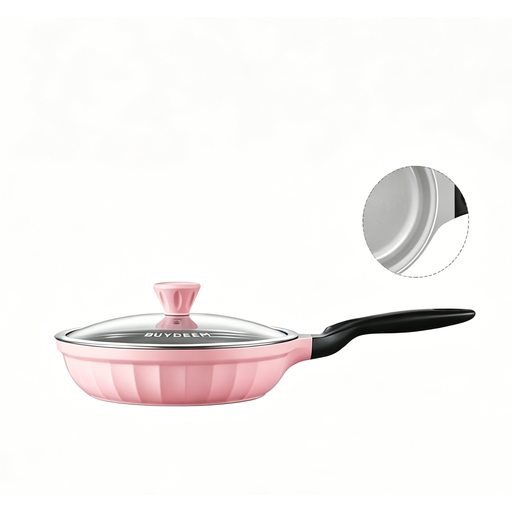
Why this product fits the profile: The 26 cm pan with 2.4 l capacity is designed for everyday meals and around three to four portions. According to the description, it’s suitable for gas, electric, ceramic and induction hobs.
Hob compatibility and capacity are stated clearly. The ceramic coating is described by the seller as PFAS-, PFOS- and PFOA-free.
Cast aluminium, glass lid and a stay-cool handle according to the product details; handwash with a soft sponge is recommended.
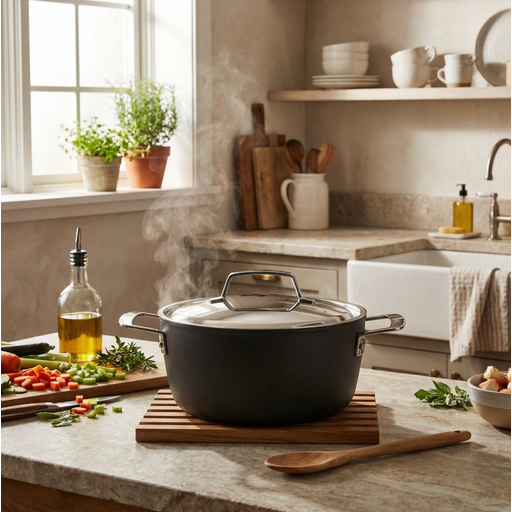
Why this product fits the profile: The 24 cm size is a well-balanced choice for smaller households. The pan features an aluminium body, titanium non-stick coating, glass lid and a 4.3 l capacity.
The listing states a maximum temperature of 230 °C and gives specific guidance against heating empty and using metal utensils.
Described as suitable for all common hob types including induction; dishwasher-safe and oven-safe according to the product data.
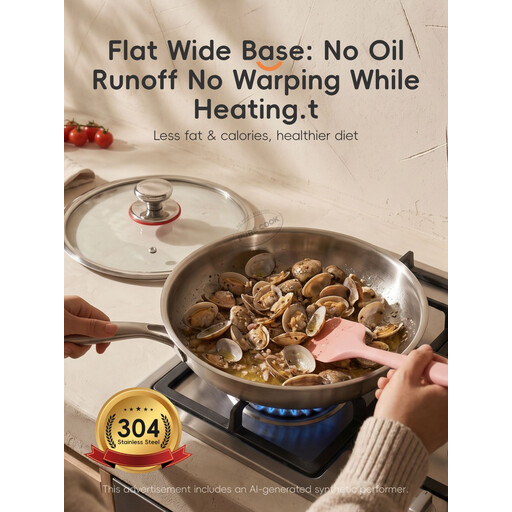
Why this product fits the profile: The large cooking surface suits multiple portions as well as frying and braising. Its three-layer build with aluminium core is listed as suitable for gas, induction, ceramic and halogen hobs.
The surface is described as uncoated. That removes the need to choose a non-stick layer; you’ll still need good temperature control when frying.
304 stainless steel, glass lid and dishwasher-safe according to the product data; the manufacturer also claims a scratch-resistant surface.
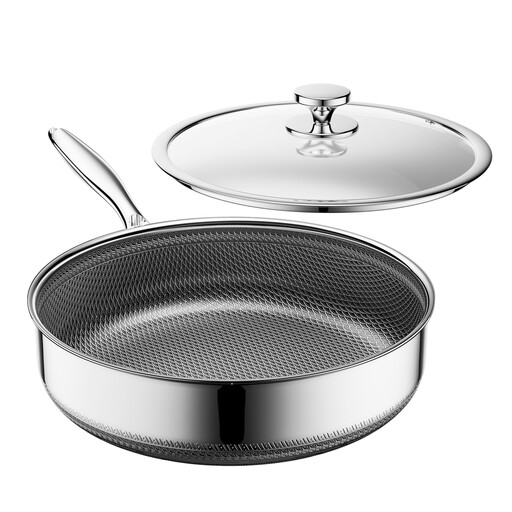
Why this product fits the profile: The deep shape is great for braises, sauces and larger batches. The hybrid surface combines stainless steel and a ceramic coating; the seller states it’s suitable for all the hob types mentioned.
The description states a PFAS-, PTFE- and PFOA-free coating, plus separate temperature limits for the pan and the lid.
Oven-safe up to 260 °C for the pan, glass lid up to 148 °C, and dishwasher-safe according to the seller.
We’ve put together a complete, continuously updated list of products that fully meet these strict selection criteria and comply with EU safety regulations.
A 20 cm frying pan is enough for small portions, eggs or sides. For two people with more room to turn food, a 24 cm pan is usually more practical. If you regularly cook multiple portions or braises, choose 26 to 28 cm.
No. Suitability depends on the model. Some products are labelled as a dishwasher-safe frying pan, others must be cleaned by hand only. Even if permitted, handwashing can help protect the coating in everyday use.
Check that the manufacturer explicitly mentions induction and that the base sits flat. A pan for all hobs should explicitly list gas, electric, ceramic and induction. The base diameter must also match the hob zone so heat is transferred as evenly as possible.