
Lieferung heute & morgen

Qualitätsgarantie

Willkommens-Angebote freischalten: KOSTENLOSE Lieferung | Bis zu 80 % RABATT | Kostenlose 30-Tage-JoyPlus-Testphase
App herunterladen
A frying pan set can replace several individual pans and make your kitchen kit more streamlined. However, a low price or the term "non-stick" doesn't automatically mean you're making the right choice. What really counts is hob compatibility, material, coating, pan sizes and the actual permitted cleaning temperature.
Joybuy's Product Recommendation Officer filters the most important product details and highlights which features are relevant for everyday cooking in British kitchens. This helps you avoid typical buying mistakes without relying solely on marketing claims.
With an induction frying pan set, the induction suitability should be explicitly stated in the product details. An aluminium body alone is not magnetic and therefore won't automatically work on an induction hob. Look for a closed, induction-compatible base surface and also check whether gas, electric and ceramic hobs are mentioned.
Compatibility can differ for halogen or infrared hobs. If these hob types are relevant to you, check the manufacturer's specification before purchasing.
Coated frying pans are often made from aluminium with a non-stick layer applied. This is not the same as a pan made from solid ceramic material. Terms like granite, stone or titanium coating don't automatically describe the complete material construction either.
With ceramic frying pans, it's therefore important to know whether a ceramic non-stick coating on aluminium is actually meant, or a different construction. Claims like "PFAS-free pans" or "PFOA-free" should refer to the specific product description or labelling. According to the product details, for example, the USELUCK-Lebof set is stated to be free from PFAS, PFOA and PTFE. Such a claim doesn't replace checking the care instructions and temperature limits.
"Dishwasher-safe" doesn't mean the coating will remain unchanged after frequent machine washing. Despite this suitability, many product descriptions still recommend hand washing with mild detergent and a soft sponge.
Oven-safe pans also often have limitations: with a Naturepan set, the temperature rating of up to 230 °C applies to the pan body; lids should be removed before use in the oven. Plastic handles can have a significantly lower temperature limit. Before buying and before each use, you must therefore consider the body, handle and lid separately.
Non-stick pans are particularly suitable for delicate foods such as eggs, pancakes or fish. However, a non-stick coating is not a licence for consistently high heat. Many manufacturers recommend low to medium temperatures and warn against prolonged heating when empty.
Use wooden, silicone or nylon utensils unless the manufacturer states otherwise. Metal utensils can scratch the surface. A damaged coating should not be subjected to further heavy use.
An aluminium pan set is usually lighter than cast iron and heats up relatively quickly. However, heat distribution depends on the base construction and material thickness. For induction, a suitable capsule or fully clad base is required.
The combination of a 24 cm and 28 cm pan set covers many everyday situations: 24 cm is suitable for smaller portions, side dishes or one to two people; 28 cm offers more surface area for larger quantities. When checking, don't just look at the top diameter, but also the base diameter. A pan base of 19.1 cm on a 24 cm pan, for example, fits smaller cooking zones, while a base of 22.3 cm on a 28 cm pan makes better use of more surface area.
A 20 cm, 24 cm and 28 cm pan set is more flexible if you regularly prepare different-sized portions. The 20 cm pan can be used for single eggs, small side dishes or warming up small amounts. However, a three-piece set requires more storage space.
With dishwasher-safe frying pans, you should follow the manufacturer's recommendation: hand washing with a soft sponge can preserve the coating for longer. Allow the pan to cool naturally before cleaning and avoid sudden temperature changes.
Also check whether the handle is firmly attached, removable or oven-safe. Metal handles can usually withstand higher oven temperatures; plastic or wooden handles often have limitations. During and after cooking, the pan and handle become hot. Oven gloves or mitts are essential.
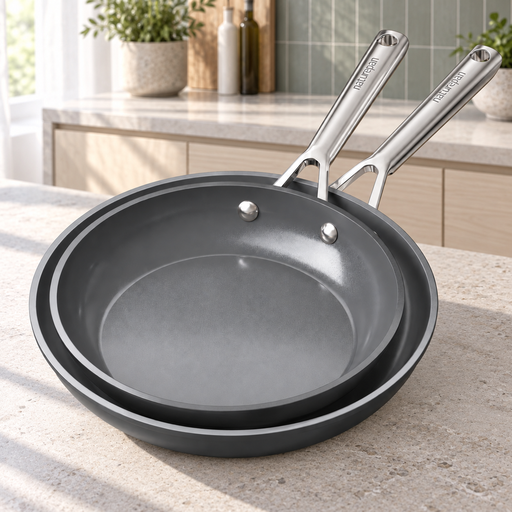
Why this product fits the profile: The two-piece set focuses on two commonly used sizes and is stated to be suitable for induction, gas, electric and ceramic hobs.
The hob compatibility and the pan body's temperature limit of up to 230 °C are clearly stated.
Aluminium body, ceramic non-stick coating, 24 cm and 28 cm sizes, and stainless steel handles.
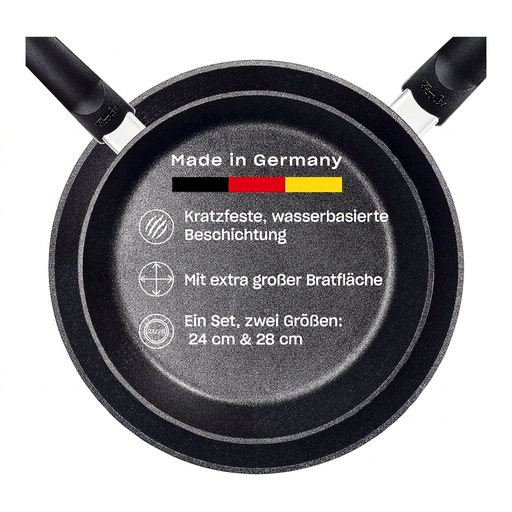
Why this product fits the profile: The set combines two standard sizes with a scratch-resistant aluminium construction and stated suitability for induction.
The product description specifies material, coating, dimensions and hob type, rather than relying on generic non-stick terms.
24 cm and 28 cm pans, aluminium body, non-stick coating and manufactured in Germany according to the product details.

Why this product fits the profile: The three sizes – 20, 24 and 28 cm – offer flexibility for single portions, side dishes and larger meals.
The product details specify specific hob types, dishwasher suitability and an oven temperature of up to 842 °F or approximately 450 °C.
Three-piece set, ceramic coating, forged aluminium body and riveted stainless steel handles according to the product description.
We've put together a complete, regularly updated list of products that fully meet these strict selection criteria and the safety regulations in force in the EU.
The lifespan depends on the coating construction, temperature, cleaning method and frequency of use. A general guarantee of years is therefore not reliable. Visible scratches, chipping or a noticeably changed surface are reasons to replace the pan.
For many households, 24 cm and 28 cm are sufficient. A 20 cm, 24 cm and 28 cm pan set is more versatile but requires more storage space. Also crucial are the actual base diameters and the size of your cooking zones.
No. "Ceramic" initially describes the type of coating, not automatically the complete absence of certain substances. Look for a specific manufacturer statement such as "PFAS-free", "PFOA-free" or "PTFE-free" for the particular product.
No. Check the permitted temperature for the pan body, handle and lid separately. With some sets, only the body is oven-safe; plastic handles or lids may be excluded.