
Lieferung heute & morgen

Qualitätsgarantie

Willkommens-Angebote freischalten: KOSTENLOSE Lieferung | Bis zu 80 % RABATT | Kostenlose 30-Tage-JoyPlus-Testphase
App herunterladen
A frying pan with a lid can combine frying, braising, sautéing and reheating in one piece of cookware. However, eye-catching product claims do not automatically mean you are making the right choice. What matters are the technical details that are genuinely relevant in everyday use: hob compatibility, capacity, type of coating, cleaning and lid design.
A frying pan may be advertised as suitable for gas, electric, ceramic and induction hobs. However, an induction frying pan requires a magnetic base. Without a clear reference to induction or a magnetic stainless-steel base, the hob compatibility information is incomplete.
The size of the base also matters. A 28 cm rim does not necessarily mean that the entire base sits evenly on the hob. This is particularly important with induction, where the base should match the cooking zone.
Terms such as “healthy”, “naturally non-stick” or “stone coating” are not, on their own, a technical classification. Instead, check which coating is specifically stated and whether the manufacturer provides information about PTFE, PFOA, PFAS or PFOS.
A ceramic-coated frying pan, for example, may include a corresponding material specification. However, this does not indicate how long the surface will last if the pan is used incorrectly. Heating an empty pan to excessive temperatures, using metal turners and using abrasive cleaners can damage coatings. Statements about material composition should therefore always be understood as manufacturer information.
A frying pan with a glass lid makes it easier to monitor the food without heat and liquid escaping through frequent removal of the lid. A sturdy handle, a suitable seal or clean rim closure, and the stated temperature resistance are also important.
Not every glass lid is suitable for oven use. With some models, the pan is oven-safe but the lid is only suitable up to a lower temperature. These values must be considered separately.
A frying pan for all hob types should be explicitly approved for the cooking technology you have at home. For induction, specifications such as “magnetic stainless-steel base”, “induction base” or “induction-compatible” are relevant. Even heat distribution is helpful on gas hobs, while on ceramic and electric hobs, a flat base that sits evenly is a practical requirement.
Multi-layer bases, such as those made from stainless steel and aluminium, can distribute heat more quickly. With a traditional stainless-steel frying pan, you need a little more experience when preheating and adding fat, as food can stick more easily than in a non-stick frying pan.
For a household of two to three people, 24 to 28 cm is often a practical size. A diameter of 28 to 30 cm provides more room for vegetables, meat or pasta dishes, but also requires more storage space and a suitably large cooking zone.
Also pay attention to the height of the rim. A shallow non-stick frying pan is suitable for pancakes, eggs or quickly fried food. A deeper braising pan or serving pan is useful when you want to cook liquid, vegetables and larger portions together. A wok-style frying pan with a lid is suitable for sautéing, braising and larger quantities, provided that the shape of the base is compatible with your hob.
When choosing a non-stick frying pan, check the following:
Silicone, wooden or plastic turners reduce the risk of scratches on coated surfaces. Stainless-steel models are generally less sensitive to suitable metal utensils, but food can stick more readily if the temperature is not controlled correctly.
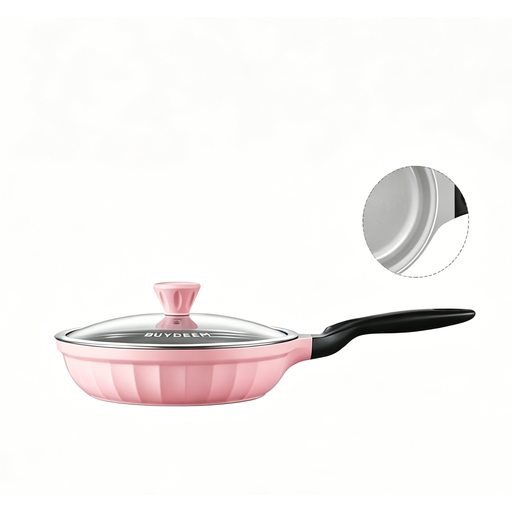
Why this product suits this profile: According to the product information, the 26 cm pan has a capacity of 2.4 litres, is designed for around three to four portions, and is suitable for gas, electric, ceramic and induction hobs. The ceramic coating and glass lid cover typical everyday cooking tasks.
The manufacturer’s information specifies the hob types and advises hand washing, soft sponges and avoiding metal utensils. This makes the key care limitations clear.
Aluminium body described as similar to cast iron, 2.4-litre capacity, glass lid and compatibility with several hob types.
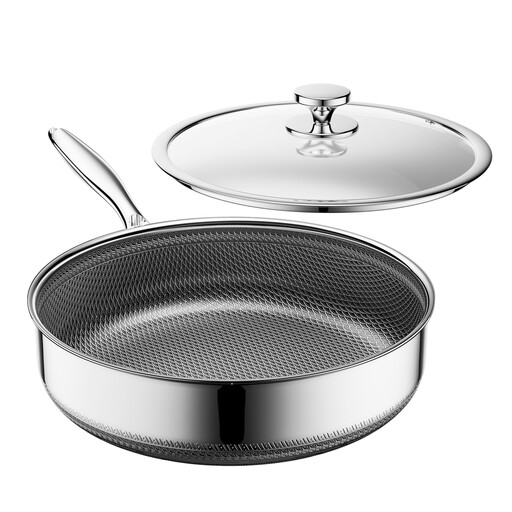
Why this product suits this profile: According to the product description, the deep stainless-steel pan with ceramic coating is suitable for gas, electric, ceramic, halogen and induction hobs. It can be used in the oven up to 260 °C, while the lid is suitable up to 148 °C.
The different temperature limits for the pan and glass lid are clearly stated. This prevents the common assumption that every covered piece of cookware is automatically fully oven-safe.
Stainless-steel and ceramic combination, glass lid, stated oven suitability and dishwasher compatibility.
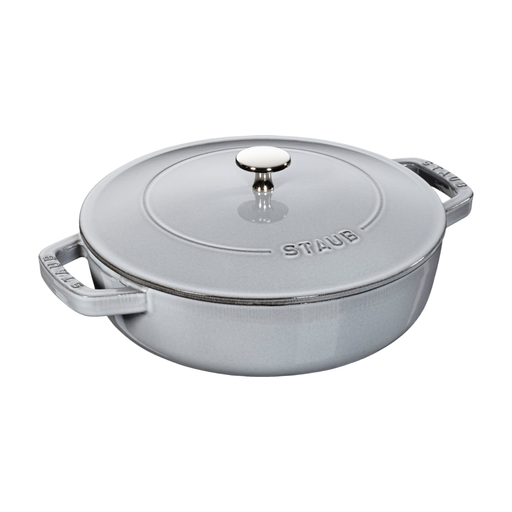
Why this product suits this profile: The enamelled cast-iron pot, with a diameter of 28 cm and a capacity of 3.7 litres, is designed for braising, slow cooking and serving. According to the product description, it works on all common hob types, including induction, and in the oven up to 260 °C.
Rather than relying on a coating as the only solution, this model uses enamelled cast iron. Its weight of 5.4 kg should be taken into account before purchase and during everyday handling.
3.7-litre capacity, suitable for hob and oven use, and a lid design with condensation return, according to the product information.
We have put together a complete, regularly updated list of products that fully meet these strict selection criteria and the safety regulations applicable in the EU.
For smaller households, 24 to 26 cm is often sufficient. A 28 cm pan is suitable for several portions and family meals. With high sides or a capacity of around three litres or more, the pan can also be used for braising and one-pot dishes.
Only if the manufacturer explicitly states that it is induction-compatible. A coating alone says nothing about the base. You should therefore check the information about the hob type and magnetic base plate.
Its service life depends on the coating, temperature, cleaning method and utensils used. Gentle heat, avoiding metal utensils and hand washing can be less demanding on the surface. Without specific guarantee or care information, it is not possible to give a reliable general lifespan.