
Lieferung heute & morgen

Qualitätsgarantie

Willkommens-Angebote freischalten: KOSTENLOSE Lieferung | Bis zu 80 % RABATT | Kostenlose 30-Tage-JoyPlus-Testphase
App herunterladen
A frying pan with lid has to pull its weight in the British kitchen: sautéing vegetables, braising meat, reducing sauces or whipping up a quick one-pot meal. In practice, though, it’s often only after you’ve bought it that you discover whether the coating, hob compatibility and cleaning routine actually suit your everyday cooking.
A coated frying pan can be finished with PTFE, ceramic, titanium or quartz. Terms like “granite” or “stone-effect” don’t automatically tell you what the material is. What really matters are the manufacturer’s specific details about PFAS, PTFE, PFOA and the recommended usage.
With a PFAS-free pan, you should check whether the claim applies to the entire coating or only to certain added substances. “PFOA-free” is also a narrower statement and doesn’t automatically mean PFAS-free.
A lid may be fine for hob cooking but have a different maximum temperature to the pan itself. With an oven-safe model, you therefore need to note two values: the temperature limit of the oven-safe frying pan and that of the lid. Plastic or Bakelite handles can further restrict use in the oven.
An induction frying pan needs a magnetic base. On gas, electric and ceramic hobs, the construction of the base is also important to ensure heat is transferred as evenly as possible. A multi-layer base with an aluminium core can improve heat distribution, while cast iron or solid aluminium have different properties when it comes to weight and heat retention.
A non-stick frying pan makes it easier to release delicate foods like eggs, pancakes or fish. Coated models should generally never be heated empty on a high setting. Wooden, silicone or nylon utensils reduce the risk of scratches.
Ceramic pans are often sold without intentionally added PFAS, PTFE or PFOA. These claims should be understood as manufacturer statements and checked in the respective product details. A ceramic coating isn’t automatically dishwasher-safe; gentle hand washing often extends the life of the surface.
A 28 cm frying pan offers a large enough surface for several portions and fits well in most households. For smaller quantities, 24 to 26 cm is more manageable. A deep frying pan or sauté pan is useful if you need room for liquids, vegetables or larger ingredients alongside the frying.
Pay attention to the usable internal diameter, not just the external measurements. A high rim increases versatility but can make the pan heavier. For two to three people, a capacity of around 2 to 4 litres is usually practical for everyday use.
A glass lid for a frying pan lets you keep an eye on things without having to lift it off regularly. A steam vent can reduce pressure inside. Also check whether the handle is removable and whether the pan is listed as dishwasher-safe in the product details.
“Dishwasher-safe” doesn’t necessarily mean the coating will stay unchanged in the long term. For coated pans, hand washing with a soft sponge is usually the gentler option for the material.
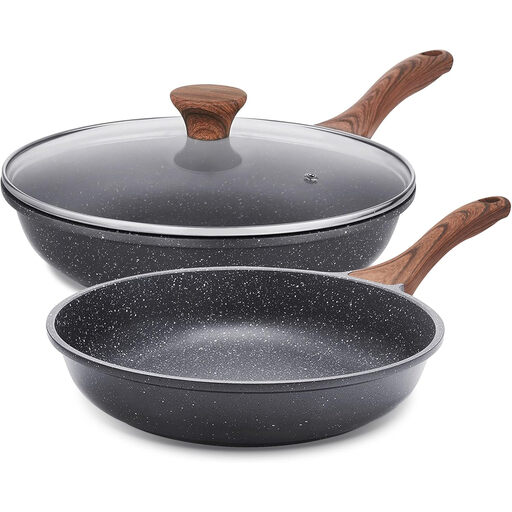
Why this product fits the profile: The set combines an 8-inch omelette pan with an 11-inch frying pan with glass lid, covering different portion sizes.
According to the product details, the pan has a magnetic stainless steel base for induction, gas and electric hobs. The stated temperature limit is 400 °F.
Quartz/granite coating as per the product description, glass lid and stated dishwasher suitability. Several substances are listed as not intentionally added to the coating.
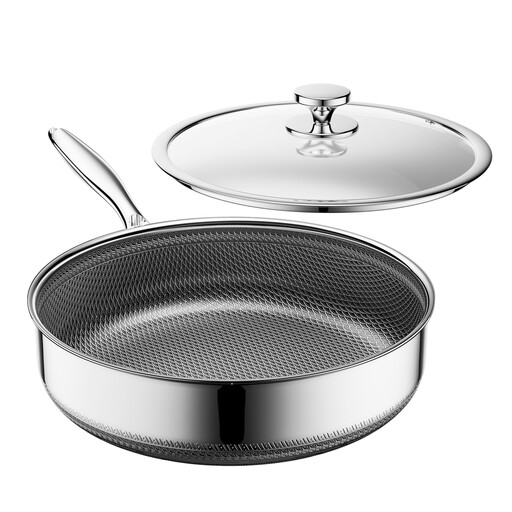
Why this product fits the profile: The deep stainless steel pan with ceramic coating is designed for braising, sauces and larger quantities.
The product details state it is free from PFAS, PTFE and PFOA. Different temperature limits are also specified for the pan and the glass lid.
Stainless steel-ceramic hybrid construction, induction compatibility, oven use up to 260 °C for the pan and dishwasher suitability according to the product description.
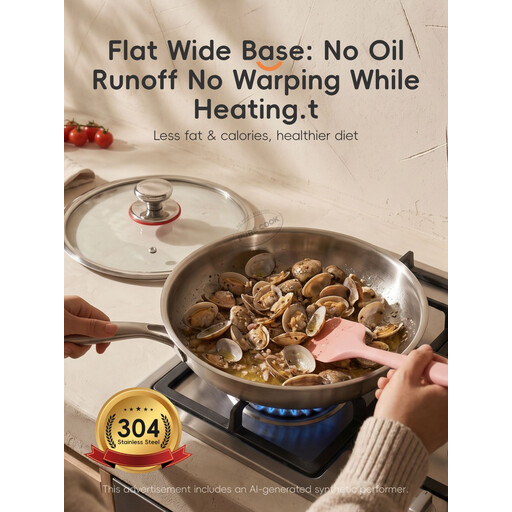
Why this product fits the profile: The uncoated stainless steel construction with aluminium core is ideal for users who want a robust pan for regular frying and braising.
Instead of a delicate non-stick layer, this model uses 304 stainless steel with an aluminium core, according to the details. This removes the need to choose suitable plastic or wooden utensils.
Tri-ply construction, 28 cm format, glass lid and compatibility with gas, induction, ceramic and halogen hobs according to the product description.
We’ve put together a full, regularly updated list of products that meet these strict selection criteria and the safety regulations in force in the EU.
A 28 cm frying pan is often good for two to four portions. For smaller kitchens or single meals, 24 to 26 cm can be more practical. A deep shape offers extra possibilities for braising and dishes with liquid.
No. Look for an explicit “induction-compatible” label or a magnetic stainless steel base. The suitability should be confirmed in the technical product data for the specific model.
The lifespan depends on heat, cleaning, the utensils you use and how often you cook. A coating can lose performance more quickly through overheating, metal cutlery or harsh cleaning. With regular use, gentle temperatures and hand washing are therefore a good idea.