
Lieferung heute & morgen

Qualitätsgarantie

Willkommens-Angebote freischalten: KOSTENLOSE Lieferung | Bis zu 80 % RABATT | Kostenlose 30-Tage-JoyPlus-Testphase
App herunterladen
A frying pan with a lid can handle searing, sautéing, braising and steaming in a single piece of cookware. However, an eye-catching product description does not automatically lead to the right purchase decision. What matters are verifiable details about hob compatibility, materials, coating, size and cleaning.
The designation frying pan for all hob types should be supported by specific information on compatibility with induction, gas, electric and ceramic hobs. Halogen or infrared hobs may require additional confirmation from the manufacturer. Aluminium bodies in particular need a magnetic stainless-steel base for the pan to work on induction.
A non-stick frying pan, ceramic pan or other coated frying pan can make cleaning easier. Nevertheless, high temperatures, prolonged empty preheating, metal utensils and sudden temperature changes can put stress on the surface. “Dishwasher-safe” also does not mean that the coating will remain unchanged after repeated dishwasher cycles. For several models, the product information recommends hand-washing even when dishwasher cleaning is technically possible.
A 28- or 32-centimetre pan requires not only sufficient space on the hob, but also adequate storage room for the lid and handle. With round pans, the usable base can be significantly smaller than the top diameter. More compact models are often more practical for one or two portions; for family meals or larger quantities, a deep sauté pan or a wok with a lid is a better choice.
Multi-layer constructions often combine stainless steel with an aluminium core. This can distribute heat more evenly across the base. One example is the three-layer construction of the PURECOOK wok, which is made from 304 stainless steel according to the product information. The WMF Multiply wok also features three material layers with an aluminium core, according to the manufacturer.
An uncoated stainless-steel pan is scratch-resistant and suitable for high temperatures. However, it requires the right cooking technique: preheat the pan, add the oil afterwards and control the temperature carefully. Excessive heat can cause food to stick and lead to discolouration.
Coated aluminium or stainless-steel models generally release food more easily. For ceramic and hybrid coatings, use kitchen utensils made from wood, silicone or nylon wherever possible. Claims such as “PFAS-free”, “PTFE-free” or “PFOA-free” should always be understood as specific product properties rather than general guarantees of quality.
A glass lid allows you to monitor the cooking process without lifting the lid. An integrated steam vent can help release steam in a controlled manner. Also check whether the lid may be used in the oven. Several products have a lower maximum temperature for the glass lid than for the pan itself.
According to the product information, “stay-cool” handles remain relatively cooler during cooking, but they can heat up during extended use or in the oven. Oven mitts or pot holders are required when handling hot cookware.
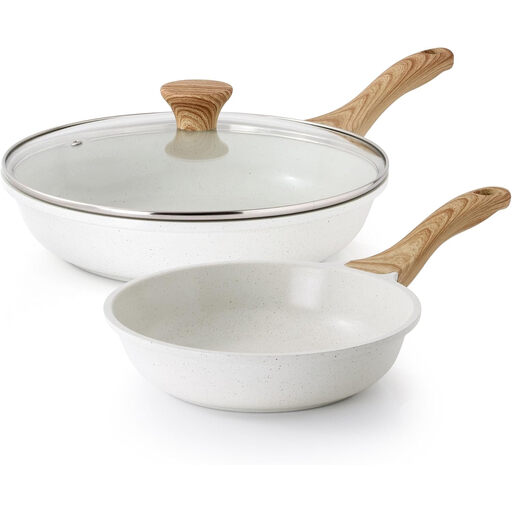
Why it fits the profile: Two sizes—20 and 28 cm—cover small and medium-sized everyday meals. According to the product information, the set is suitable for induction, gas and electric hobs.
The specifications explicitly identify the compatible hob types and recommend hand-washing. This prevents “easy to clean” from being confused with unrestricted dishwasher suitability.
Ceramic coating, glass lid and two different pan sizes; according to the product information, oven-safe up to 550 °F.

Why it fits the profile: The uncoated construction is aimed at buyers who prefer stainless steel and regularly sear or stir-fry at higher temperatures.
The product information specifies the material layers, hob compatibility and absence of a coating. This makes it clear that the user must apply the right temperature and oil technique.
Three-layer construction, metal lid with adjustable steam vent and, according to the manufacturer, compatibility with all standard hob types as well as the oven.
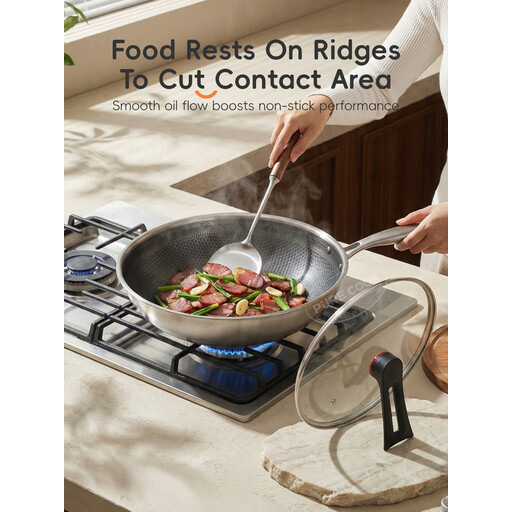
Why it fits the profile: According to the product information, the large wok is suitable for stir-frying, searing, braising and preparing larger quantities for the household.
The 32 cm diameter and compatibility with gas, induction and electric/ceramic hobs are clearly specified. Nevertheless, check the diameter of your hob before purchasing.
304 stainless steel, three-layer construction, glass lid and, according to the product information, a textured interior without a conventional chemical non-stick coating.
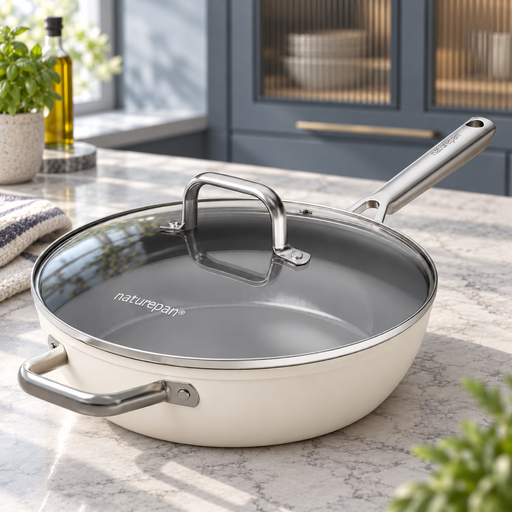
Why it fits the profile: The 28 cm sauté pan, with its 7.5 cm-high sides, is designed for sauces, vegetables, braised dishes and one-pan meals.
According to the product information, the 230 °C oven limit applies only without the lid. This distinction prevents incorrect use of the glass cover.
Ceramic-coated aluminium body, matching lid, compatibility with induction, gas, electric and ceramic hobs and, according to the product information, dishwasher suitability.
We have put together a current selection of products that take these criteria for an induction frying pan with lid into account.
Look for explicitly stated induction compatibility and a magnetic base. Aluminium or ceramic models require an integrated stainless-steel base. A magnet test can provide an initial indication, but it does not replace the manufacturer’s specifications.
That depends on the individual model. According to the product information, some stainless-steel pans and certain coated pans are dishwasher-safe. To extend the service life of the coating, hand-washing with mild detergent and a soft sponge is generally the gentler option.
There is no reliable way to specify a fixed service life. It depends on the temperature, utensils, cleaning method and frequency of use. Coatings that are damaged, flaking or noticeably deformed should no longer be used. Uncoated stainless-steel pans are less dependent on surface care, but they still require the right temperature-control technique.