
Lieferung heute & morgen

Qualitätsgarantie

Willkommens-Angebote freischalten: KOSTENLOSE Lieferung | Bis zu 80 % RABATT | Kostenlose 30-Tage-JoyPlus-Testphase
App herunterladen
A new frying pan should perform reliably every day, whether you’re frying vegetables, cooking fried eggs, searing meat or simmering a sauce. But there’s a huge range to choose from. Terms such as ‘non-stick’, ‘suitable for all hob types’ or ‘extra durable’ don’t, on their own, tell you much about how suitable a pan really is.
The following criteria will help you compare frying pans objectively and avoid common buying mistakes.
A pan with a diameter of 28 cm doesn’t necessarily have a 28 cm cooking surface. The rim, base shape and curvature can all reduce the usable area. 24 cm pans are often enough for a two-person household. Families usually choose 28 cm pans or 30 cm pans when they want to cook several portions at once.
The hob ring also needs to match the pan. If the base is much larger than the cooking zone, heat may not be distributed evenly.
A coated frying pan can make it easier to remove delicate foods. However, its coating needs the right temperature and suitable kitchen utensils. Metal turners, scouring pads and prolonged heating when empty can damage the surface.
If you’re considering a PFAS-free pan, check the specific product description. Terms such as ‘PFAS-free’, ‘PTFE-free’ and ‘PFOA-free’ aren’t interchangeable; they refer to different groups of substances. For the products mentioned here, these properties are stated in the relevant product descriptions.
A pan may be dishwasher-safe but not suitable for use in the oven. Conversely, a model may be oven-safe up to a certain temperature, but its handle could get hot. Wooden or Bakelite handles often come with additional restrictions. Before buying, check the maximum temperature, handle material and cleaning instructions.
A stainless steel frying pan is uncoated and durable. It’s suitable for searing at high heat, but requires careful temperature control to help prevent food from sticking. Multi-layer bases with an aluminium core can improve heat distribution.
Aluminium heats up relatively quickly and is often combined with a non-stick or ceramic coating. This makes it handy for eggs, pancakes and delicate foods. Coated models should generally be used at low to medium heat.
A cast iron frying pan retains heat for a long time and is ideal for searing and slow cooking. It’s usually heavier and needs to be dried thoroughly after cleaning. Uncoated cast iron or iron often needs to be seasoned and lightly oiled regularly.
Carbon steel combines relatively low weight with excellent heat resistance. A natural patina can develop through seasoning and regular use. However, these pans aren’t completely maintenance-free and may rust if stored in damp conditions.
If you’re looking for a pan for induction, check that it’s explicitly described as ‘suitable for induction’. It needs a magnetic base that sits flat on the hob. Suitable models are generally also designed for gas, electric or ceramic hobs, but the manufacturer’s information should always be taken as definitive.
A sandwich or multi-layer base is typically made from stainless steel and aluminium. Aluminium distributes heat, while stainless steel adds stability and provides a robust cooking surface. On a gas hob, the flame shouldn’t extend beyond the base of the pan.
A shallow frying pan is handy for pancakes, omelettes and everyday frying. A deep pan with a lid or a sauté pan offers more room for sauces, vegetable dishes and meals that need to continue cooking after searing.
A wok with a high rim makes tossing food easier. However, traditional carbon steel or iron woks need more care than coated versions. For larger diameters, such as 30 or 35 cm, you should also consider the weight, storage space and size of your cooking zone.
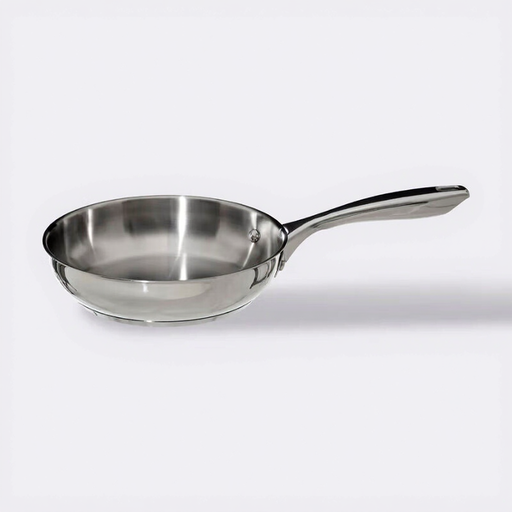
Why this product suits this profile: With a usable capacity of 1.2 litres, this compact stainless steel pan is well suited to smaller households and individual portions. According to the product information, it’s suitable for gas, electric, ceramic, halogen and induction hobs.
The uncoated surface helps avoid the mistaken assumption that a non-stick coating is automatically dishwasher-safe or resistant to damage from incorrect temperatures.
Stainless steel construction, 20 cm size and, according to the product information, dishwasher-safe.
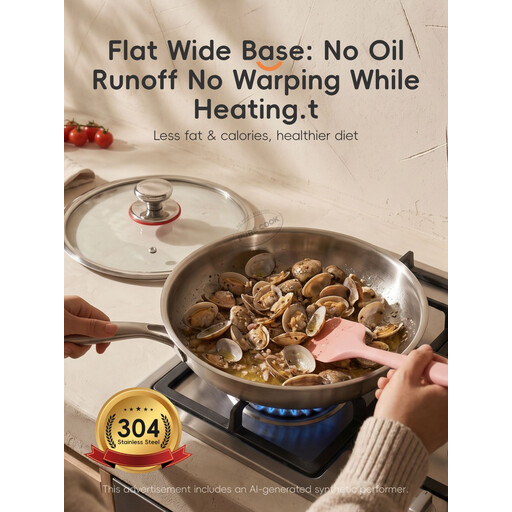
Why this product suits this profile: This 28 cm pan has a stainless steel-aluminium-stainless steel construction using 304 stainless steel. It’s designed for households that want to combine frying, sautéing and braising with the convenience of a lid.
Details of the multi-layer base, lid and compatibility with several hob types make it easier to check important features before buying.
Tri-Ply construction, glass lid and, according to the product information, suitability for gas, induction, ceramic and halogen hobs.
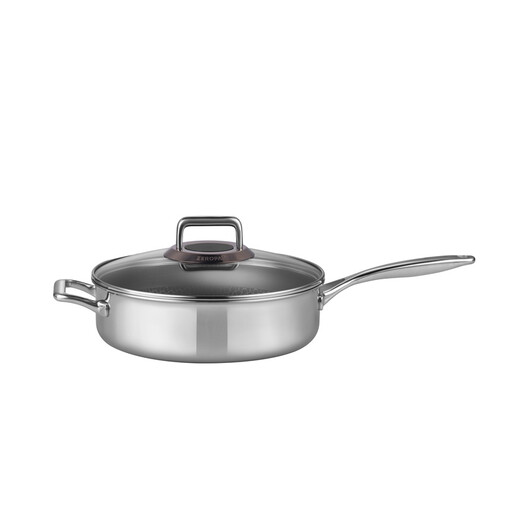
Why this product suits this profile: Its deep shape is designed for saucy dishes, larger quantities of vegetables and versatile sautéing. The product description states that the pan is suitable for all common hob types, including induction.
The product description explicitly states that it’s free from PFAS, PTFE and PFOA. Be sure to check the temperature limit and cleaning instructions before use, too.
Deep 26 cm shape, three-layer composite base and, according to the product information, oven-safe up to 260 °C.
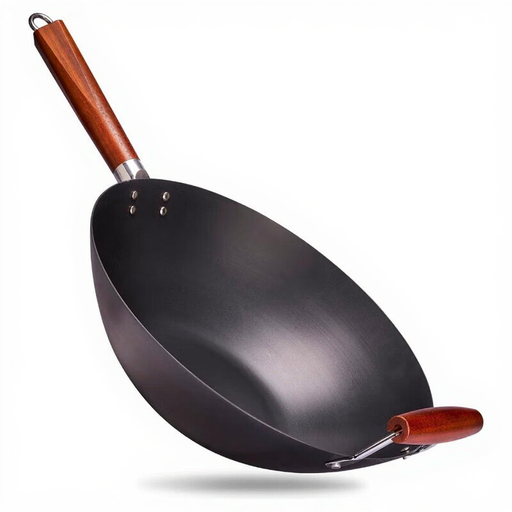
Why this product suits this profile: This 35 cm carbon steel wok offers plenty of space for stir-fries, vegetables and larger portions. It’s designed for people who are happy to season it and care for it by hand.
The care requirements are clearly stated: hand-wash, dry immediately and apply a light coating of oil. This makes it clear that an uncoated pan still needs looking after.
Carbon steel without a PFOA or PTFE coating, plus a large 35 cm diameter.
We’ve put together a complete, regularly updated list of products that meet these strict selection criteria and fully comply with the safety regulations in force in the EU.
A pan for induction needs a magnetic base that sits flat on the hob. Stainless steel alone doesn’t guarantee that it’s suitable. The product description should explicitly say ‘suitable for induction’ or ‘induction-compatible’.
24 cm pans are often suitable for one or two portions. A 28 cm pan offers more room for a household of two or more. 30 cm pans are handy for family meals, but need a sufficiently large cooking zone and more storage space.
Its lifespan depends on the quality of the coating, the temperature, the utensils you use and how you clean it. Low to medium heat, gentle utensils and hand-washing can help protect the surface. If the pan has noticeable scratches, chips or warping, you should stop using it.