
Lieferung heute & morgen

Qualitätsgarantie

Willkommens-Angebote freischalten: KOSTENLOSE Lieferung | Bis zu 80 % RABATT | Kostenlose 30-Tage-JoyPlus-Testphase
App herunterladen
A tidy child's or teen's room often seems like an impossible dream. Between toys, schoolbooks, and clothes, available space quickly runs out. A functional bed promises a solution: it combines sleeping, storage, and sometimes even a workspace into a single piece of furniture. But not every solution delivers on its promise. Many parents invest in a model that proves to be impractical or unstable after just a short time.
Before you make a decision, it's crucial to know the most common pitfalls. This will ensure your investment makes daily life easier, not harder.
To avoid these problems, you should base your choice on objective criteria. Pay attention to the following three core aspects to find a durable and truly functional piece of furniture.
The stability and safety of the bed depend directly on the material.
A good storage bed offers a well-thought-out concept tailored to the needs of children and teenagers.
The standard size for a single bed that fits from childhood to the teenage years is 90x200 cm. Such a 90x200 single bed offers sufficient space and a wide selection of compatible mattresses and bedding. A well-designed teen's room bed is characterized by its ability to adapt to changing requirements. For example, some models offer the option to remove a desk later or add extra shelving units.
Instead of making a one-size-fits-all recommendation, we have identified models tailored to specific profiles and needs.
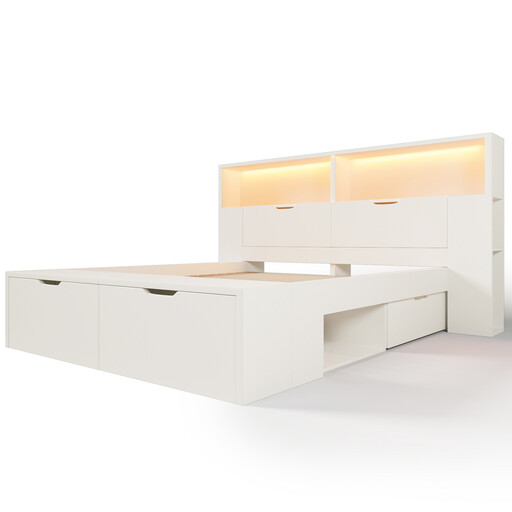
Why This Fits Their Persona: This bed is more than just a place to sleep; it's a command centre for the modern teen's room. At 140x200 cm, it offers plenty of space, while the integrated technology meets teens' needs for connectivity and customisation.
The high-quality wood construction ensures stability, while the versatile storage (drawers, shelves, bench) is genuinely usable and not just for decoration.
Integrated LED lighting with app control and USB charging ports (USB-A and USB-C) directly on the bed.

Why This Fits Their Persona: The classic and highly efficient solution for smaller kids' rooms. This bed combines sleeping, homework, and storage in a minimal footprint, creating clear structure in the room.
The solid pine and MDF construction provides stability. Raised side panels and rounded edges ensure the safety that is often missing in cheaper models.
A full-fledged, integrated desk and two large drawers ensure maximum use of space within the footprint of a single bed.

Why This Fits Their Persona: Although it's not a bed, this children's table and chair set with storage solves the core problem of room organisation for the youngest ones. It creates a dedicated space for drawing, crafting, and playing, fostering a sense of order from an early age.
This set directly addresses the safety pitfall: it features rounded edges, a stable, child-friendly construction, and is made from E1 class engineered wood.
A complete set of a table, two chairs, and three fabric storage bins encourages collaborative play and independent tidying.
We have compiled a complete, up-to-date list of products that fully meet these strict selection criteria and German safety regulations.
The most important safety features are a stable construction, rounded edges to prevent injuries, and the use of non-toxic materials. Look for certifications like the E1 emission class. For loft or bunk beds, a guardrail that complies with current DIN standards is essential.
In most cases, a suitable slatted base, often in the form of simple roll-out slats, is already included with the functional bed. This will be explicitly stated in the product description. If no slatted base is included, a standard one in the correct size (e.g., 90x200 cm) is usually sufficient.
This is particularly important for beds with a raised frame or a guardrail. To ensure the barrier's protective function, manufacturers often specify a recommended maximum mattress height (e.g., 13 cm or 15 cm). You can find this important information in the product's technical specifications. A mattress that is too high can render the safety barrier ineffective.