
Lieferung heute & morgen

Qualitätsgarantie

Willkommens-Angebote freischalten: KOSTENLOSE Lieferung | Bis zu 80 % RABATT | Kostenlose 30-Tage-JoyPlus-Testphase
App herunterladen
Games and learning toys for children aged 3 and over should be entertaining, easy to understand and suited to the child’s stage of development. In practice, unclear age recommendations, incomplete information and unsuitable game mechanics often lead to disappointing purchases. A game may appear educational on the packaging yet remain unused after just a few rounds if the rules are too complicated, the pieces are too small or the playing time is too long.
This selection guide explains what parents, grandparents and other family members should look for when choosing children’s games, board games for children, puzzles and learning toys for children aged 3 and over.
“From 3 years” is a useful guide, but it does not replace carefully checking the contents. Children differ in their concentration span, language comprehension and fine motor skills. A game with simple colour rules may be suitable for a three-year-old, while a game with lots of special rules may be overwhelming despite having a similar age recommendation.
It is also important to distinguish between “from 3 years” and “for children aged 3 to 6”. The first generally indicates a minimum age, not the ideal period for every child.
Terms such as Montessori toys, “supports development” or “learning game” say little on their own about how a product is actually used. Verifiable details are more helpful: Which materials are used? Are there numbers, colours or shapes to match? How many players can take part? Does an adult need to explain the game?
Play-based activities can encourage logical thinking, memory, hand-eye coordination or social interaction. However, these are possible game elements, not medical or therapeutic claims.
Puzzle and board-game pieces can get lost or be put in the mouth by younger siblings. Warnings about small parts that can be swallowed and long cords should be read before buying. Dimensions, packaging and storage are also relevant: a large family game needs more storage space than a compact travel game for children.
Check the age recommendation directly in the product description and on the packaging. For toys for children aged 3 and over, you should also pay attention to information about small parts, edges, cords and the supervision required. The CE marking is a mandatory conformity mark in the EU for many product groups. Even so, it does not replace checking the product and its warnings yourself.
For battery-powered products, the battery type, items included and access to the battery compartment should be clearly stated. If this information is missing, comparing the product with other options is more difficult.
A 3x24-piece children’s puzzle contains three pictures, each made up of 24 pieces. This format offers quick moments of success and lets children switch between different pictures. For children aged 3 and over, 12 to 24 pieces are often a useful starting point; what matters most is whether the child already enjoys completing puzzles of a similar level of difficulty.
For board and family games, the number of players and playing time are equally important. A game for 2 to 4 people lasting around 10 minutes is more likely to fit into family life than a long children’s strategy game with many stages.
Puzzle pieces made from sturdy card, a matt surface and a precise cut make pieces easier to pick up and match. For wooden toys, the product description should clearly state the material and explain how the item is made. With a skill game, stability, game size and the safe storage of small balls or playing pieces are important.
Electronic features, such as lights, sounds or a calculator in a role-play toy, can be appealing. However, check whether batteries are included and whether the child can operate the functions independently.
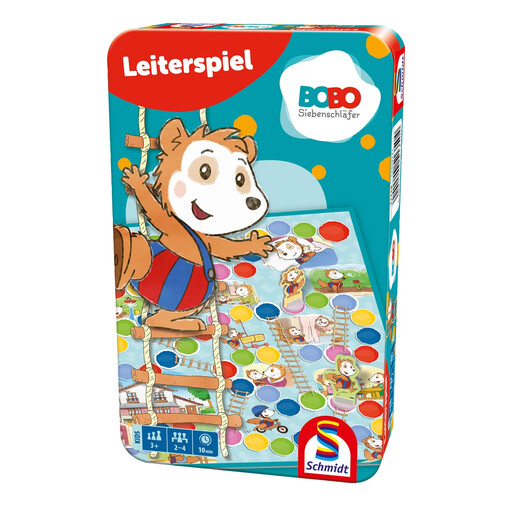
Why this product suits this profile: The game is designed for 2 to 4 players, is suitable from the age of 3 and has a stated playing time of around 10 minutes. Players move by matching colours rather than following lengthy written rules.
Short rules and a manageable playing time reduce the risk of a first board game being left unused because the gameplay is too complicated.
2–4 players, around 10 minutes of playing time, a large die and colour-based movement.
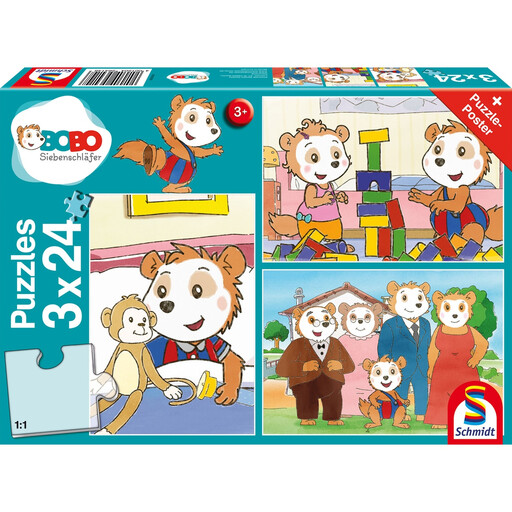
Why this product suits this profile: Three pictures with 24 pieces each, a matt linen-textured surface and precisely cut card pieces provide clearly stated product features for beginners.
The number of pieces and the material are clearly specified. This makes it easier to assess suitability than relying on general educational claims.
Three puzzles, 3x24 pieces, stated dimensions of 27,5 × 19 × 3,8 cm and a linen-textured surface.
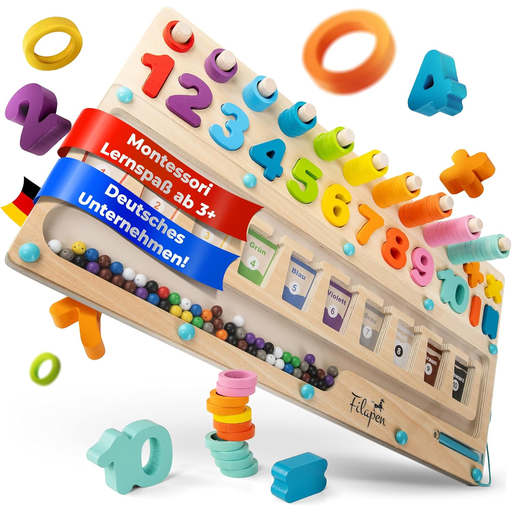
Why this product suits this profile: This wooden toy combines a magnetic maze with colour matching and numbers from 1 to 10. It requires no batteries and is designed for repeated, short practice sessions.
The functions are clearly stated and do not depend on an app or batteries. This makes the toy easier to use at home and on the go.
Solid wood, magnetic pen, numbers 1–10, colour sorting and dimensions of 23 × 43,5 × 4 cm.
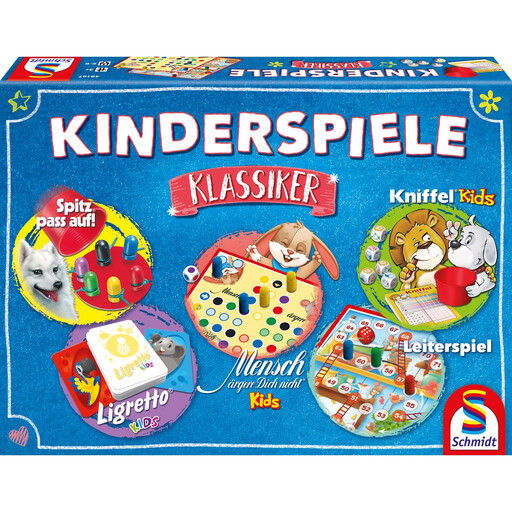
Why this product suits this profile: The collection contains five different games, including Mensch ärgere Dich nicht, Kniffel Kids, Ligretto Kids!, Spitz pass auf and a ladder game. This allows the family to choose a different format depending on who is playing.
A collection reduces the risk of the family’s interests not matching a single game mechanic.
Five game variations, recommended for ages 3 and over, no batteries and dimensions of 37,5 × 27,5 × 5,7 cm.
We have put together a complete, regularly updated list of products that fully meet these strict selection criteria and the safety regulations applicable in the EU.
As a starting point, 12 to 24 pieces are often recommended. A 3x24-piece children’s puzzle may be suitable if the child is already familiar with simple puzzles. Observe whether they can match shapes and pictures independently and whether they enjoy the activity. If they become frustrated, a smaller puzzle may be more suitable.
Safety depends on the specific product. Check the age recommendation, warnings, material details and the size of the playing pieces. Products containing small parts that can be swallowed should not be given to younger children. During the first game, an adult should explain the rules and supervise its use.
The lifespan depends on the material, construction, storage and intensity of use. Card puzzles should be stored flat and kept dry. Wooden toys remain usable for longer if they are protected from liquids and heavy impacts. For games with lots of small pieces, a sealable box is recommended to prevent anything from getting lost.