Players with limited mouse space
If your keyboard and mouse have to share a narrow surface, you’ll need to weigh up how much mouse space a compact layout frees up against which keys you still want to reach directly.


First, check which F keys, arrow keys and other shortcuts you need to reach directly in the strategy game you play. Then measure the space available for your keyboard and mouse. A 75% layout keeps the F-key row and arrow keys in a compact arrangement. TKL offers a less crowded layout, while 60% takes up particularly little desk space but may require more secondary key functions. Adjustable magnetic switches are an extra option for customising input, not a prerequisite for success in ranked matches.
If your keyboard and mouse have to share a narrow surface, you’ll need to weigh up how much mouse space a compact layout frees up against which keys you still want to reach directly.
If you often use the F-key row, arrow keys or navigation keys during a match, check whether your chosen layout gives you access to these shortcuts without switching to an Fn layer.
If you want to adjust actuation or key assignments, weigh up the setup involved and operating system support against the benefits for the way you play.
A good fit if: you want to free up as much mouse space as possible and can access your gaming shortcuts using the available keys or secondary functions.
The trade-off: 60% keyboards don’t have a dedicated F-key row; with 65% models, check the exact arrow-key layout.
A good fit if: you want a compact board but still need direct access to the F-key row and arrow keys.
The trade-off: the keys are more closely spaced than on many TKL layouts. Check the navigation-key layout on the specific model, too.
A good fit if: you prefer a less crowded layout without a number pad, and there’s room on your desk for both the keyboard and mouse.
The trade-off: TKL takes up more width than smaller formats.
Measure the usable width of your desk with your mouse mat in place, then compare it with the dimensions of the specific model. The format alone won’t tell you whether you can reach your most important gaming shortcuts directly.
| Criteria | What to check before buying | Who it matters most to |
|---|---|---|
| Mouse space and width | Measure the available space and compare it with the model’s dimensions. | If space for my mouse is tight on my small desk, I weigh up the keyboard’s width against having direct access to the keys I need. Around 31% of consumers say mouse space is their main concern. |
| Direct access to gaming shortcuts | Compare the actual key layout with the F keys, arrow keys and navigation keys you use most often. | If I use the same shortcuts frequently during a match, I want to reach them without switching to an Fn layer wherever possible. Around 25% of consumers prioritise direct access to gaming shortcuts. |
| Adjustable actuation | Check the switch type, available settings, software and operating system support. | If I want to tailor actuation to the way I play, I also consider whether accidental inputs can be avoided. Around 19% of consumers prioritise customising their input. |
| Noise and typing feel | Compare the exact switch variant and construction; try the typing feel if possible. | If I want to keep keyboard noise down in my room, I look at the specific construction rather than relying on the switch name alone. Around 13% of consumers prioritise noise and typing feel. |
| Connectivity and cables | Check the available connection types and which accessories come with the model. | If I want fewer cables on my small desk, I also need to consider charging and connection management. Around 12% of consumers prioritise cable management. |
An especially compact board can free up mouse space, but it may leave out the F and navigation keys you need to reach directly.
Before buying, check the layout against the gaming shortcuts you use most. If direct access matters, consider 75% or TKL as well.
A product range can include several language variants; the Keychron K2 HE, for example, is listed in DE-ISO alongside other ISO versions.
Check the language and layout of the specific option you’re buying rather than relying on the model name alone.
A technical polling rate doesn’t prove that you’ll perform better in ranked matches. Wooting describes the practical performance gain between the 60HE+ and the 60HE v2 as incremental for most players.
Start by prioritising the right format and easy-to-reach commands, then consider any additional input features.
For the Keychron K2 HE, the manufacturer lists only Gateron Double-Rail Magnetic switches as compatible magnetic switches.
Before buying replacement switches, check that they’re approved for your exact model and switch variant.
The K2 HE is a 75% option with an F-key row, arrow keys and magnetic switches, available in a specifically listed DE-ISO variant.
The MX 8.2 TKL Wireless and K5 Pro TMR Compact represent different formats and switch types.
The Apex Pro TKL Gen 3 in the specified DE variant is aimed at buyers looking for a TKL layout with adjustable magnetic switches.
The PRO X TKL RAPID is a wired TKL option with magnetic analogue switches and adjustable actuation.
The 60HE v2 is a 60% option for particularly limited mouse space and customisable input.
This selection includes TKL, 65%, 75% and 60% keyboards for setups where mouse space, directly accessible gaming shortcuts or different connection types matter.
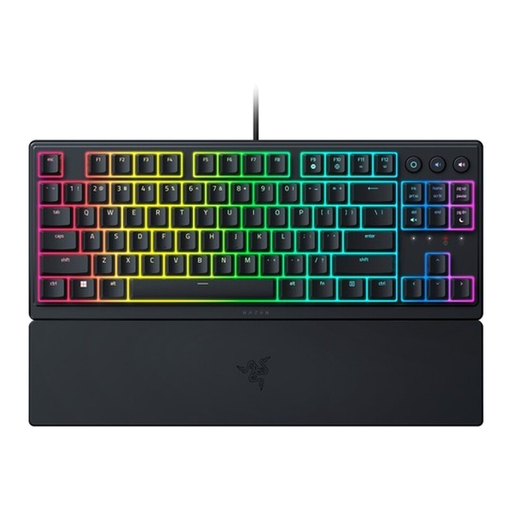 No image available
A TKL option if you want a German layout and its dimensions fit your small desk.
TKL format; German layout.
 No image available
The 65% format is a compact option; check the exact key layout against your gaming shortcuts.
65%; German QWERTZ; tri-mode with 2.4 GHz, Bluetooth and USB-C.
 No image available
A 75% option if you’re looking for a compact format with a German ISO layout.
75%; ISO-DE; mechanical; tri-mode wireless; hot-swappable; VIA-compatible.
 No image available
Before choosing this model, check that the US QWERTY layout suits your preferred key labels and assignments.
75%; US QWERTY; tri-mode wireless; hot-swappable.
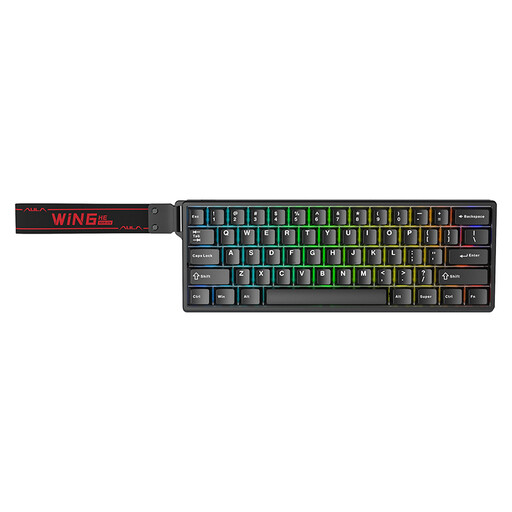 No image available
The 60% format could be a good fit if you want to use as little desk space as possible for your keyboard and are happy using secondary functions.
60%; wired; magnetic hot-swappable switches; adjustable actuation; Rapid Trigger mode.
If you often use the F-key row or arrow keys directly, a 75% layout is a sensible place to start: Razer’s description of the BlackWidow V4’s 75% layout includes both groups of keys. With a 60% keyboard, first check how your gaming shortcuts map to the available keys and Fn layers.
First, check you have the right language layout, then test your gaming shortcuts, especially the F keys, arrow keys and navigation keys. If you have adjustable magnetic switches, you can tailor the actuation point to the way you play; the most sensitive setting isn’t a must for everyone.
With wireless models, charging and any suitable replacement parts are worth factoring into your decision; potential costs depend on the model. For business purchases in the EU, you have a legal right to a minimum two-year guarantee from the seller, starting when you receive the goods. This is separate from any additional manufacturer’s warranty.
Electrical equipment covered by harmonised EU rules requiring CE marking must carry it. According to Your Europe, the manufacturer uses the mark to declare that the product complies with those rules. The German Environment Agency advises that old electrical keyboards must not be put in household waste; they should be disposed of through the designated collection and return scheme for electrical equipment.