
Lieferung heute & morgen

Qualitätsgarantie

Willkommens-Angebote freischalten: KOSTENLOSE Lieferung | Bis zu 80 % RABATT | Kostenlose 30-Tage-JoyPlus-Testphase
App herunterladen
The right atmosphere can be the difference between a standard game night and a fully immersive experience. Many gamers and streamers are looking for ways to make their gaming room not just functional, but also visually stunning. However, the selection of gaming lighting is vast, and the technical specifications can be overwhelming.
This guide is here to help. We'll outline objective criteria to consider when choosing and present a selection of products with different specialities to help you make an informed decision.
Before you decide on a product, there are a few fundamental aspects to consider. These criteria will help you find the right solution for your individual setup.
How you control your lighting significantly impacts the user experience. Common options include:
A well-designed smart lighting system often combines several of these control methods.
The design of the lighting elements defines the aesthetic of your space. There are several different approaches:
For maximum immersion, sync capabilities are crucial. The two main types are:
Here is a curated selection of products that cover different needs and use cases.
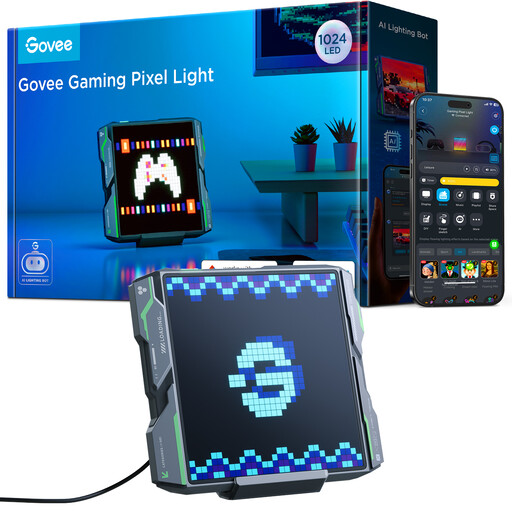
Why It Stands Out: The Govee Pixel Light is more than just an RGB wall light. With its 32x32 pixel grid, it functions as a programmable display. According to the manufacturer, an AI-powered feature allows for the quick creation of pixel art. The panel can also display useful information like weather data or stock prices.
Pros:
Who It's For: This panel is aimed at creative users who want not just ambient lighting, but an interactive and customisable display for their setup. It's ideal for fans of retro aesthetics and pixel art.
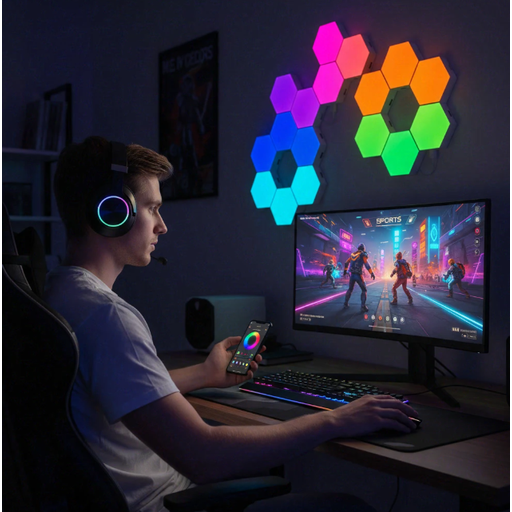
Why It Stands Out: These LED Hexagon panels represent maximum modularity. The eight individual hexagons can be connected in any pattern via their USB ports. This allows for a completely customised gaming room decor that can be expanded or rearranged at any time.
Pros:
Who It's For: Ideal for gamers and streamers who want to create a unique wall decoration and value flexibility. The ability to expand the system with more panels later offers future-proofing.
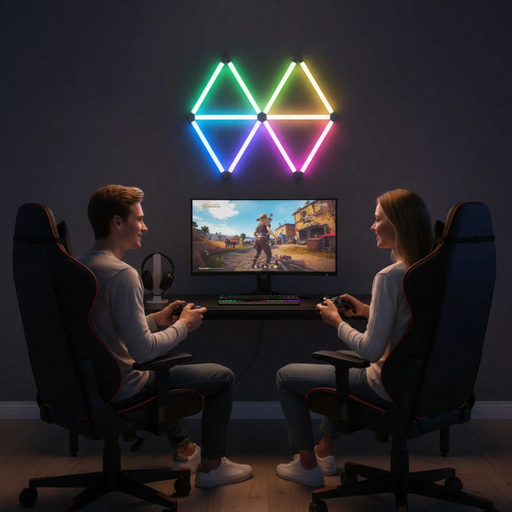
Why It Stands Out: These wall light bars offer a flexible alternative to rigid panels. The six individual bars can be arranged in various configurations to create geometric patterns or linear designs. Seamless integration into smart home systems is a key feature.
Pros:
Who It's For: This set is a great choice for smart home enthusiasts who want to control their lighting with their voice and integrate it into automated routines. The linear shape is well-suited for accenting monitors, TVs, or architectural lines.
The products featured here already cover a wide spectrum. However, if you haven't found the perfect solution for your vision yet, there are many more options to explore. Different shapes, sizes, and feature sets offer the right lighting for almost any setup.
? Explore a wider range of designs and features in our Panel Lighting category.
1. How does music sync work with gaming lights? Most systems use a small microphone integrated into the control unit or the light elements themselves. This microphone picks up the sound waves from music or game audio. A processor then analyses the frequency and volume, translating this information into real-time light effects like colour changes or pulsing brightness. Alternatively, syncing can also be done via the connected smartphone's microphone through the app.
2. What is the difference between RGB and RGBIC?RGB (Red, Green, Blue) is the standard technology where an entire light strip or panel can only display a single colour at a time. While you can change the colour of the whole strip, you cannot display different colours simultaneously. RGBIC (Independent Control) is a more advanced technology. Here, each LED chip or segment of chips has its own IC (Integrated Circuit) chip. This allows multiple colours to be displayed on a single strip at the same time, creating flowing, rainbow-like effects.