Competitive gamers who value speed
If you want to track opponents clearly on a large screen and react quickly, consider motion handling, input lag and your setup’s frame rate together.


For fast-paced arena matches, a large WQHD LCD monitor is a good option if your PC can deliver high frame rates at that resolution. A 4K OLED may be a better fit if you can make use of the extra detail and are mindful of static content. RTINGS notes that competitive PC gamers may prefer higher frame rates at lower resolutions. However, a high refresh rate alone tells you neither the input lag nor how well that particular monitor handles motion.
If you want to track opponents clearly on a large screen and react quickly, consider motion handling, input lag and your setup’s frame rate together.
If having more screen space for matches and other applications matters to you, you don’t automatically need to take on the demands of 4K gaming.
If you want to combine fast-paced matches with detailed visuals, consider what your PC can handle and how you’ll manage static content on an OLED screen.
A good fit if: smooth gameplay on a screen of around 32 inches matters more to you than 4K detail.
The trade-off: What matters is the frame rate your PC can actually achieve at WQHD.
A good fit if: your setup can deliver high frame rates at 4K and you value image detail.
The trade-off: 4K at high frame rates puts greater demands on your PC and connection. You’ll also need to consider the risk of OLED burn-in when displaying static content.
A good fit if: you want to switch between 4K detail and a higher refresh rate at FHD.
The trade-off: The LG 32GS95UX-B offers 480 Hz at FHD and 240 Hz at 4K. LG Germany lists this specific model as no longer available.
| Buying priority | What to check | Who it matters most to |
|---|---|---|
| Clear motion and low latency | Compare independent measurements for the specific model and mode you want to use; check your PC’s output, input and VRR. | If clear motion and responsive controls matter most to me when changing direction quickly, I look beyond the refresh rate. Around 36% of consumers put speed first when choosing. |
| A large, easy-to-see display | Check the screen size, native resolution and space required, including the stand, for the specific model. | If I want a large view for matches and other applications without automatically assuming I need 4K, the right screen size matters to me. Around 29% of consumers prioritise a spacious view. |
| A resolution that suits your PC and connection | Check your PC’s output resolution and frame rate, along with the modes supported by the input you plan to use. | If I want to make sure my current PC can deliver the resolution and frame rate I’m after, I check the model against my setup. Around 21% of consumers focus mainly on this performance match. |
| Panel choice and long-term use | For OLED, check how you use the screen, its care features and the specific model’s warranty terms. For LCD, also look at independent measurements of the model. | If the same elements are often displayed on my screen for long periods, I want to weigh the risk of OLED burn-in against potential motion-handling benefits. Around 14% of consumers prioritise long-term panel use. |
On LG’s dual-mode monitor, 480 Hz applies to FHD, while the stated 4K mode runs at 240 Hz. These figures only make sense when considered alongside their respective resolutions.
Note the resolution and refresh rate as a combination, then check that your PC can actually output them.
You may not be able to use a mode if your PC or connection can’t output the combination you want.
GtG response time and input lag describe different things. An advertised minimum figure doesn’t tell you how the monitor handles motion overall or what the input lag is on that specific model.
Check independent measurements for the exact model and mode you’ll be using. RTINGS describes input lag as the time it takes for a monitor to receive a signal and display the image.
Displaying the same content for long periods carries a risk of burn-in. Care features don’t remove the need to take this risk into account.
Check the care guidance and warranty terms for the specific model, and consider how often you’ll have static content on screen.
The models below are examples of different product ranges and buying considerations, not an overall assessment of each brand.
The MAG 321CQFDE E18 is an example of a large WQHD monitor with a 180 Hz refresh rate and Rapid VA panel.
The ROG Swift OLED PG32UCDM Gen3 is a 31.5-inch 4K QD-OLED model with a 240 Hz refresh rate.
The Odyssey OLED G8 G80SH (LS32HG800SUXEN) is a 32-inch 4K QD-OLED model with a 240 Hz refresh rate.
The 32GS95UX-B is a 32-inch OLED monitor with switchable modes for 4K/240 Hz or FHD/480 Hz.
The AW3225QF is a curved 31.6-inch 4K QD-OLED monitor with a 240 Hz refresh rate.
This selection includes 32-inch gaming monitors with WQHD or 4K resolution. For each model, check which combination of resolution and frame rate your PC can actually output through the connection you plan to use.
 No image available
For a large 4K view, with the option to switch to a higher frame rate at FHD. The product details list 4K UHD at 3840 × 2160 pixels and 240 Hz, and 480 Hz at FHD; 480 Hz does not apply to 4K.
The product name lists AMD FreeSync Premium and Burn-in Protection. With OLED, you still need to consider the risk from displaying the same content for long periods.
 No image available
An option if you’re looking for a large QHD display with a high refresh rate. The product name lists 180 Hz, Adaptive Sync, 1500R curvature and a 1 ms response time.
Response time isn’t the same as input lag; if you need to, check independent measurements for this specific model.
 No image available
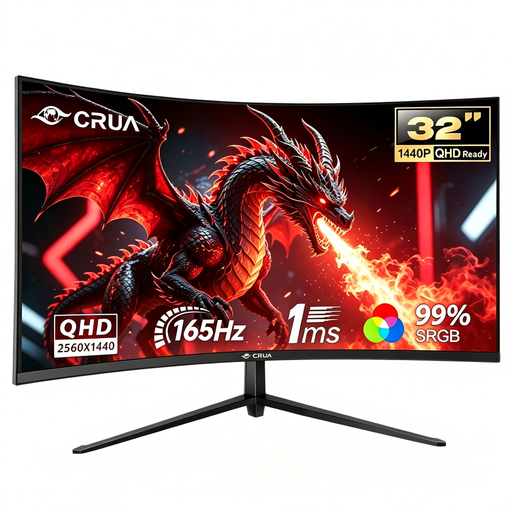
For a large QHD view; the product name lists 165 Hz and FreeSync. The 1 ms figure is given as GtG and isn’t an input lag measurement.
The product name also lists 1500R curvature and a DisplayPort connection.
 No image available
For a large QHD view at 180 Hz. The product details list an IPS panel, 2560 × 1440 pixels, AMD FreeSync and HDR10.
The product name lists a 1 ms response time. This doesn’t automatically tell you the monitor’s input lag.
 No image available
For a large 4K view; the product name lists 3840 × 2160 pixels and Adaptive Sync.
Other specifications in the product name include a VA display, 3000R curvature and HDR10. Check that 4K output and your preferred frame rate are compatible with your PC and connection.
No. Check the input you’ve selected, the mode output by your PC, and your operating system and monitor settings. The manufacturer’s stated figure alone doesn’t confirm that your setup can deliver that resolution and refresh rate.
Check the care guidance and warranty terms for the specific model, and avoid leaving unchanged content on screen for long periods where possible. ASUS lists an OLED care feature to help reduce the risk on the PG32UCDM Gen3, but the general risk of burn-in remains.
For a typical online consumer purchase, you generally have a 14-day right to cancel. Exceptions and when the period starts depend on the contract. The Verbraucherzentrale distinguishes this statutory right from the seller’s statutory liability for defects and a manufacturer’s voluntary guarantee.
Computer monitors generally fall within the scope of EU energy labelling rules; the European Commission explains how electronic displays are labelled. Don’t put an old monitor in household waste: take it to a separate collection point, as recommended by the German Environment Agency.