First, measure the available desk space, including the stand, and check which resolution and refresh rate your PC or console can output. A compact Full HD monitor is more likely to save desk space, while a suitable QHD model offers more pixels for small interior details. A larger OLED model could be another option if you have enough space and are comfortable with the considerations involved in displaying static menus for long periods. In a shared bedroom, also check whether you can use headphones or another suitable audio solution.
Which monitor is right for you?
Gamers with limited desk space
If you share a room and desk, both the screen size and the stand’s actual footprint matter, so there’s still room for your input devices. AOC lists the 24G4X as 23.8 inches, but it’s still worth checking the dimensions of the specific stand.
Detail-focused interior designers
If you want to see small items of furniture, textures and menus clearly, compare the monitor’s native resolution with the output of your device. Dell, Samsung and LG list QHD resolution of 2560 × 1440 pixels for the 27-inch models featured here.
Considerate gamers
In a shared bedroom, make sure the audio solution suits your setup; built-in speakers aren’t a given. LG doesn’t list speakers for the 27GS75QN-B, while Dell lists a headphone output on the G2725D.
What should you look for when buying?
Compact Full HD IPS monitor
A better fit if: you have limited desk space and your device outputs Full HD.
Trade-off: 1920 × 1080 offers less resolution headroom for small on-screen details than QHD. The 180 Hz listed by AOC isn’t an established minimum requirement for this mainly relaxed use case.
27-inch QHD IPS monitor
A better fit if: you have enough desk space and viewing distance, and your device supports QHD. The Dell, Samsung and LG models featured here have a resolution of 2560 × 1440 pixels.
Trade-off: This size class needs more desk space than the 23.8-inch class we looked at. For the Dell G2725D, Dell lists up to 180 Hz over DisplayPort and 144 Hz over HDMI at QHD resolution.
QD-OLED monitor
A better fit if: you’re specifically considering a larger QD-OLED display and have enough space. MSI lists the MPG 322URXDE QD-OLED as a 31.5-inch UHD model.
Trade-off: The model we looked at belongs to a considerably larger size class. MSI describes OLED Care as a way to reduce the risk of burn-in, not as proof that there’s no risk when game menus remain on screen for a long time.
| Buying consideration |
What to look for |
Who is it important to? |
| Desk space and size |
Compare the monitor’s width and stand depth with the space you have available; don’t just compare screen sizes. AOC lists the 24G4X as 23.8 inches, while the Dell, Samsung and LG models featured here are all 27 inches. |
When I share a desk, I need room for my input devices as well as the screen. That’s why around 29% of consumers put available desk space first. |
| Interior details |
Compare the model’s native resolution with the output of your PC or console, and consider how clearly you can read the game interface from your seat. AOC lists 1920 × 1080, while Dell and LG list 2560 × 1440 for the models featured here. |
When I want to assess furniture, colours and small controls, I pay attention to how clearly they appear on my device. Around 29% of consumers prioritise being able to make out fine details. |
| Audio and positioning |
Check whether the monitor has speakers, where you can plug in headphones and what adjustments the stand allows. LG doesn’t list speakers for the 27GS75QN-B; Dell lists a headphone output on the G2725D. |
When others are sleeping or relaxing in the bedroom, I want to choose suitable audio output and position the screen for where I’m sitting. Around 24% of consumers put being considerate in a shared space first. |
| Ports and refresh rate |
Check that your device’s output, the monitor’s input and the resolution and refresh rate you want all work together. Remember to consider compatible cables and your audio solution, too. For the G2725D, Dell lists up to 180 Hz over DisplayPort and 144 Hz over HDMI at QHD resolution. |
When I want to keep using my existing devices, I want to know in advance whether my connection can deliver the resolution and refresh rate I’m after. Around 18% of consumers make device compatibility their top buying priority. |
Common buying mistakes
-
Comparing screen size alone
The diagonal measurement doesn’t tell you how much depth the stand takes up. The models featured here range from 23.8 to 27 to 31.5 inches.
Measure your available desk space and compare it with the dimensions of the specific model variant.
If the stand doesn’t fit, a monitor arm could be another option.
-
Assuming the maximum refresh rate is available on every connection
For QHD resolution on the G2725D, Dell lists different maximum refresh rates over DisplayPort and HDMI.
Compare the resolution and refresh rate you want with your device’s output, the monitor’s input and the right cable.
-
Assuming speakers are included or OLED use is risk-free
LG doesn’t list speakers for the 27GS75QN-B. MSI describes OLED Care on the MPG 322URXDE as a way to reduce a risk, not as proof that the risk has been eliminated.
Check the audio connections and, for OLED, the care and warranty terms for the exact model, especially if game menus stay on screen for long periods.
If suitable speakers aren’t built in, you’ll need another way to play audio. With OLED, follow the display care guidance.
Relevant brands and example models
AOC
The 24G4X is an example of a 23.8-inch Full HD gaming monitor.
- AOC lists Fast IPS, 1920 × 1080 pixels and 180 Hz for this model.
- It has fewer pixels than the QHD models featured here. These specifications don’t confirm a particular level of colour accuracy in games or whether the stand will fit on your desk.
Dell
The G2725D is a 27-inch QHD IPS option with clearly stated connection limits.
- Dell lists a headphone output and a tilt-adjustable stand. At QHD resolution, the manufacturer specifies up to 180 Hz over DisplayPort and up to 144 Hz over HDMI.
- The maximum refresh rate depends on which input you use. Check that your device and cable support the combination you want.
Samsung
The Odyssey G5 G50F, variant LS27FG502EUXEN, is an example from the 27-inch QHD IPS class.
- Samsung lists QHD, IPS and 180 Hz for this variant.
- Manufacturer claims about HDR and motion performance aren’t independent test results, and other Odyssey G5 variants may differ.
LG
The UltraGear 27GS75QN-B is another example of a 27-inch QHD IPS monitor.
- LG lists 2560 × 1440 pixels and 180 Hz in standard operation.
- The 200 Hz figure is marked as an overclocked rate; LG doesn’t list speakers for this model.
MSI
The MPG 322URXDE QD-OLED is an example of a larger UHD QD-OLED option.
- MSI lists a 31.5-inch panel for this model and describes OLED Care as a way to reduce the risk of burn-in.
- The care feature doesn’t prove that the risk is eliminated. Test results for other MSI models can’t be applied to this one.
Joybuy monitors for detail-focused interior design
The following models are aimed at detail-focused interior design, with QHD or 4K resolution. Before buying, check that your device supports the resolution and that a 27-inch monitor will fit on your desk.
 No image available
Z-Edge AGEX, 27-inch
If your device outputs QHD, this model’s 2560 × 1440 resolution is suited to detail-focused interior design.
Fast IPS; 144 Hz; 1 ms MPRT; height-adjustable stand.
View on Joybuy
 No image available
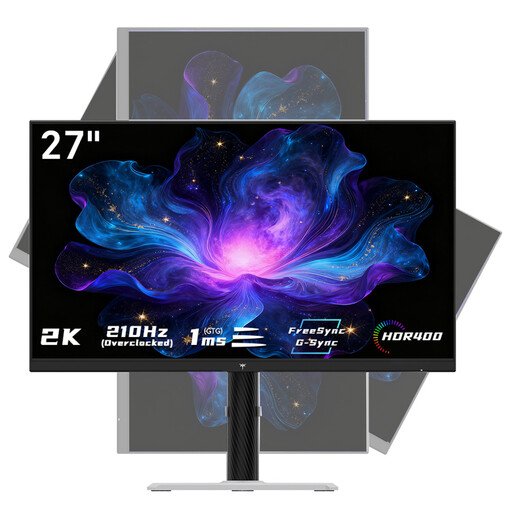
KTC H27T6
If your device supports QHD and you want to adjust the screen to suit your seating position, the product title lists a stand with a range of adjustment options.
QHD, 2560 × 1440; Fast IPS; 200 Hz, up to 210 Hz with overdrive. The stand is described as height-adjustable, tiltable, swivel and pivot adjustable.
View on Joybuy
 No image available
INNOCN 2751S PLUS, 27-inch
If your device can output QHD and you want to play audio directly through the monitor, the product description lists built-in speakers.
Mini LED with 1152 zones; QHD; IPS; 275 Hz; built-in speakers; height-adjustable stand.
View on Joybuy
 No image available
KTC H27D9, 27-inch
If your device supports QHD, this model offers 2560 × 1440 pixels to display interior details.
IPS; 120 Hz; Adaptive Sync; HDMI and DisplayPort. The description lists a tilt-adjustable stand and VESA compatibility.
View on Joybuy
 No image available
KTC M27P6, 27-inch
If your device can output 4K and you want the option to switch resolution, the description lists both 4K and Full HD modes.
Mini LED; Fast IPS; 4K at 160 Hz or FHD at 320 Hz; USB-C with 65 W. The description also lists a height-adjustable, tilting and swivelling stand.
View on Joybuy
Frequently asked questions
Do I need a particularly high refresh rate for virtual home design?
The model specifications listed here don’t establish a minimum refresh rate for this use. Start by checking the screen size, resolution and your device’s output. For the Dell G2725D, Dell lists different maximum refresh rates over DisplayPort and HDMI at QHD resolution.
How can I stop game audio disturbing others in the bedroom?
Match your audio output to your device and the connections on the specific monitor. Dell lists a headphone output on the G2725D; LG doesn’t list built-in speakers for the 27GS75QN-B.
How can I compare monitors’ power consumption?
Check the EU energy label and the product information for the exact model. For monitors covered by the rules, the European Commission provides energy information. To estimate your own costs, you’ll also need your usage hours and electricity tariff.
What happens if a product is faulty after an online purchase in Germany?
Statutory rights relating to faulty goods are generally claims against the seller and are separate from a voluntary guarantee. The Verbraucherzentrale (German consumer advice centre) gives the general period as two years. For sales contracts from 31 July 2026, it also describes a one-off 12-month extension if you choose a repair when a fault occurs. Many online purchases also usually come with a 14-day right to cancel.
Which markings matter on a monitor sold in Germany?
EU energy labelling and ecodesign rules apply to electronic displays within their scope. A CE marking is required where the relevant EU rules say it must be displayed on the specific device; it isn’t an independent quality mark. Check the information for the model being sold.


