For dark stealth games, it’s worth comparing OLED with high-contrast VA or Mini-LED LCD models; the highest refresh rate alone won’t determine which monitor is right for you. If you’re sharing the room, desk space, adjustable brightness and a private audio option matter too. An LCD may be a better fit if you often have static HUDs or desktop content on screen for long periods. Whichever model you choose, check its VRR performance and connectivity.
Who this comparison is for
Fans of dark stealth scenes
If you often play with little ambient light, you’ll want to make out both shadows and bright details. RTINGS.com explains the differences between OLED, VA and IPS, which you should weigh against the potential drawbacks of each panel type.
Considerate housemates
If you share the room, you need a monitor that fits on your desk and can be used at a suitable brightness with private audio. Check the footprint and audio connections of the model you’re considering. For example, ASUS lists a headphone socket for the PG32UCDM Gen3, but no speakers.
Players who share their screen
If desktop content or HUD elements are also displayed on the same monitor for long periods, OLED care should factor into your buying decision. RTINGS.com highlights the risk of burn-in with static content displayed for extended periods; an LCD alternative may also be worth considering for this kind of use.
What to consider when choosing
OLED and QD-OLED
A good fit if: you mostly play in a darkened room and prioritise deep blacks and clear motion.
The trade-off: HUDs left on screen for long periods can increase the risk of burn-in; VRR flicker may be noticeable when frame rates fluctuate. RTINGS.com describes these risks for the relevant panel types.
VA LCD
A good fit if: you want LCD contrast for dark scenes and would rather avoid OLED burn-in.
The trade-off: dark objects in motion may show smearing on some models. Check reviews of the specific model rather than relying on the panel type alone. RTINGS.com describes VA as typically offering higher contrast than IPS.
IPS LCD
A good fit if: you often use your monitor for static desktop content or viewing angles matter when sharing a room.
The trade-off: standard IPS typically can’t match the black levels of VA or OLED. Also check that the stated refresh rate is compatible with your gaming device and connection.
Mini-LED LCD
A good fit if: you’re considering local dimming on an LCD and have room for a larger monitor on your desk.
The trade-off: local dimming zones aren’t individual pixels that can be switched off like on OLED. Consider the size, curvature and potential light effects when choosing a monitor for a shared room.
| Consideration |
What to check before buying |
Who it matters most to |
| Dark gaming scenes |
Check the panel type and how the specific model handles dark motion; RTINGS.com says VA typically offers higher contrast than IPS. |
If I want to make out shadows and bright details in low ambient light, I compare contrast and motion performance. Around 33% of consumers put dark scenes first. |
| Space, light and sound |
Measure the width and depth, including the stand; check brightness, audio output and headphone socket. |
If I need to be considerate in a shared room and share the desk with others, I factor in the footprint and a private audio option. Around 27% of consumers prioritise space and consideration for others. |
| Motion and connectivity |
Check the model’s dark transitions and VRR performance; match the resolution and refresh rate to your gaming device and connection. |
If I want smooth, clear motion on my PC or console, I check the monitor and connection together. Around 20% of consumers prioritise motion and device connectivity. |
| Extended mixed use |
Check how long static HUDs and desktop content stay on screen, OLED care requirements, the specific warranty terms and the model’s EU energy label. |
If my monitor often displays unchanged content for long periods, I factor care, warranty and energy information into my decision. Around 20% of consumers put mixed use first. |
Buying decisions to check carefully
-
Assuming the highest refresh rate is the best choice for stealth games
The maximum refresh rate tells you nothing about black levels or dark motion transitions. It also assumes that your gaming device and connection can support the required output.
Start by comparing dark scenes, motion performance and the connection you actually use. Then check which refresh rates your setup can handle.
-
Focusing only on gameplay when choosing OLED
HUDs or desktop interfaces left on screen for long periods can increase the risk of burn-in. Care features don’t eliminate that risk.
Consider how long static content tends to stay on your screen, then compare the care and warranty terms for the specific model with LCD options.
-
Planning for screen size alone
The stand and casing may take up more desk space than the screen diagonal suggests. Not every model has speakers, either.
Measure the width and depth, including the stand, and check where you can connect headphones or other personal audio devices before buying.
Notable brands and model examples
ASUS ROG
The ROG Swift OLED PG32UCDM Gen3 is an example of a 31.5-inch 4K QD-OLED monitor with a 240 Hz refresh rate.
- ASUS lists OLED Care and a three-year warranty that includes panel burn-in for this model. According to the manufacturer, the monitor has a headphone socket but no speakers.
- The specifications state that the stand requires 71,8 × 27,6 cm of desk space. Care features don’t guarantee that burn-in is impossible.
Philips Evnia
The Philips Evnia 27M2N3500NL/01 is a 27-inch QHD Fast VA model with a stated refresh rate of 180 Hz.
- Its VA panel makes this an LCD option worth considering when comparing performance in dark scenes.
- The manufacturer’s claims about motion performance don’t replace independent testing of this model’s dark pixel transitions.
MSI
The MAG 274QRFDE QD E2 is a 27-inch WQHD Rapid IPS model with a stated refresh rate of 180 Hz and Adaptive-Sync.
- The model’s product page lists settings including Night Vision, which you can try with your specific game and monitor.
- A standard IPS panel typically has weaker black levels than VA; the listed settings alone don’t demonstrate any particular benefit for stealth games.
Samsung Odyssey
The Odyssey Neo G7 LS32BG750NPXEN is a 32-inch 4K Mini-LED model with a 165 Hz refresh rate and 1000R curvature.
- Samsung states that this model has 1.196 local dimming zones.
- Its size, pronounced curvature and rear lighting may matter in a shared room. The manufacturer’s claims aren’t a substitute for an independent assessment of how it performs in a bedroom.
Dell Alienware
The Alienware AW2725DF is a 27-inch QHD QD-OLED model with a refresh rate of 360 Hz, according to Dell.
- Dell lists QHD resolution and a 360 Hz refresh rate for this model.
- Dell says it has no built-in speakers. A high refresh rate alone doesn’t prove that it’s better for stealth games; consider the OLED risk and audio options separately.
Joybuy products for different gaming setups
These models cover VA, Mini-LED, QD-OLED and IPS LCD options for dark gaming scenes, mixed use and different space requirements.
 No image available
Gigabyte GS27QCA 27-inch curved QHD monitor
This VA LCD may be worth considering if contrast in dark scenes matters to you; check how the specific model handles dark motion transitions.
The listing gives a 27-inch screen, QHD resolution, VA panel, 180 Hz refresh rate, 1500R curvature and 3,5-mm headphone output.
View at Joybuy
 No image available
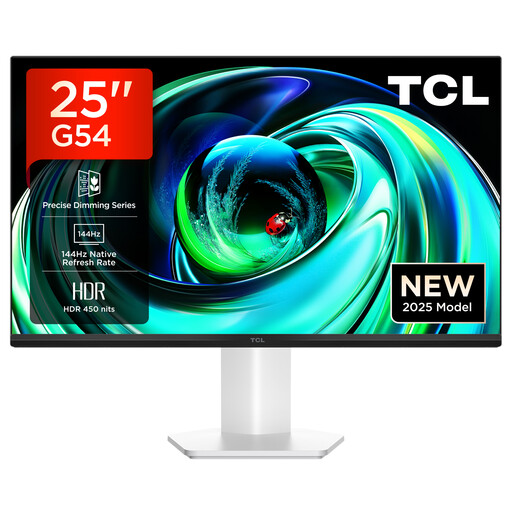
TCL 25G54 25-inch Mini-LED monitor
The stated 25-inch screen size may help when planning a shared desk. Check whether Full HD suits your gaming device and the level of detail you want.
The listing specifies Full HD, 144 Hz, IPS, Mini-LED, 450 Nits and VESA DisplayHDR 400.
View at Joybuy
 No image available
KTC M27P6 27-inch 4K Mini-LED monitor
If you want to use different picture modes, compare the stated resolution in each mode with its refresh rate and your connection.
Fast IPS, Mini-LED and 65 W USB-C are listed. The title states that the model offers 4K at 160 Hz or FHD at 320 Hz. The higher refresh rate applies in FHD mode.
View at Joybuy
 No image available
MSI MAG 272QPDE QD-OLED X24
QD-OLED is an option if you prioritise deep blacks in dark gaming scenes; bear the risk of OLED burn-in in mind if you use static HUDs for long periods.
The listing specifies QHD, 240 Hz, Adaptive-Sync, USB-C and a 3,5-mm audio output. It gives the actual screen diagonal as 26,5 inches.
View at Joybuy
 No image available
Gigabyte G27Q20 27-inch QHD monitor
An IPS LCD may be an alternative if you often use your monitor for static content; weaker black levels than VA are a potential compromise in dark scenes.
The listing specifies SS-IPS, QHD, 200 Hz and a height-adjustable stand. The title gives 210 Hz as the overclocked figure; a headphone output is also listed.
View at Joybuy
Frequently asked questions
Do I need to buy an OLED monitor for dark stealth games?
No. OLED offers deep blacks, while VA LCD is a high-contrast LCD alternative and Mini-LED is an LCD option with local dimming. IPS may suit frequent mixed use. Compare how the specific model performs and consider your usual lighting conditions.
How can I set up my monitor without unnecessarily disturbing anyone else in the room?
Measure the available space, including the stand, adjust the screen brightness and plan to use a suitable private audio connection on the monitor or source device. For the ASUS PG32UCDM Gen3, the manufacturer lists a headphone socket but no speakers; check the connections on other models separately.
What should I bear in mind when using an OLED monitor every day?
Factor in how long HUDs and desktop content stay on screen, and read the care and warranty terms for the specific model. ASUS lists OLED Care and a warranty that includes panel burn-in for the PG32UCDM Gen3; this doesn’t eliminate the risk.
How do I compare energy use and what happens if something goes wrong?
Compare the EU energy labels for the models you’re considering against how you plan to use them; the European Commission also explains the HDR information shown on the labels. In Germany, statutory consumer rights against the seller are distinct from a voluntary warranty, as explained by Verbraucherzentrale.
How do I dispose of an old monitor in Germany?
Don’t put it in household waste. The German Environment Agency recommends separate disposal, for example at a recycling centre or through suitable take-back points at retailers. Check what return options are available locally.


