If you want to keep an eye on the map, team status and abilities, start with a large 16:9 monitor and check the HUD positions in your own game from where you sit. A 21:9 model may be a better fit if the game displays the format properly; the resolution and refresh rate should also match the outputs and performance of your PC or console. If static HUD elements are on screen for long periods, factor the risk of burn-in on an OLED display into your decision.
Who benefits from each priority?
Support players who focus on the HUD
If you want to read the map, team status and abilities on a large screen, check the size and aspect ratio in the game itself and from where you sit. MSI lists a 31.5-inch 16:9 model, while LG specifies a 34-inch 21:9 model; this does not mean one is generally better for support roles.
Fast-paced players who want a large screen
If fast movement matters as much to you as the information on screen, compare the refresh rate, connections and motion handling of the specific model. MSI lists 180 Hz and 240 Hz for two models respectively; the manufacturers’ specifications alone do not show how clearly motion will appear in your game.
Long-session players with a persistent HUD
If the map or other HUD elements often stay in the same place for long periods, weigh an OLED display’s picture quality against the risk of burn-in. RTINGS.com describes this risk with static elements that remain in the same position; IPS and VA LCDs are potential alternatives to compare on a model-by-model basis.
What should you look for when buying?
First decide whether the familiar 16:9 format or a wider 21:9 display is right for your games and desk. Then compare readability, picture output and panel type on the specific model.
| Priority |
What to check before buying |
Who it matters most to |
| HUD readability |
HUD position and scaling in your game; monitor dimensions including the stand. |
If I want to take in the map, team status and abilities quickly while playing, how things look from where I sit is crucial. Around 28% of consumers put HUD readability first. |
| Motion handling |
Refresh rate through the intended input; independent testing of the exact model. |
If I want to see movement clearly as I watch and react, I compare more than just the stated refresh rate. Around 22% of consumers prioritise clear motion handling. |
| Hardware compatibility |
Match your desired resolution and refresh rate to the monitor’s stated modes and connections. |
If I want to keep using my existing PC or console, the desired combination of resolution and refresh rate must match its video output. Around 22% of consumers focus primarily on device compatibility. |
| Aspect ratio and desk space |
Test 16:9 or 21:9 in your game; consider the stand dimensions and viewing distance. |
If I want a wider gaming area without losing sight of HUD elements, I check how it looks in the specific game and how much desk space it takes up. Around 17% of consumers make aspect ratio and desk space their main priority. |
| Panel for long training sessions |
Check your usage habits and the care and warranty terms for the exact OLED model; compare LCD alternatives. |
If my HUD is often visible in the same positions for long periods, I factor the risk of OLED burn-in into my decision. Around 11% of consumers prioritise long-term use with static displays. |
Buying and usage pitfalls
-
Assuming a larger screen automatically gives you a better view
Screen size alone won’t tell you where the map and team status appear in your game, or how easily you can see them from where you sit.
Check the HUD layout in the game you actually play and measure the available space, including the stand.
-
Treating refresh rate and response-time figures as a complete real-world test
Manufacturer specifications apply to specific modes and models. What you actually see also depends on the connection and gaming device.
Check the input mode you want to use and, if motion handling is a priority, consult independent tests of the exact model.
-
Overlooking static HUD elements and OLED limitations
On an OLED display, showing the same elements continuously can pose a risk of burn-in. A voluntary warranty is not the same as your statutory rights.
Compare your usage habits with LCD alternatives, and read the care guidance and warranty terms for the specific model before buying.
Key brands at a glance
MSI
MSI offers two specific models that take different approaches to a large 16:9 display.
- MSI specifies 31.5 inches, WQHD and 180 Hz for the MAG 325CQRF QD E2, and 31.5 inches, 4K and 240 Hz for the MPG 321URXDE QD-OLED.
- These manufacturer specifications apply to the models listed and do not support general claims about motion quality, warranty or brand availability.
Dell
The G3223Q is a specific example of a large 16:9 IPS monitor with listed connections for PCs and consoles.
- Dell specifies 3840 × 2160 at 144 Hz for this 32-inch model through the listed HDMI 2.1 and DisplayPort 1.4 inputs.
- These specifications apply to this model and its listed inputs; they do not automatically apply to other monitors or devices.
LG
The UltraGear 34GX90SA-W is a specific 21:9 OLED model for buyers considering a wider display.
- LG lists 34 inches, 3440 × 1440 and 240 Hz for this model.
- The manufacturer’s specifications don’t prove that the format will benefit you in your game or that the HUD will be positioned appropriately.
LC-Power
The LC-M32UCO is a specific large 16:9 QD-OLED model.
- LC-Power lists 31.5 inches, 4K, 165 Hz and a curved screen. COMPUTER BILD rated the picture quality and response times positively in its review of this device.
- COMPUTER BILD noted that the maximum brightness is a little low. The manufacturer’s specifications and the review apply to this model, not the brand as a whole.
Gaming monitors at Joybuy
The models below include large 16:9 gaming monitors and one 21:9 ultrawide model. Check how well the format displays the map, team status and other HUD elements in the game you play.
 No image available
KTC H32S17, 32-inch, QHD, 180 Hz
An option if you’re looking for a large 16:9 VA LCD for gaming.
The product title lists 32 inches, 2560 × 1440, 180 Hz, HVA, 1500R and Adaptive Sync.
View at Joybuy
 No image available
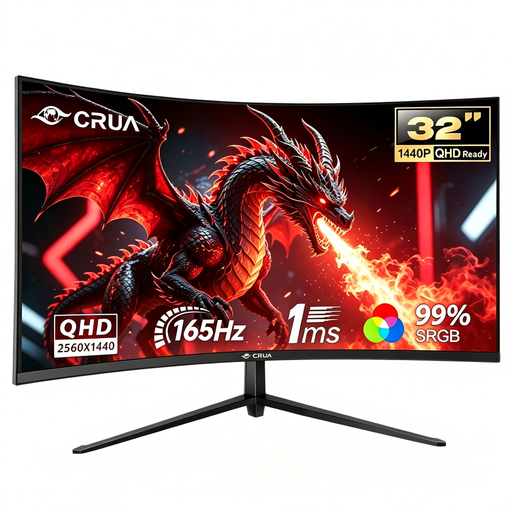
CRUA CR320C-H, 32-inch, QHD, 165 Hz
This curved VA model is another large gaming option geared towards 16:9.
The product title lists 32 inches, QHD, 165 Hz, 1500R and FreeSync. Check the exact resolution listed for the model before buying.
View at Joybuy
 No image available
Samsung Odyssey G5 G50F, 32-inch, QHD, 180 Hz
An option if you’re looking for a large 16:9 IPS monitor.
The product title lists 32 inches, 2560 × 1440, 180 Hz, IPS, HDMI 2.0 and DisplayPort 1.2.
View at Joybuy
 No image available
CRUA CR340QA-H, 34-inch, 21:9, 165 Hz
The ultrawide format may suit you if your game displays HUD elements appropriately and the wider screen fits your setup.
The product title lists 3440 × 1440, 21:9, 165 Hz and a 1500R curve.
View at Joybuy
 No image available
CRUA CR320QB, 32-inch, 4K, VA
An option if you’re considering a large 4K gaming monitor with a VA panel.
The product title lists 32 inches, 3840 × 2160, 3000R, HDR10 and Adaptive Sync.
View at Joybuy
Frequently asked questions
Would 32 inches or a 34-inch ultrawide be better for my support game?
It depends on how your game displays the format and HUD elements. Check the position of the map and team status, as well as scaling in the game itself. The specified 16:9 and 21:9 models offer different screen areas, but neither is generally better for support roles.
How do I set the resolution and refresh rate I want?
Use an input that supports the mode you want, then check the output resolution and refresh rate in your display settings. Dell lists 4K at 144 Hz for the G3223Q through specific HDMI 2.1 and DisplayPort 1.4 inputs; this specification does not automatically apply to other monitors or devices.
What should I consider when using OLED with a frequently visible HUD?
Elements displayed in the same position for long periods can pose a risk of burn-in on OLED. Check the care guidance and warranty terms for the specific model; if you don’t want to take that risk, compare IPS or VA LCDs.
How can I compare power consumption and running costs?
Compare the EU energy label and product data sheet for similar monitors. The European Commission lists display power consumption in kWh per 1,000 hours; your actual electricity costs also depend on how long you use the monitor and your electricity tariff.
What are my rights when buying online or if a product develops a fault in Germany?
When you buy as a consumer online, you generally have a 14-day right to cancel. Your statutory rights against the seller are separate from any voluntary guarantee. For purchase contracts dated on or after 31 July 2026, the Verbraucherzentrale also describes a one-off 12-month extension to the statutory warranty period if you choose repair rather than replacement when a fault occurs; the relevant conditions apply.


