If your desk and graphics card can handle QHD, a 27-inch QHD LCD is a sensible starting point for work and co-op shooters; PRAD describes this size and resolution as a practical everyday combination. If space is limited, an adjustable-height 23.8-inch Full HD LCD may be a better fit, as demonstrated by the ASUS VG249QL3A. QHD QD-OLED is worth considering if contrast and gaming performance are priorities, provided you also take static office windows and the care guidance for the specific model into account.
Which monitor is right for you?
Co-op gamers who work on the same monitor
You want to balance fast-paced gameplay with work windows that are easy to read. That means connection modes, resolution and adjustability all matter; ASUS lists different maximum refresh rates for the VG27AQ3A depending on the input.
Gamers with a small desk
You need to fit your screen and stand into a limited workspace, and weigh up a more compact Full HD monitor against the extra workspace of QHD. ASUS describes the 23.8-inch VG249QL3A as height-adjustable.
Evening gamers who prioritise contrast
You prioritise dark-scene detail and high refresh rates, but also use your screen for static work windows. Dell describes Pixel Shift on the AW2725DF as a measure to help prevent image retention; this doesn’t replace checking the care guidance and warranty terms for the specific model.
What should you consider when buying?
First, check that the size and resolution suit your desk, viewing distance and work applications. Then match your preferred gaming mode to your graphics card and monitor input. If you’re considering OLED, also think about how long static work windows will remain on screen.
| What matters when buying |
What to check |
Who it matters most to |
| Smooth visuals |
Check the refresh rate supported by the specific HDMI or DisplayPort input, as well as VRR support from both the monitor and connected device. ASUS lists up to 180 Hz via DisplayPort and 144 Hz via HDMI for the VG27AQ3A. |
If I want fast camera movements to look smooth, the mode I can actually use matters more than a single maximum figure; around 36% of consumers prioritise smooth shooter gameplay. |
| Text and workspace |
Compare screen size, native resolution, scaling and how easy your usual applications are to read from your seat. PRAD describes 27-inch QHD as a practical everyday combination. |
If I regularly use several work windows alongside gaming, I want text and content to be easy to see at a glance; around 29% of consumers prioritise workspace and text readability. |
| Space and positioning |
Check the dimensions of the screen and stand, and whether the height can be adjusted. ASUS describes the VG249QL3A as height-adjustable, while the VG27AQ3A does not have height adjustment. |
At a small desk, I want to position the screen comfortably without the stand getting in the way of my workspace; around 21% of consumers put a suitable setup first. |
| OLED contrast and care |
Check the panel type, protective features and written warranty terms for the exact model and seller. Dell describes Pixel Shift on the AW2725DF as a measure to help prevent image retention. |
If rich contrast in dark scenes matters most to me, I also want to factor in static work windows; around 14% of consumers prioritise the OLED picture quality. |
Common buying misconceptions
-
The highest listed refresh rate automatically applies to every input
For the ASUS VG27AQ3A, ASUS lists different maximum refresh rates for DisplayPort and HDMI. A single figure doesn’t tell you which mode will work with your PC and the input you plan to use.
Check the mode table for the specific model, resolution, input and graphics card you want to use.
-
A fast gaming monitor is automatically ergonomically adjustable
Stands can differ even between similar models: ASUS describes the VG27AQ3A as not having height adjustment, while the smaller VG249QL3A does have height adjustment.
Compare the stand, desk dimensions and adjustment options before choosing. If the setup still won’t work, check whether you’ll need a compatible VESA mount.
A separate monitor arm may need extra planning and a compatible VESA mount.
-
Choosing OLED contrast without accounting for static work windows
Dell describes image retention as a risk and Pixel Shift on the AW2725DF as a countermeasure. This doesn’t mean the risk is eliminated or that a particular warranty will cover it.
Read the care guidance and written warranty terms for the specific model and seller before choosing OLED for regular office work.
Brands and suitable model ranges
ASUS
The TUF Gaming models mentioned offer a compact Full HD option and a larger QHD alternative.
- ASUS describes the VG249QL3A as a 23.8-inch Full HD model with a height-adjustable stand.
- The VG27AQ3A does not have height adjustment, and ASUS lists different maximum refresh rates via HDMI and DisplayPort.
Samsung
The Odyssey G5 G50F LS27FG502EUXEN is a 27-inch QHD IPS model with a listed refresh rate of 180 Hz.
- Samsung lists G-Sync compatibility and FreeSync Premium for this model.
- Check the stand and connection modes of the specific model before choosing it for a shared work and gaming space.
Dell Alienware
The AW2725DF offers a QHD QD-OLED setup with a listed refresh rate of 360 Hz, according to Dell.
- Dell describes Pixel Shift on the AW2725DF as a measure to help prevent image retention.
- If you use static work windows, the care guidance and terms of the specific warranty still matter; Pixel Shift doesn’t guarantee that image retention is ruled out.
MSI
The MPG 271QRDE QD-OLED X50 is a QHD QD-OLED option for buyers considering very high listed refresh rates.
- For the DE variant, MSI lists 500 Hz and a VRR range of 48 to 500 Hz.
- These manufacturer specifications don’t prove a general advantage in every co-op shooter; check the exact model variant and whether your PC supports it.
LG
The UltraGear 27GS75QX-B is another 27-inch QHD IPS option with a listed refresh rate of 180 Hz.
- LG lists DisplayPort 1.4 and two HDMI 2.0 ports for this model.
- LG states that the 27GS75QX-B has no built-in speakers, so plan for separate audio output if needed.
Joybuy products
The models below include QHD gaming monitors for work and play, as well as a compact 23.8-inch Full HD monitor.
 No image available
Z-Edge AGEX 27-inch QHD gaming monitor
The listed QHD resolution and height-adjustable stand may be useful for a shared work and gaming space.
Listed in the title: 2560 × 1440 pixels, 144 Hz, Fast IPS, FreeSync, HDR10, DisplayPort and HDMI. For 144 Hz at QHD, the product description specifies DisplayPort and a compatible graphics card as requirements.
View at Joybuy
 No image available
Samsung Odyssey G5 G50F 32-inch QHD gaming monitor
This model features a QHD IPS display with a high refresh rate for both gaming and work.
Listed in the title: 2560 × 1440 pixels, 180 Hz, IPS, FreeSync and G-Sync Compatible. Check what refresh rate your PC can actually deliver through the connection you plan to use.
View at Joybuy
 No image available
INNOCN 2751S PLUS 27-inch QHD Mini LED monitor
QHD and a height-adjustable stand are features that may suit a shared work and gaming space.
Listed in the title: Mini LED, 1152 zones, Fast IPS, 275 Hz, FreeSync, HDMI and DisplayPort. The refresh rate you can achieve also depends on your graphics card and chosen connection.
View at Joybuy
 No image available
GIGABYTE G27Q20 27-inch QHD gaming monitor
This model combines QHD with a height-adjustable stand, making it an option to consider for a shared work and gaming space.
Listed in the title: SS-IPS, 200 Hz (OC 210 Hz), 0.5 ms, G-SYNC Compatible and FreeSync Premium Pro. The 210 Hz refresh rate is specified as an OC figure.
View at Joybuy
 No image available
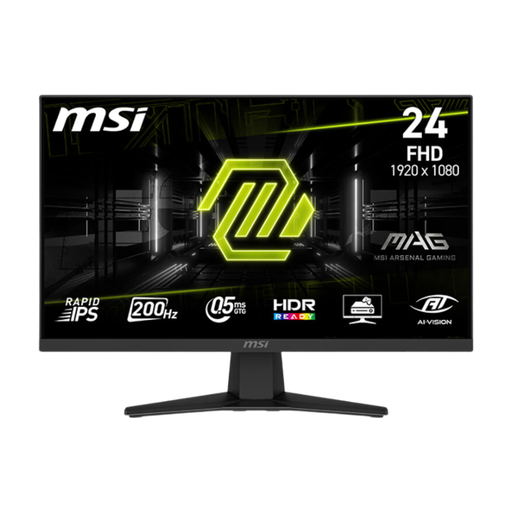
MSI MAG 244F 23.8-inch Full HD gaming monitor
This compact Full HD format may be a good fit if you don’t have much desk space for a larger monitor.
Listed in the title: 200 Hz, Rapid IPS, DisplayPort and HDMI. Full HD offers less workspace and image detail than QHD.
View at Joybuy
Frequently asked questions
What should I check to make sure I can use the refresh rate I want?
Check the combination of native resolution, PC output, cable and exact monitor input. ASUS lists a maximum of 180 Hz via DisplayPort and 144 Hz via HDMI for the VG27AQ3A. Then select a supported mode in your display settings.
What should I bear in mind when using an OLED monitor for everyday work?
Follow the care guidance for the specific model and avoid leaving static, high-contrast content on screen for longer than necessary. Dell lists Pixel Shift on the AW2725DF as a measure to help prevent image retention, but it isn’t a guarantee of complete protection.
Are the manufacturer’s warranty and your statutory rights the same thing?
No. For consumer purchases, your statutory rights are with the seller; a warranty is an additional voluntary promise subject to its own terms. The EU’s consumer information states that faulty goods are generally covered by a minimum two-year legal guarantee. For OLED offers, check separately who provides the warranty and what terms apply.
What rules apply to monitors bought online and energy labelling?
For online orders from a business seller in Germany, you generally have a 14-day right to cancel from the date you receive the goods; statutory exceptions apply. The European Commission lists computer monitors as electronic displays that carry an EU energy label. Compare the information on the labels when assessing the energy consumption of different devices.


