For arena matches, the advertised refresh rate isn’t the only thing that matters. Compare motion handling and input lag, too, using tests carried out under comparable conditions. If you use the same monitor for office work every day, also consider resolution, desk space and connectivity. With OLED, static work content and the warranty terms should also factor into your decision.
Which monitor is right for you?
Arena players who prioritise motion
If fast movement and a responsive feel are your priorities, consider frame rate, motion handling and input lag together. RTINGS.com explains that input lag is the time a monitor takes to process a signal and display the image.
Players who work at their screen every day
If you use the same desk for gaming and work, you’ll need to weigh gaming speed against resolution, desk space and how you handle static content. RTINGS.com describes QHD as a potential middle ground between Full HD and 4K, though the frame rate your computer can achieve also matters.
Players using multiple devices or connections
If you switch between computers or inputs, check which resolution and refresh rate are actually supported by your specific connection. These specifications can vary depending on the input and model.
What to look for when buying
When choosing a monitor for both gaming and work, the right option depends on whether speed, readability for work, connection compatibility or the handling of static content matters most to you.
Compact e-sports LCD
A good fit if: fast movement in games matters more to you than extra screen space for multiple work windows.
The trade-off: Check that the size and resolution will also suit your everyday office tasks.
QHD IPS for gaming and work
A good fit if: you want to game and work regularly on one monitor, and QHD suits your desk and computer.
The trade-off: QHD puts more demands on your graphics card than a lower resolution if you want high frame rates.
QHD OLED
A good fit if: you’re specifically considering OLED and are factoring your use of static work screens into your decision.
The trade-off: Read the protection and warranty terms for the specific model. ASUS notes that static, high-contrast images may cause burn-in on OLED displays.
| Priority |
What to check before buying |
Who is this most relevant to? |
| Motion handling |
Check the refresh rate at your desired resolution, as well as comparable tests of motion handling and input lag. |
If I want to clearly see fast movement in arena matches, a high refresh rate alone isn’t enough. Around 36% of consumers put speed of motion first. |
| Readability for work and desk space |
Compare the screen size, native resolution and footprint with your work windows and the desk you have available. |
If I regularly work with several windows on the same screen, I need a suitable resolution and enough room on my desk. Around 29% of consumers prioritise readability for work. |
| Performance over your connection |
Compare the manufacturer’s specifications for the input you’ll actually use, your desired resolution and your computer’s output. |
If I use my monitor with a particular computer or input, it needs to support the frame rate I want. Around 21% of consumers prioritise connection compatibility. |
| Static work content |
For OLED, read the protection features and warranty terms for the specific model, and consider how you use static content. |
If leaving work windows unchanged for long periods is part of my routine, I want to weigh up potential OLED risks and maintenance before deciding. Around 14% of consumers put the handling of static content first. |
Common buying mistakes
-
Confusing the highest refresh rate with the rate you can actually use
The refresh rate available on a monitor can vary depending on the input. Dell lists the G2725D as supporting up to 180 Hz at QHD via DisplayPort and up to 144 Hz via HDMI.
Check the manufacturer’s specifications for the exact input you plan to use.
-
Taking advertised milliseconds as a complete measure of speed
Pixel response time and input lag describe different aspects of performance. So a single response-time figure won’t tell you how the image handles movement in your gaming conditions.
Compare independent tests carried out under similar conditions, and check which frame rate was tested. RTINGS.com describes input lag as the time between processing the signal and displaying the image.
-
Choosing OLED based only on its gaming features
ASUS notes that static, high-contrast images displayed for long periods may cause burn-in on an OLED display.
Consider the work you do on screen, and read the protection and care guidance as well as the warranty terms for the specific model.
Key brands at a glance
BenQ ZOWIE
The XL range takes a compact LCD approach geared towards fast-paced e-sports. The XL2546X is a specific example, with a Fast TN panel and 240 Hz refresh rate.
- ZOWIE lists DyAc 2 and height adjustment for the XL2546X.
- Manufacturer claims about advantages over IPS aren’t an independent comparison. Weigh up the size and resolution against your office tasks.
LG UltraGear
The 27GS85QX-B is an example of a 27-inch QHD Nano IPS monitor designed for gaming and work.
- LG lists a native refresh rate of 180 Hz for this model, with an optional overclock to 200 Hz.
- Check the specifications for the input you plan to use, and how motion looks at the frame rate your computer can actually achieve.
ASUS ROG
The PG27AQWP-W represents a fast QHD OLED option.
- ASUS lists up to 540 Hz at QHD for this model, and a three-year warranty that includes panel burn-in.
- ASUS notes that static, high-contrast images displayed for long periods may cause burn-in. Read the specific warranty terms and check which use cases they cover.
Dell
The G2725D shows why refresh rate by input matters when setting up a monitor for gaming and work.
- Dell lists QHD at up to 180 Hz via DisplayPort and up to 144 Hz via HDMI for this model.
- These figures apply to the G2725D and shouldn’t be assumed to apply to other models.
Joybuy product options
The Joybuy monitors below are intended for arena gaming and use at the same desk where you work from home. Compare each model’s resolution, refresh rate and format with your computer and workspace.
 No image available
TCL 27P2A 27-inch Mini-LED monitor
A QHD option for gaming and work windows on the same screen.
QHD at 2560 × 1440, 200 Hz, HFS (IPS), VESA DisplayHDR 600 and AMD FreeSync Premium. The product name also lists 1 ms GTG.
Joybuy
 No image available
INNOCN E34A1R 34-inch curved gaming monitor
The ultrawide format can bring gaming and work content together on one screen, but you’ll need enough desk space.
3440 × 1440 UWQHD, 21:9, VA panel, 200 Hz, 1500R and FreeSync; the product name also lists PIP and PBP.
Joybuy
 No image available
INNOCN 2751S PLUS 27-inch Mini-LED monitor
A QHD option for anyone looking to game and work at the same desk.
QHD at 2560 × 1440, IPS display and 275 Hz; the product name also lists 1,152 dimming zones.
Joybuy
 No image available
KTC H27D9 27-inch QHD monitor
A QHD option for work windows and gaming if 120 Hz suits the way you plan to use it.
2560 × 1440, IPS panel, 120 Hz and Adaptive Sync.
Joybuy
 No image available
KTC H27E6S 27-inch QHD gaming monitor
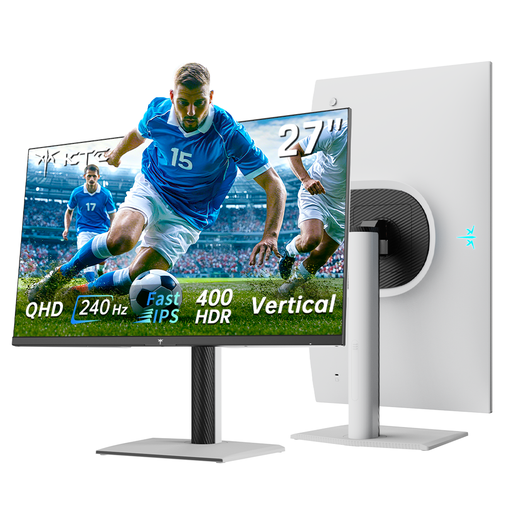
A QHD option for fast-paced games and use at the same desk. Check the refresh rate your computer can achieve through the input you’ve chosen.
2560 × 1440, Fast IPS and a native refresh rate of 240 Hz; the product name says it can be overclocked to up to 275 Hz. FreeSync and G-Sync compatibility are also listed.
Joybuy
Frequently asked questions
What should I check before choosing the highest possible refresh rate?
First check the frame rate your computer delivers in your game, and the refresh rate the monitor supports at your desired resolution through the input you’ll actually use. For fast-paced games, also compare independently tested motion handling and input lag.
Does a monitor for working from home need to be a particular size?
Simply working from home doesn’t mean there’s a single minimum screen size for your personal monitor. Germany’s ASR A6 guidance from the Federal Institute for Occupational Safety and Health applies, among other things, to screen-based workstations in workplaces and teleworking stations within its defined scope. It does not apply to private use outside such teleworking stations. If your employer has set up your workstation, check how it is classified with them.
How should I use an OLED monitor for office work?
ASUS notes that static, high-contrast images displayed for long periods may cause burn-in, and describes protection features. If you choose OLED, read the manual for the specific model and check its protection features and warranty terms. This guidance doesn’t automatically apply in the same way to every device.
Which labels and consumer rights are relevant when buying a monitor in Germany?
The European Commission includes computer monitors among the electronic displays covered by the EU energy label. Compare the label for the specific model. The Verbraucherzentrale distinguishes between your statutory rights against the seller and a voluntary guarantee. Online purchases generally come with a right to cancel, usually within 14 days; when the period starts and any exceptions depend on the specific contract and goods.


