What to look for when buying
First decide whether fine detail or smooth gameplay matters more to you. Then check whether a wider format or an OLED panel suits your game, your space and the way you use your monitor.
| Priority |
What to check when buying |
Who it matters most to |
| Detail on a large screen |
Consider screen size and native resolution together; with 4K, check how your system performs in the game you want to play. |
If I want to see furniture and small room details clearly, fine detail on a large screen is essential. Around 40% of consumers put image sharpness first. |
| Smooth gameplay |
Check resolution, refresh rate, connection and PC performance together; the Hz rating alone doesn’t tell you how many fps your system can achieve. |
If my PC can’t reach the frame rate I want at 4K, I want a large gaming screen without unnecessarily high graphics demands. Around 30% of consumers prioritise smooth gameplay. |
| Wide view and desk space |
Check whether your particular game supports 21:9, along with your desk’s width, stand depth and whether the screen’s curvature suits you. |
If I want more horizontal screen space while designing, the game needs to display the wider format properly and my desk needs to have enough room. A wide view is the main priority for around 20% of consumers. |
| Contrast and care |
Check the panel type, care instructions and written warranty terms for the specific model; reducing risk doesn’t mean eliminating it. |
If contrast matters more to me than maximum detail or a wider format, OLED could be a better fit – particularly if I’m careful to follow the care instructions. Around 10% of consumers prioritise image contrast. |
Joybuy products for expansive gaming
This selection includes 32-inch QD-OLED and QHD monitors, as well as 34-inch ultrawide models. For each one, check that the resolution, format and stated refresh rate suit your PC, your game and the space you have available.
 No image available
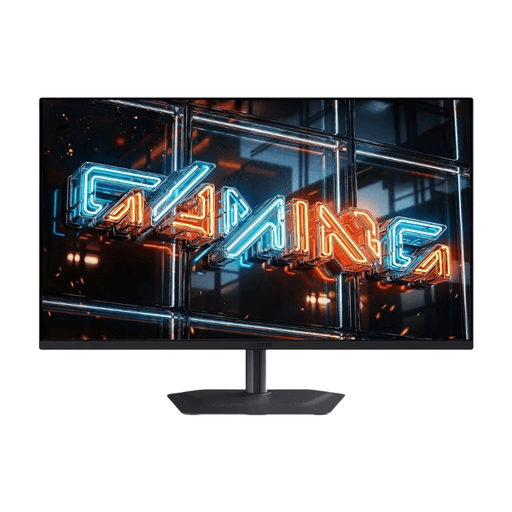
GIGABYTE MO32U24 OLED Gaming Monitor, 32 inches
An option if you want to compare a large 4K screen with QD-OLED.
The product title lists 32 inches, 3840 × 2160 pixels, QD-OLED, 240 Hz and a 16:9 format.
4K puts more strain on your PC than QHD; the frame rate you can achieve depends on your system and the game you’re playing.
View at Joybuy
 No image available
KTC H32S17 Gaming Monitor, 32 inches, QHD
This monitor could suit you if you’re looking for a large QHD screen instead of 4K and prefer a curved display.
The product title lists 2560 × 1440 pixels, 180 Hz, HVA, 1500R and Adaptive Sync.
At a similar screen size, QHD offers less fine detail than 4K; whether the curvature suits you depends on your seating position and how you use the monitor.
View at Joybuy
 No image available
Samsung Odyssey G5 G50F, 32 inches, QHD
A QHD option if you want a large screen and would rather avoid the extra demands of 4K on your system.
The product title lists 2560 × 1440 pixels, an IPS panel, 180 Hz, HDR10 and FreeSync.
At a similar screen size, QHD offers less fine detail than 4K; the frame rate you can achieve depends on your PC and game.
View at Joybuy
 No image available
INNOCN E34A1R, 34-inch ultrawide gaming monitor
This wide display could suit you if your particular game supports 21:9 properly and you have enough room on your desk.
The product title lists 34 inches, 3440 × 1440 pixels, 21:9, 200 Hz and 1500R curvature.
3440 × 1440 is not a 4K resolution; the extra width you see depends on how the game displays it.
View at Joybuy
 No image available
Xiaomi G34WQi ultrawide gaming monitor, 34 inches
A wide gaming screen could be right for you if you want a broader horizontal view and your game supports the 21:9 format.
The product specifications list 34 inches, 3440 × 1440 pixels and 180 Hz.
3440 × 1440 is not a 4K resolution; remember to measure the space available for the monitor too.
View at Joybuy
Frequently asked questions
Do I need 4K for virtual homes?
No, 4K isn’t essential. The higher pixel count can show fine details, but GameStar notes that it puts more strain on your PC. If smooth gameplay matters more, compare QHD based on how your own system performs.
What should I check before connecting and setting up my monitor?
Compare your PC’s outputs with the inputs on the specific monitor and check which resolution and refresh rate the connection supports. Also measure the space you’ll need, including room for the stand.
What does a monitor’s energy efficiency rating tell me?
The European Commission describes an A to G energy label for electronic displays, including computer monitors. Check the energy label and stated consumption figures for the specific model rather than assuming that screen size alone determines power use.
What are my rights when buying online in Germany?
For a standard online purchase by a consumer, you generally have a 14-day right to cancel; exceptions depend on the goods and the contract. If goods are faulty, you have statutory rights against the seller. EU guidance gives a minimum period of two years from receipt; this is separate from any voluntary manufacturer’s warranty.
Does OLED Care offer complete protection against burn-in?
No. MSI describes OLED Care 2.0 on the MPG 322URXDE as helping to reduce the risk, not as offering complete protection. Check the care instructions and written warranty terms for the specific model.


