For a better view from the cockpit
You want to see your instruments and surroundings across a wide PC screen, and can check whether your game displays 21:9 correctly.


A 21:9 ultrawide monitor is worth considering if your PC can handle the resolution and your game displays the format correctly, including its HUD. Otherwise, 16:9 is the simpler choice. Next, consider whether you prioritise OLED contrast or LCD, the frame rate you can actually achieve, and how you’ll connect your headphones for audio. Check these points for your specific gaming setup and monitor model, rather than choosing solely on the basis of the highest advertised refresh rate.
You want to see your instruments and surroundings across a wide PC screen, and can check whether your game displays 21:9 correctly.
Smooth motion matters to you, as does a refresh rate that matches your PC’s actual performance.
Contrast matters to you. If you’re considering OLED, factor in cockpit displays that stay on screen for long periods, as well as the panel’s care features.
| What matters | What to check before buying | Who will particularly value this |
|---|---|---|
| Cockpit view and aspect ratio | Check how 21:9 and the HUD display in your specific game, as well as the space you’ll need and your PC’s performance at the native resolution. | If I want to see as much of the cockpit and surroundings as possible, my game needs to display the wider format correctly. Around 33% of consumers put the extra cockpit view first. |
| Motion and frame rate | Compare your PC’s in-game performance with the resolution and mode supported by the input you’ll actually use. | For fast manoeuvres, I want a frame rate my PC can actually deliver, rather than relying on a maximum figure alone. Around 25% of consumers prioritise smooth motion. |
| Dark scenes and a static HUD | Check the panel type, care features and warranty terms for the exact model. Consider how long HUD elements stay unchanged on screen. | If dark space scenes matter to me, I also want to know how to manage cockpit displays that stay visible for long periods. Around 25% of consumers focus on contrast and a static HUD. |
| Headphone audio connection | Decide whether to connect your headphones to the monitor or directly to your gaming device, then check the socket and selected output device. | An easy-to-understand way to connect my headphones matters to me; I don’t necessarily need built-in speakers for gaming. Around 17% of consumers pay particular attention to the headphone audio connection. |
The display modes available also depend on your PC’s performance and the input you’re using. For the MSI MAG 274QRF QD E2, MSI lists up to 180 Hz at QHD over DisplayPort or USB-C, and up to 144 Hz over HDMI.
Check the mode table for the connection you’ll actually use, then compare it with your game’s performance.
The extra screen width is only useful if the specific game displays the format correctly, including its HUD. You’ll also need to make sure the screen and stand fit on your desk.
Check the game settings and HUD at your chosen resolution, and measure the space available.
A monitor can have a headphone output without built-in speakers. On a Windows PC, you’ll also need to select the audio device you want to use.
Decide how you’ll connect your headphones and check that the specific model has the right socket. In Windows, you can check which output device is selected.
ASUS describes the PG34WCDN’s OLED Care feature as a way to reduce the risk of burn-in. It doesn’t guarantee that burn-in won’t happen; warranty terms apply to the specific model.
Read the terms for the exact model and consider how long you use it with a HUD that stays visible on screen.
The PG34WCDN is a 34-inch QD-OLED monitor with a 21:9 aspect ratio, aimed at PC gamers looking to combine a wide screen with OLED.
The AW3425DW and AW2725Q are examples of models designed around different priorities: 34-inch ultrawide and 27-inch 4K, respectively.
The 34GS95QE-B is an example of a strongly curved 21:9 OLED monitor with a headphone output.
The MAG 274QRF QD E2 is a 27-inch, 16:9 QHD IPS monitor for buyers who don’t need an ultrawide display.
The options below include 16:9 QHD monitors, 34-inch UWQHD models and 4K OLED. What matters is whether your game supports the format you want and your PC can handle the resolution and frame rate.
 No image available
A 16:9 QHD option if you’d rather skip ultrawide and check how your game looks at 2560 × 1440.
Listed specifications include QHD, 144 Hz, a Fast IPS panel, HDR10 and 1 ms MPRT. HDMI and DisplayPort are listed.
 No image available
An option if you prioritise 4K and OLED over extra width; check whether your PC can reach your desired frame rate at 4K.
Listed specifications include 4K UHD (3840 × 2160), OLED and 240 Hz; the title also mentions 480 Hz at FHD and 0.03 ms GtG. HDMI, DisplayPort and a headphone output are listed.
If your cockpit displays stay visible on screen for long periods, make sure you follow the OLED care guidance.
 No image available
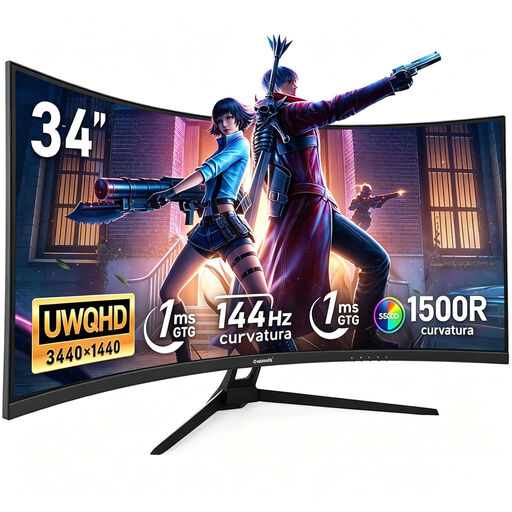
A wide-screen option if your game displays 21:9 correctly, including its HUD, and you have enough room on your desk.
Listed specifications include UWQHD (3440 × 1440), 144 Hz, 1500R curvature and a Fast VA panel. The title mentions HDR with 400 nits and no speakers.
 No image available
An ultrawide option for a better cockpit view, provided the specific game displays 21:9 correctly.
Listed specifications include UWQHD (3440 × 1440), 165 Hz, 1500R curvature and a VA panel. DisplayPort is listed.
 No image available
A 16:9 QHD option if you don’t need the extra horizontal screen space of an ultrawide.
Listed specifications include QHD (2560 × 1440), SuperSpeed IPS and a maximum refresh rate of 260 Hz; the title mentions up to 275 Hz with OC. HDMI 2.1, DisplayPort 1.4 and a headphone output are listed.
No, provided your headphones work with a suitable audio connection on your gaming device or monitor. Check the connection on the specific model; in Windows, you can select the output device you want to use.
Compare the mode supported by the input you’re using with your PC’s performance, then choose a suitable refresh rate. For the MAG 274QRF QD E2 at QHD, MSI lists up to 180 Hz over DisplayPort or USB-C and up to 144 Hz over HDMI.
If you choose an OLED model, take its care features and warranty terms into account. For the PG34WCDN, ASUS describes a feature that reduces the risk of burn-in, not one that prevents it altogether.
When buying online from a trader in the EU, you generally have a 14-day right to cancel from the date of delivery; faulty goods are covered by a minimum statutory guarantee of two years from receipt. Your Europe highlights possible exceptions and conditions that may apply to your specific situation.
EU energy-labelling and ecodesign requirements apply to electronic displays. The European Commission lists this product group under electronic displays; check the label on the specific device.