For detailed spaceship designs on a large screen, a 4K monitor is an obvious choice. If you’re more interested in having several tool windows open side by side, an ultrawide format could work, provided your software displays it well. OLED can be appealing for high-contrast gaming scenes, but if toolbars will stay on screen for long periods, check the care guidance and warranty terms for the specific model. The frame rate you can achieve also depends on your PC and connection.
Who is a large monitor right for?
Detail-focused spaceship designers
If you want to assess individual components as well as the entire 3D model, screen size and resolution both matter. LG Germany, for example, lists the 32GR93U-B as a 31.5-inch display with a resolution of 3840 × 2160 pixels.
Designers with lots of windows open
If you want to see references, your design and your tools all at once, extra horizontal screen space can be useful. What matters is whether your design software and games support the aspect ratio you choose.
Designers who enjoy immersive gaming, too
If you plan to play after designing, make sure the frame rate and connections match your PC’s output. With OLED, you should also consider how you use static image elements and check the guidance from the relevant manufacturer.
What should you look for when buying?
For design and gaming, first match the screen space and resolution to how you arrange your windows. Then choose a panel, frame rate and PC connection that suit the way you use your monitor.
| What matters |
What to check before buying |
Who is this important to? |
| Screen space and design detail |
Compare screen size and native pixel resolution together. |
If I want to assess individual components and the overall view on the same screen, the size and resolution need to work together. Around 29% of consumers put a large, detailed design view first. |
| Windows side by side |
Check the aspect ratio, native resolution and compatibility with your software. |
If you want to see your design, tools and references at the same time, a wider format can help. Around 23% of consumers say space for multiple windows is their top priority. |
| Smooth motion |
Check the frame rate at native resolution against your connection and PC output. |
If you rotate the model and then play games, a high refresh rate only matters if the rest of your setup can keep up. Around 18% of consumers prioritise smooth motion when gaming. |
| Contrast in dark scenes |
Compare the panel type and the specific HDR certification listed for the model. |
If dark gaming scenes and visual checks of your design are particularly important, take time to consider the image quality. Contrast comes first for around 18% of consumers. |
| Static toolbars |
Check the OLED care guidance and warranty terms for the exact model. |
If toolbars stay in the same place for long periods, how they remain visible over time is part of choosing a panel. Around 12% of consumers prioritise how static content is handled. |
Common buying misconceptions
-
A larger screen size automatically means a sharper design image
Screen size and native resolution are different things. A wide display with 3440 × 1440 pixels doesn’t have the same number of vertical pixels as a 3840 × 2160 display.
Compare the screen size, aspect ratio and pixel resolution with the way you actually arrange your windows.
-
OLED protection features eliminate all risk of burn-in
Manufacturers describe measures for caring for OLED screens, but that doesn’t guarantee burn-in won’t happen. If toolbars stay visible for long periods, how the screen handles static image elements is an important factor in your choice.
Compare your everyday usage with the care guidance and warranty terms for the specific model. You could also consider an IPS model.
-
The highest quoted refresh rate is automatically the frame rate you’ll get in games
A monitor’s refresh rate alone doesn’t tell you what frame rate your game will actually achieve. The resolution, connection and PC output also need to support the image you want.
Check the combination of native resolution, refresh rate and connection for the exact model and your PC.
Key brands to consider
LG
The UltraGear 32GR93U-B is a specific example of a 31.5-inch 4K IPS monitor for design and gaming.
- LG Germany lists a resolution of 3840 × 2160 pixels, 144 Hz, height adjustment, HDMI 2.1 and DisplayPort 1.4 for this model.
- These features apply to the 32GR93U-B and don’t automatically apply to other UltraGear models.
MSI
The MPG and MAG ranges include different large QD-OLED models for gaming and design.
- MSI lists 240 Hz for the MPG 321URXDE. For the MAG 321UPX, the manufacturer lists OLED Care 2.0 and three years of OLED cover, including burn-in.
- These details refer to different models. Care features and warranty terms aren’t an independent measure of durability, so check them for the exact monitor you’re considering.
Samsung
The Odyssey OLED G8 G81SF, model code LS32FG814SUXEN, is an example of a 32-inch 4K QD-OLED monitor.
- Samsung lists 240 Hz and Glare Free for this version.
- The manufacturer’s descriptions of its burn-in prevention measures don’t guarantee that burn-in can’t happen.
Philips
The Evnia range includes both a 34-inch ultrawide model and a 31.5-inch 4K monitor.
- Philips lists a resolution of 3440 × 1440 pixels for the Evnia 34M2C8600P/00 and 3840 × 2160 pixels for the 32M2N8900AM/00.
- The format alone doesn’t guarantee that a particular design app will use the screen space as you’d like.
LC-Power
The LC-M32UCO is an example of a curved 31.5-inch 4K QD-OLED monitor.
- LC-Power lists a 165 Hz refresh rate and 1700R curvature for this model.
- Whether the curve suits the way you work is a personal choice about the screen format.
Alienware
The AW3225QF is a curved 32-inch 4K QD-OLED monitor for both design and gaming.
- Dell lists a resolution of 3840 × 2160 pixels and 240 Hz for this model.
- If you want to assess straight lines on a flat display, take the curved screen into account when choosing.
Joybuy products for design and gaming
The Joybuy models featured here are large 4K monitors for design and gaming. All four product names specify OLED technology, so if you spend long sessions with static toolbars on screen, check the care guidance and warranty terms for each model.
 No image available
TCL 32x3A OLED+ 4K monitor
The stated 4K resolution is useful for a large design view. Check that the frame rate works with your PC and connection.
32 inches; 3840 × 2160 pixels; product name states 240 Hz at 4K and 480 Hz in FHD mode.
View at Joybuy
 No image available
MSI MPG 322URXDE QD-OLED
The large 4K format suits a detailed design view. If you use static toolbars, consider OLED care and the terms for the specific model.
32 inches; 3840 × 2160 pixels; 240 Hz; DisplayHDR True Black 400; HDMI 2.1 and DisplayPort 2.1a; USB-C with 98 W PD; height-adjustable.
View at Joybuy
 No image available
ASUS ROG Swift OLED PG32UCDMR
This OLED model combines a stated 4K resolution with a high refresh rate. Check what output your PC can deliver through the connection you choose.
32 inches; 3840 × 2160 pixels; 240 Hz; DisplayHDR 400; DisplayPort 2.1, HDMI 2.1 and USB-C with 90 W.
View at Joybuy
 No image available
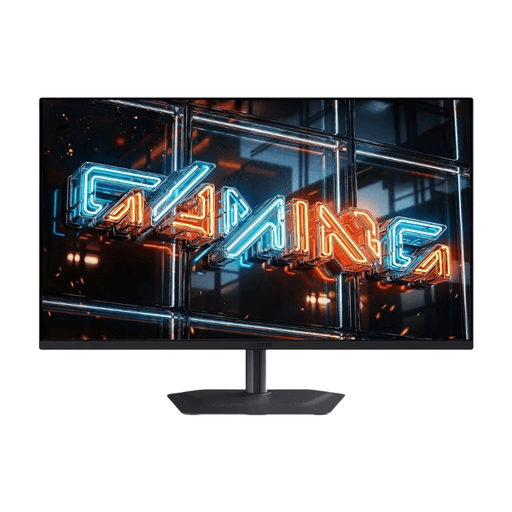
GIGABYTE MO32U24 OLED
The flat screen may be useful when assessing straight lines. Consider whether you prefer a curved or flat display.
32 inches; 3840 × 2160 pixels; product name lists tilt, swivel, height adjustment and pivot, as well as HDMI, DP and USB.
View at Joybuy
Frequently asked questions
Can you always use 4K and a high refresh rate at the same time?
No. Check the native resolution and maximum refresh rate against the specific connection and your PC’s output. The monitor’s refresh rate alone doesn’t guarantee the same frame rate in games. For example, LG Germany lists 144 Hz for the 32GR93U-B.
What should I measure before buying a large monitor?
Measure the space available on your desk and check the adjustment options listed for the specific model. For example, LG Germany lists height adjustment and a 100 × 100 mm VESA mount for the 32GR93U-B; these details apply to that model.
How can I compare the running costs of different monitors?
Compare the energy labels for the specific models. To estimate your own costs, also take your usage time and electricity tariff into account. The European Commission includes monitors as electronic displays in its energy labelling scheme.
Which return and fault-related rights matter when buying online in Germany?
Consumers generally have a 14-day right to cancel a distance purchase; your rights if an item is faulty are separate. The Verbraucherzentrale also points out that a voluntary guarantee is not the same as your statutory rights. Check the terms that apply to your specific purchase.


