Who benefits from which specification?

3D modellers

If you mainly work on shapes, components and scenes interactively, choose a PC to suit your software and the scale of your projects. Puget Systems highlights the importance of strong single-core CPU performance for modelling and animation work; the Blender Foundation recommends 32 GB of RAM for Blender.

People who render and game

If you want to render scenes on the GPU and then play games on the same computer, check that the exact configuration supports the right rendering backend and has enough graphics memory. The Blender Foundation notes that complex scenes may be limited by the available memory when rendering on the GPU.

Buyers short on space

If you plan to keep your PC in your home office, check its case dimensions and required connections against your available space and existing equipment. A product description such as ‘compact’ doesn’t tell you how noisy a specific model is or how well it’s ventilated.

What matters when buying?

Consideration What to check when buying Who it matters most to
Interactive 3D work Check the processor, installed RAM and upgrade options for the exact variant. The Blender Foundation recommends 32 GB of RAM for Blender; this isn’t a minimum requirement for every project. If I’m working on larger scenes or using several programmes, I pay particular attention to the processor and memory. Around 40% of consumers prioritise modelling when choosing a PC.
GPU rendering Check the graphics memory of the exact GPU and support for your chosen rendering backend. If I want to render frequently in Blender Cycles using the graphics card, I check that the backend and memory are suitable for my scenes. Around 30% of consumers put GPU rendering first.
Gaming alongside creative work Compare the requirements of the games you actually play with the specifications of the exact PC variant. If I want to play games and design a spaceship on the same computer, I factor in both tasks when choosing. Around 20% of consumers initially prioritise gaming.
Space and connections Check the case dimensions and the video and USB connections you need against your own workspace. If space is limited or I want to connect existing monitors, I check the dimensions and connections of the exact variant. Around 10% of consumers prioritise the space the PC takes up.

Common buying misconceptions

  • Comparing only the gaming graphics card

    Modelling, CPU-based tasks and GPU rendering can all have different requirements. A gaming GPU that looks suitable doesn’t tell you on its own whether the processor and memory will also suit your projects.

    First, prioritise modelling, rendering and gaming according to your needs. Then compare the RAM, processor and graphics card in the complete model variant with your software and projects.

  • Assuming the range name tells you what’s inside

    A desktop range can include different configurations. Graphics memory, connections and case dimensions may vary between model numbers.

    Check the full model number and its specifications rather than assuming details from another variant apply.

  • Confusing a guarantee with your statutory rights

    A guarantee is voluntary; statutory rights relating to faulty goods are against the seller. The Verbraucherzentrale (German consumer advice centre) clearly distinguishes between these rights.

    Read the guarantee terms separately from the information about your statutory rights, and contact the seller if you have questions about a fault.

Relevant brand ranges to consider

HP OMEN 35L

A specific OMEN configuration to compare for gaming and creative GPU workloads.

  • HP lists the GT17-0770ng with 32 GB of RAM, a 1-TB SSD and an RTX 5070 Ti with 16 GB of graphics memory.
  • HP describes the range as upgradeable; this doesn’t independently confirm its cooling, noise levels or support for every possible upgrade.

Lenovo Legion Tower

A desktop range with clearly listed configurations that can be compared by model number.

  • Lenovo lists the Legion Tower 5i Gen 10, product number 90YA009TGF, with 32 GB of RAM, a 1-TB SSD and an RTX 5070 with 12 GB.
  • The manufacturer’s claims about gaming suitability aren’t a Blender or gaming benchmark for this configuration.

Acer Predator Orion 3000

An example of a tower where you should check the specifications and dimensions for the exact variant.

  • Acer lists the PO3-655, reference DG.E45EG.00F, with 32 GB of RAM, a 1-TB SSD and an RTX 4070 SUPER with 12 GB of graphics memory.
  • These specifications apply to the variant named and can’t automatically be assumed to apply to other Orion 3000 models.

ASUS ROG

The ROG model range includes different desktop formats to compare for your home office.

  • The German model range includes, among others, a ROG GR70 mini PC and larger ROG G1000 desktops.
  • The variety of models doesn’t mean that the entire range has consistent performance, noise levels or upgrade options.

PCs for 3D work and gaming

This Joybuy selection includes gaming desktops and a mini PC to suit different requirements for rendering, memory and desk space.
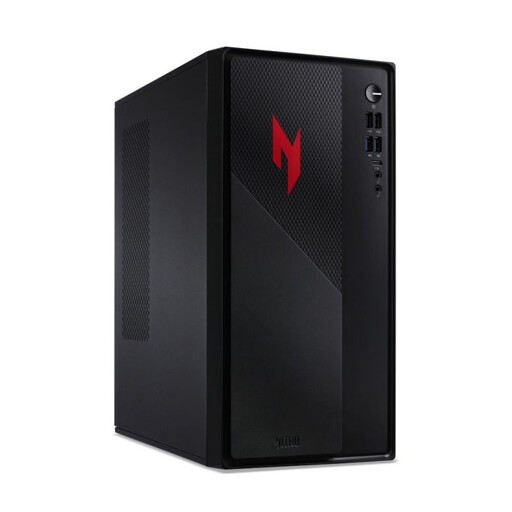
Acer Nitro 20 N20-100 desktop i5 with 32 GB RAM, 1 TB SSD, 1 TB HDD and RTX 5060

Acer Nitro 20 N20-100 desktop i5, 32 GB, 1 TB, RTX 5060

A desktop configuration with clearly listed specifications for buyers who want to use one computer for gaming and creative applications.

32 GB RAM; 8-core processor; RTX 5060 with 8 GB of graphics memory; 1 TB SSD and 1 TB HDD. Leave at least 10 cm of clearance on all sides for ventilation.

View at Joybuy

Dell Alienware Aurora ACT1250 1J3N5 with Core Ultra 9 285K, 32 GB RAM, 2 TB SSD and RTX 5080

Dell Alienware Aurora ACT1250 1J3N5, Core Ultra 9 285K

A configuration with listed components for buyers weighing up GPU rendering and gaming on the same desktop.

24-core processor; 32 GB RAM; RTX 5080 with 16 GB of graphics memory; 2 TB SSD. Keep the ventilation openings clear.

View at Joybuy
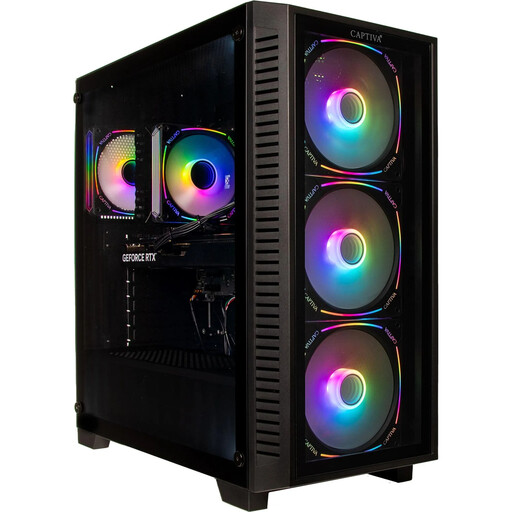
Captiva Highend Gaming PC R89-503 with Ryzen 7 7800X3D, RTX 5070 Ti and 32 GB RAM

Captiva Highend Gaming PC R89-503, Ryzen 7 7800X3D

A tower configuration for buyers who want to combine 3D work, GPU rendering and gaming with a dedicated graphics card that has clearly listed specifications.

8-core processor with 16 threads; 32 GB DDR5 RAM; RTX 5070 Ti with 16 GB of graphics memory; 2 TB M.2 SSD. Remove the internal protective material before switching on, then place the tower on a hard, level surface with 10–15 cm of clearance behind it.

View at Joybuy
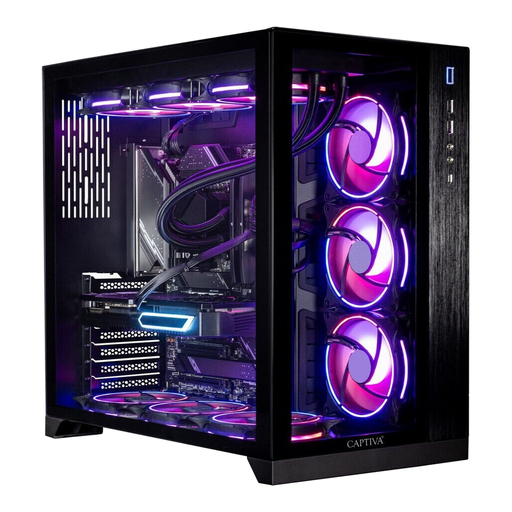
Captiva Highend Gaming PC R90-463 with Ryzen 7 7800X3D, RTX 5070 Ti and 64 GB RAM

Captiva Highend Gaming PC R90-463, Ryzen 7 7800X3D

This variant has more memory than the R89-503 configuration; whether that matters for your projects depends on your software and scene complexity.

8-core processor with 16 threads; 64 GB DDR5 RAM; RTX 5070 Ti with 16 GB of graphics memory; 2 TB M.2 SSD. Remove the internal protective material before switching on, then place the tower on a hard, level surface with 10–15 cm of clearance behind it.

View at Joybuy

FIREBAT F1 mini PC with Ryzen 5 7640HS, 24 GB RAM and Radeon 760M

FIREBAT F1 mini PC, Ryzen 5 7640HS

A mini PC for a space-conscious workspace. Before choosing, check that its listed specifications are suitable for your 3D projects.

6-core processor with 12 threads; 24 GB LPDDR5 RAM; 512 GB PCIe 4.0 SSD; Radeon 760M graphics; USB 4.0 and HDMI 2.1. The Blender Foundation recommends 32 GB of RAM for Blender. It’s listed as supporting up to three displays.

View at Joybuy

Frequently asked questions

Do I definitely need 32 GB of RAM to create a virtual spaceship?

No, not just because of the subject matter. The Blender Foundation lists 8 GB as the minimum and 32 GB as the recommended amount for Windows. When choosing, take your software version, scene size and any programmes you’ll have open at the same time into account.

How do I enable rendering on the graphics card in Blender?

In the Cycles settings, choose a backend supported by your GPU and set the scene to ‘GPU Compute’. The Blender Foundation documents CUDA and OptiX for supported NVIDIA cards, and HIP for supported AMD cards, among others. Driver requirements depend on the backend.

What should I check before setting up the PC and upgrading it later?

Compare the dimensions and connections of the exact PC variant with your workspace. If you’re planning upgrades, also check the documentation for the specific case and power supply. A promise that a product range is upgradeable doesn’t guarantee that every upgrade you want will be possible.

What are my rights in Germany if something is faulty or I buy online?

Your statutory rights relating to faulty goods are against the seller and are separate from a voluntary guarantee. The Verbraucherzentrale (German consumer advice centre) says that newly purchased goods generally carry statutory rights for two years. For online purchases, you usually have a 14-day right to cancel from the date you receive the goods, subject to the circumstances and any applicable exceptions.

What should I look for in safety and compliance information?

For the specific device on offer, check the CE marking, manufacturer information and any required safety information in German. The Bundesnetzagentur (German Federal Network Agency) lists these as aspects of market surveillance. According to information from the European Union, the manufacturer is responsible for meeting the applicable requirements and affixing the CE marking. The mark is not a general, independent quality endorsement.