
Lieferung heute & morgen

Qualitätsgarantie

Willkommens-Angebote freischalten: KOSTENLOSE Lieferung | Bis zu 80 % RABATT | Kostenlose 30-Tage-JoyPlus-Testphase
App herunterladen
A gaming PC case shouldn't just match your setup. It needs to house your existing components, manage heat dissipation effectively, and leave enough room for future upgrades. Many purchases go wrong because buyers focus solely on ARGB lighting, glass panels, or the number of included fans.
Common pitfalls include:
The motherboard largely determines the right case category. A classic ATX PC case typically accommodates ATX, Micro-ATX and Mini-ITX boards. For larger boards, you'll need a PC case for E-ATX. Always check the manufacturer's specifications carefully, as E-ATX doesn't always refer to the same dimensions.
A mid-tower case offers a balanced compromise between footprint and expandability for most gaming systems. If you're only using a Micro-ATX or Mini-ITX motherboard, you can choose a more compact case. A Micro-ATX case or Mini-ITX case saves desk space, but depending on the model, it may limit the number of drives, expansion cards and fan mounts.
Before buying, you should compare at least three measurements:
Some models from our selection offer generous allowances: the XPG STARKER AIR BTF supports graphics cards up to 390 mm and CPU coolers up to 180 mm, according to the manufacturer. The XPG VALOR AIR PRO offers up to 400 mm GPU length and 167 mm cooler height. For particularly long graphics cards, the GAMDIAS ATLAS P2 is interesting, with a stated GPU support of up to 430 mm. However, you should always cross-check your own hardware's dimensions against your specific build configuration.
An airflow PC case typically has a perforated or fully mesh front panel. A directed airflow path makes sense: cool air in from the front or bottom, warm air out from the back or top. Dust filters on the intake points make maintenance easier.
With a gaming case for water cooling, it's not just the maximum radiator size that matters. The mounting position, radiator thickness including fans, and clearance from RAM, motherboard and graphics card are all important. The NZXT H7 Flow supports a front radiator up to 420 mm and a top radiator up to 360 mm, according to the product specs. The XPG STARKER AIR BTF and the XPG VALOR AIR PRO both support radiators up to 360 mm at the front and top respectively.
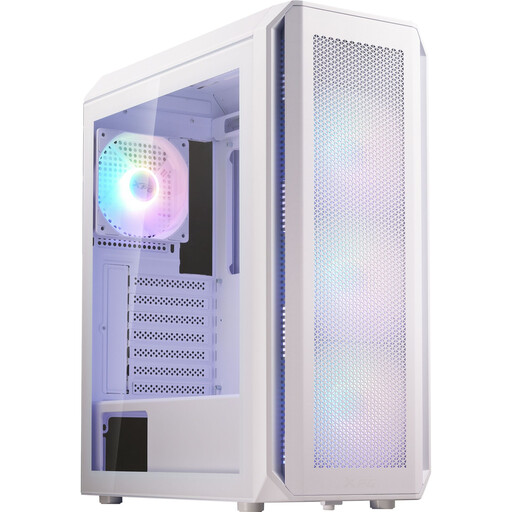
Why this product fits the profile: This mid-tower case supports ATX, Micro-ATX and Mini-ITX and comes with four pre-installed 120 mm ARGB fans. That makes it ideal for a straightforward build without needing to buy extra case fans straight away.
The GPU and cooler height specifications are clearly stated: up to 340 mm and 160 mm respectively. That makes it easy to check compatibility before buying.
Four 120 mm ARGB fans, support for a front radiator up to 360 mm, and a tempered glass side panel.
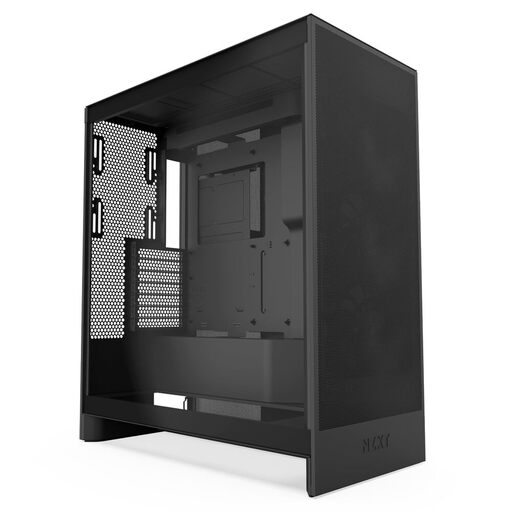
Why this product fits the profile: This case is aimed at high-performance ATX systems where mesh panels, cable management and flexible radiator positions matter more than a completely solid front panel.
The mesh design promotes air exchange, and three 120 mm front fans are pre-installed. The interior also has mounting points for three additional fans targeting the GPU area.
Support for front radiators up to 420 mm and top radiators up to 360 mm, plus dedicated bottom fans for the graphics card.
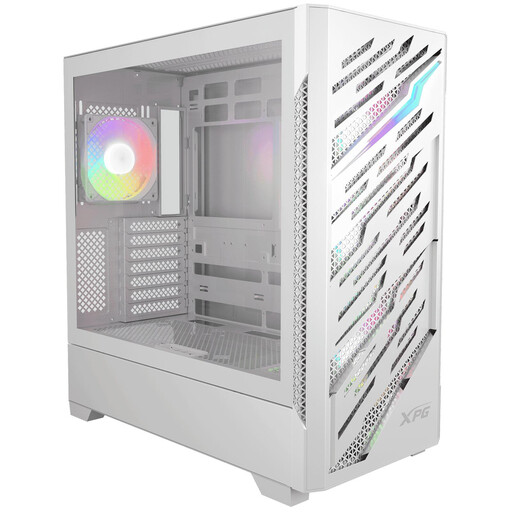
Why this product fits the profile: This model is ideal for users who want to combine E-ATX, ATX and reverse-connector motherboards while also needing plenty of fan or radiator options.
Support for multiple motherboard formats and the stated clearances for GPU, CPU cooler and power supply make it easier to plan future upgrades.
Four pre-installed 120 mm ARGB fans, up to twelve fan mounts, radiator support up to 360 mm, and a front panel with USB-C.
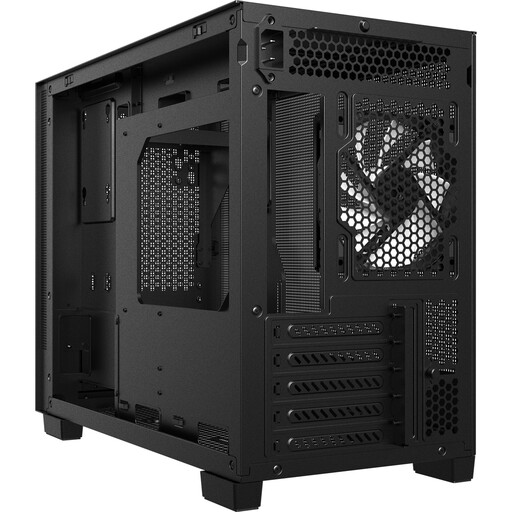
Why this product fits the profile: This compact Micro-ATX case is designed for smaller builds, without compromising on modern front panel connectors or long graphics card support.
The mesh front panel with dust filter addresses the limitation of solid front panels. However, you should check your Micro-ATX or Mini-ITX motherboard and power supply length before buying.
GPU support up to 370 mm, top radiator up to 360 mm, and USB-C 3.2 Gen 2 on the front panel.
We've put together a complete, regularly updated list of products that fully meet these strict selection criteria and the safety regulations in force in the EU.
For most systems, two or three front fans for intake and one rear exhaust fan provide a practical foundation. With high-performance hardware, additional fans on the top or bottom can be beneficial. What matters most are the positions, the direction of rotation, and an unobstructed airflow path.
No. The radiator size, mounting position, RAM height and graphics card length all need to be compatible. A case that supports 360 mm doesn't guarantee that every 360 mm radiator can be mounted in every position. You should therefore check the technical specifications of both the case and the cooler together.
The lifespan depends on the materials, mechanical stress and how well it's maintained. Steel frames can last through many upgrade cycles with careful use. Dust filters should be cleaned regularly, and tempered glass panels should be handled with care. Always disconnect the PC from the mains power before any modification.