For repeated collision and physics tests, choose a CPU and memory that suit your project rather than selecting a graphics card on performance alone. A mini PC saves desk space, while a tower needs more room for its components and potential upgrades. In either case, check the ports, airflow and noise levels under your actual workload. As Unity explains, more powerful hardware won’t fix unsuitable collision detection settings.
Who is this buying guide for?
Physics testers
If you run collision scenes repeatedly or work on them in an engine, it’s worth considering CPU usage alongside your project settings. Unity describes physics calculations as CPU-intensive; requirements for Unity and Epic Games vary depending on the project and development environment.
People sharing a desk
If you share your desk, you’ll need to weigh up case size, ports and clear airflow against the features you need. Compact devices can vary considerably in their graphics specifications, so the exact model variant is what matters.
Graphics and upgrade planners
For visually demanding scenes or planned hardware changes, check the exact GPU and the upgrade options documented for the specific system. Epic Games publishes recommendations for Unreal development; these aren’t blanket minimum requirements for every gaming PC.
What should you look for when buying?
Your test requirements and the conditions at your shared workspace are what count. Check the exact configuration, where you’ll place the PC and the graphics demands of your actual workload.
| Consideration |
What to check when buying |
Who should pay particular attention? |
| Physics testing and editor performance |
Check the CPU and RAM in the exact variant, as well as SSD capacity. Epic Games recommends 32 GB RAM for Unreal development, but this isn’t a general minimum; Unity notes that larger projects need more memory. |
If I repeatedly simulate physics scenes or work in an editor, I want to be able to distinguish bottlenecks from simulation settings. Around 25% of consumers put physics and editor performance first. |
| Space at a shared desk |
Check the case dimensions, power supply, cable routing and clearance required at your chosen spot. Compare the monitor, USB and network connections with your own devices. |
If you share your desk, you need a PC that fits the available space without awkwardly positioned ports or airflow. Desk space is a priority for around 25% of consumers. |
| Noise and heat |
Where available, consult noise measurements for the exact model and workload. Keep air vents clear, and don’t treat manufacturer cooling claims as equivalent to independent noise measurements. |
If other people work at the same desk, I want to take noise and exhaust air into account under my own test workload. Around 20% of consumers prioritise keeping shared use as undisturbed as possible. |
| Graphics for test scenes |
Choose your engine, rendering features and target resolution; also check the GPU type and graphics memory in the exact variant. Epic’s figure of at least 8 GB graphics memory applies to the specific Unreal use case it describes. |
For visually demanding scenes, I want to choose a suitable GPU without confusing graphics performance with the CPU work involved in physics tests. The graphics demands of their own tests are the main consideration for around 15% of consumers. |
| Upfront cost and future changes |
Compare the RAM and SSD included, along with any upgrade options explicitly documented for the exact model. Specifications for a product range don’t automatically apply to every variant. |
If I’m weighing up the purchase price against possible future changes, I want to know which components are actually included and upgradeable. Around 15% of consumers prioritise these cost and upgrade considerations. |
Avoid common buying mistakes
-
Assuming a high frame rate means collisions are working correctly
A high frame rate doesn’t confirm that your scene is detecting collisions as intended. Unity describes a trade-off between processing demands and detecting fast-moving collisions.
Test your own scene and check the simulation step, collision mode and CPU usage before choosing a more powerful GPU solely because collisions are being missed.
-
Assuming every model in a range has the same specifications
Different components may be offered under the same range name. A current model name doesn’t automatically tell you what’s included in an older variant, either.
Compare the full model number and the components included in the specific product on offer with what you need.
-
Choosing the smallest PC without considering where it will go
A compact design doesn’t guarantee quiet operation under sustained load or suitable graphics performance. Case size, cooling and graphics specifications are separate considerations.
Check the dimensions, ports and airflow at your chosen spot. When looking at noise claims, make sure they relate to the exact device and workload.
Key brands to consider
ASUS ROG
The ROG NUC range is a compact option if you need to save desk space and want a dedicated GPU.
- ASUS lists different laptop GPUs, RAM configurations and ports for variants of the ROG NUC (2025).
- Specifications for one variant don’t indicate the performance of another or guarantee a particular noise level.
GEEKOM
The A8 Max is a mini PC option for buyers looking to save desk space and match the specifications to their specific graphics workload.
- GEEKOM lists A8 Max variants with different amounts of RAM and describes upgrade options for RAM and SSDs.
- Manufacturer claims about quiet operation under sustained load or gaming aren’t independent measurements; check the specific variant on offer.
HP OMEN
The OMEN 35L GT16-0776ng is a tower option for buyers with room for a larger case.
- For this variant, HP lists 32 GB RAM, a 1-TB SSD and a GeForce RTX 5070 with 12 GB.
- Cooling and upgrade claims for the range aren’t a measurement of noise at a shared desk.
MEDION ERAZER
The Bandit P20 is described as a more compact gaming tower option; different specifications are available under this range name.
- For the variant with a Core Ultra 7 265F, MEDION lists an RTX 5070, 32 GB RAM and a 1-TB SSD.
- The manufacturer’s description of a compact case doesn’t provide measured dimensions or noise levels for other Bandit P20 versions.
Acer Predator
The Orion 3000, as described by Acer, is a tower for buyers considering a larger PC rather than a mini PC.
- Acer describes configurations up to a Core Ultra 7 265F and RTX 5070 for the current Orion 3000 range.
- These specifications aren’t the full details of the older PO3-650 and shouldn’t be treated as equivalent.
Joybuy products for collision testing and shared desks
This selection includes gaming towers and mini PCs for shared workspaces. Compare your project requirements with the CPU, RAM and graphics, as well as the space needed for the specific variant.
 No image available
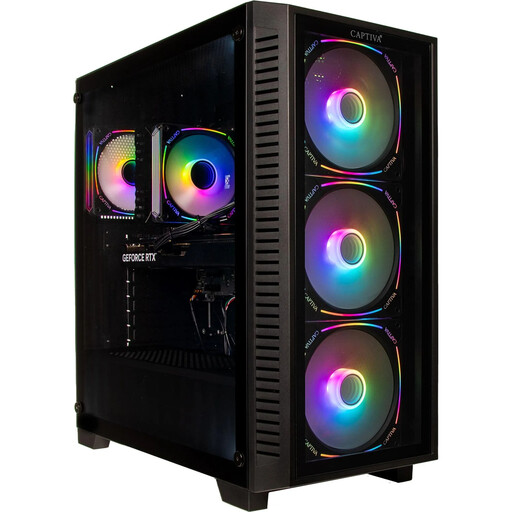
Captiva High-end Gaming PC R89-503
This tower configuration pairs a Ryzen 7 7800X3D with dedicated graphics, making it suitable for tests that put demands on both the CPU and GPU.
AMD Ryzen 7 7800X3D, 32 GB DDR5, RTX 5070 Ti with 16 GB, 2 TB SSD and Windows 11 Home.
The case is listed as measuring 44 × 28 × 44 cm; the placement instructions call for an additional 10–15 cm of clearance from the wall.
View at Joybuy
 No image available
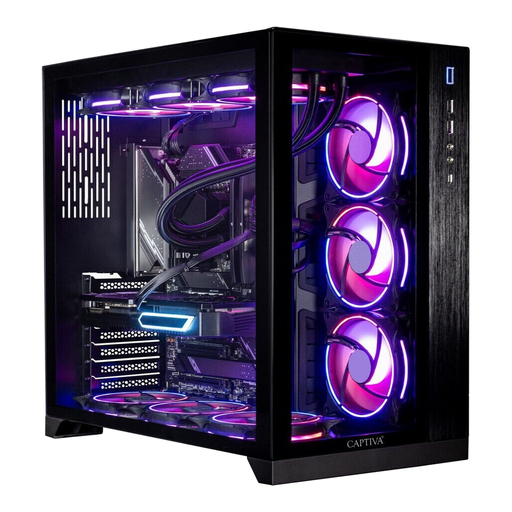
Captiva High-end Gaming PC R90-463 R7
With 64 GB RAM and dedicated graphics, this tower variant is designed for projects where you need to allow for extra memory.
Ryzen 7 7800X3D, 64 GB RAM, RTX 5070 Ti with 16 GB, 2 TB SSD and Windows 11.
The case is listed as measuring 44 × 28 × 44 cm; the placement instructions call for an additional 10–15 cm of clearance from the wall.
View at Joybuy
 No image available
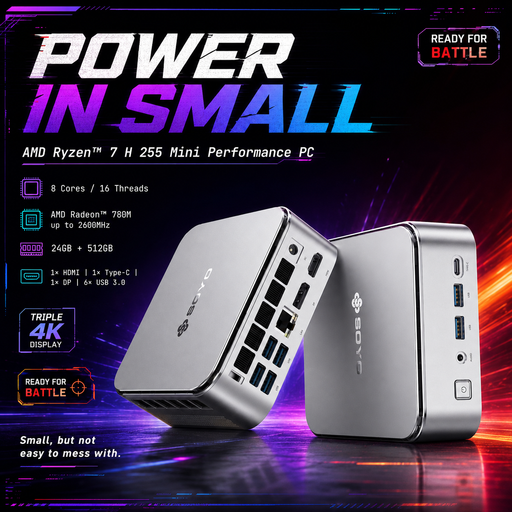
SOYO S4PLUS Mini PC Ryzen 7 H255
Its compact form makes it a good fit for a workspace with limited room, provided the integrated graphics are powerful enough for your tests.
Ryzen 7 H255, 24 GB LPDDR5, 512-GB-PCIe-3.0-SSD and integrated Radeon 780M. Listed dimensions: 128 × 128 × 47,6 mm.
Epic Games recommends 32 GB RAM for Unreal development; this model’s listed specification is below that. It has integrated, not dedicated, graphics.
View at Joybuy
 No image available
FIREBAT F1 Mini PC Ryzen 5 7640HS
This mini PC is worth considering if desk space is at a premium and its integrated graphics are suitable for the scene you’re testing.
Ryzen 5 7640HS, 24 GB LPDDR5, 512-GB-PCIe-4.0-SSD and integrated Radeon 760M.
Epic Games recommends 32 GB RAM for Unreal development; this model’s listed specification is below that. It has integrated, not dedicated, graphics.
View at Joybuy
 No image available
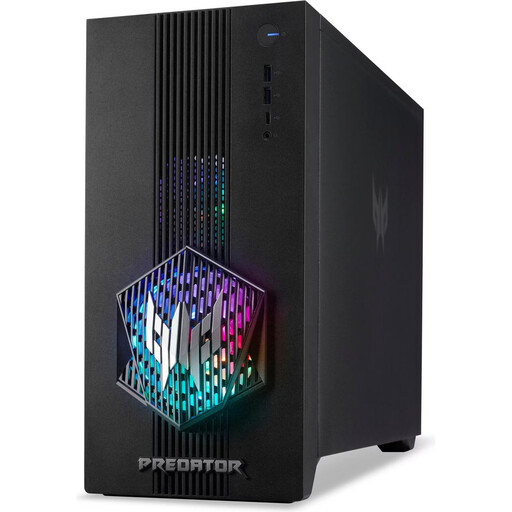
Acer Predator Orion 3000 Desktop i5
This tower combines a dedicated GPU with stated RAM expandability up to 32 GB. Check that its current specification suits your project.
16 GB RAM, 512-GB-M.2-SSD and RTX 5060 with 8 GB graphics memory. RAM expandability up to 32 GB is listed.
Epic Games recommends 32 GB RAM for Unreal development. Listed dimensions: 378 × 190 × 438 mm; the placement instructions require at least 10 cm of clearance.
View at Joybuy
Frequently asked questions
Will a more powerful graphics card automatically make collision tests more reliable?
No. Unity describes simulation frequency and collision processing as CPU-intensive. For fast-moving objects, the choice between discrete and continuous collision detection can matter; continuous methods typically use more processing resources. Start by checking behaviour and usage in your test scene.
What should I check before setting up at a shared desk?
Compare the case, power supply, cables and ports you need with the space actually available. Keep the airflow clear in line with the instructions for the specific device; a small form factor alone doesn’t give you a reliable indication of noise under your test workload.
What return and fault rights apply to private online purchases in Germany?
For a consumer distance contract, you generally have a 14-day right to cancel, starting from the day you receive the goods. Statutory consumer rights cover faults and apply against the seller; a voluntary guarantee is separate. Check any exceptions and the terms of the specific contract separately.
What should I look for to check that a PC sold in Germany complies with product requirements?
For electrical and electronic products where applicable, look for the CE marking and check that it has been applied correctly. The Federal Network Agency lists CE marking as a subject of market surveillance. It isn’t an independent performance or noise test.


