Character illustrators short on space
If you mainly draw in 2D, you’ll need room for a monitor and drawing tablet as well as your PC. Check the system requirements for your games, too, not just those for your painting software.


Choose a PC that suits the painting software and games you actually plan to use, then measure the space for the computer, monitor, drawing tablet, cables and ventilation. A mini PC takes up little desk space, but may have limitations when it comes to ports and upgrades. A compact desktop needs more room, although depending on the model it may offer different upgrade options.
If you mainly draw in 2D, you’ll need room for a monitor and drawing tablet as well as your PC. Check the system requirements for your games, too, not just those for your painting software.
When painting 3D models or textures, make sure the software version, RAM, graphics memory and graphics compatibility all meet your needs.
If you want to game and draw at the same small desk, you’ll need to weigh up the space available, ports, noise levels and potential future upgrades.
A good fit if: You mainly draw in a 2D programme and the PC also meets the requirements of your games.
The trade-off: A small form factor alone doesn’t mean a PC is powerful enough for demanding games or 3D textures.
A good fit if: Desk space is limited and you also want to use more demanding games or 3D applications.
The trade-off: Compare the specific GPU and its graphics memory with your software requirements. You can’t assume a laptop GPU is equivalent to a desktop GPU just from its model number.
A good fit if: There’s room for a larger case alongside your monitor and drawing tablet, and ports or replaceable components matter to you.
The trade-off: Measure the specific case and allow for clear airflow. A desktop GPU alone doesn’t guarantee quiet operation or make a PC suitable for every project.
The percentages refer to consumers choosing a PC for drawing a game character at a small desk. Each figure represents their main purchasing priority.
| Buying criterion | What to check before buying | Who it matters most to |
|---|---|---|
| Desk space and drawing area | Measure the space needed for the case, cables and ventilation; check the dimensions and possible placement of the specific model. | If there’s little room left alongside your monitor and drawing tablet, you’ll want a PC that takes up as little space as possible. Around 36% of consumers put available desk space first. |
| 2D painting and gaming | Krita recommends 16 GB RAM and lists OpenGL 3.0 or Direct3D 11; check the requirements for your games separately. | If you mainly draw in 2D and want to play particular games, you’ll need to check that the PC meets the requirements of each programme. Around 29% of consumers prioritise this combination of 2D painting and gaming. |
| 3D textures and graphics memory | For Windows, the Blender Foundation recommends 32 GB RAM and 8 GB VRAM. Adobe’s requirements dated 19 October 2026 list 16 GB RAM and 8 GB VRAM as the minimum for Substance 3D Painter, and recommend 32 GB RAM and 16 GB VRAM. | If you paint 3D models or textures, the specific GPU needs to work with your software version. Around 21% of consumers put 3D painting and textures first. |
| What’s included and upgrade options | Check whether RAM, an SSD and an operating system are included. MINISFORUM offers the G7 Ti as a barebone system and as a version with 32 GB RAM and a 1 TB SSD. | If you want to use your PC without extra setup or change components later, check exactly what’s included. Around 14% of consumers prioritise being ready to use and upgradeability. |
For Substance 3D Painter, Adobe lists requirements for the GPU, VRAM and RAM, and states that integrated graphics on x86-64 systems are not supported. So the label ‘gaming PC’ is no substitute for checking your specific application’s requirements.
If you use this programme, compare the requirements for your software version with the full specification of the PC version you’re considering. Don’t apply these requirements across the board to 2D painting.
Case dimensions won’t tell you whether there are suitable ports for your monitor and drawing tablet, or how much room you’ll need for cables and clear airflow.
Measure your entire setup and check the port and ventilation requirements for the specific model before choosing a form factor.
The MINISFORUM AtomMan G7 Ti barebone and pre-configured versions differ in what’s included.
Before buying, check which components and operating system come with the version you’ve chosen.
With a barebone system, you’ll need to budget for any additional components and an operating system yourself.
The ROG NUC range is aimed at people looking to save desk space with a gaming mini PC.
The AtomMan G7 Ti is positioned as a mini PC with a dedicated laptop GPU for gaming and creative work.
The MAGNUS ONE range offers a case size between very small mini PCs and larger towers.
The OMEN 16L is a compact gaming desktop and an alternative to mini PCs.
The Legion Tower 5i is a larger tower alternative if desk space and ports matter more than having the smallest possible form factor.
Here you’ll find compact mini PCs and a gaming laptop for a space-saving drawing and gaming setup. Check that the specifications suit your painting software and games, especially if you plan to work with 3D textures.
 No image available
For a space-saving 2D drawing setup with some additional gaming use, described as light gaming. Check the requirements of your specific games.
AMD 6600H, 16 GB LPDDR5, 512 GB M.2 NVMe SSD and Windows 11 Home.
Radeon 660M, HDMI 2.1 and DisplayPort 1.4. Adobe lists integrated x86-64 graphics as unsupported for Substance 3D Painter.
 No image available
For a small drawing setup, provided you check the listed graphics and compatibility with your specific games before buying.
16 GB RAM, 512 GB SSD and Radeon 680M.
Dual M.2 slots and triple-display output are listed. Adobe lists integrated x86-64 graphics as unsupported for Substance 3D Painter.
 No image available
An alternative if you’d like your monitor and PC in one device. Remember to allow room for your drawing tablet, cables and clear airflow.
16-inch QHD+ display with 240 Hz, AMD Ryzen 7 7745HX, 16 GB DDR5 RAM and 1 TB SSD.
NVIDIA GeForce RTX 5060 with 8 GB graphics memory; several USB and display outputs are listed. For gaming, the device should be placed on a hard, level surface, with the ventilation openings kept clear.
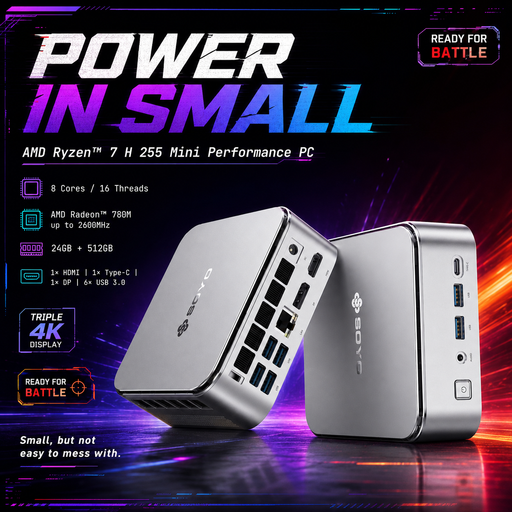 No image available
For a small desk, if the listed dimensions and display outputs suit your drawing setup.
128 × 128 × 47,6 mm, 24 GB LPDDR5 and 512 GB PCIe 3.0 SSD.
Radeon 780M; HDMI 2.0, DisplayPort 1.4 and Type-C display output are listed.
 No image available
For a compact drawing setup with some additional gaming use; check the requirements of your specific games and applications.
24 GB LPDDR5, 512 GB PCIe 4.0 SSD and Radeon 760M.
USB 4.0, HDMI 2.1 and 4K triple-display output are listed. Adobe lists integrated x86-64 graphics as unsupported for Substance 3D Painter.
Not for Krita alone: the programme recommends 16 GB RAM and lists graphics interface requirements, but doesn’t specify a particular high-end GPU. Choose any additional graphics power based on the games or other applications you actually plan to use.
First, measure the room you have for your monitor, tablet and PC, including cables and space for airflow. Krita requires a drawing tablet that’s compatible with your operating system. Also check that the tablet and monitor connections are supported by the specific PC model.
Check whether RAM, an SSD and an operating system are included in the version you’ve chosen. MINISFORUM explicitly distinguishes between the AtomMan G7 Ti barebone and a version with 32 GB RAM and a 1 TB SSD.
If a product is faulty, consumers can generally exercise their statutory rights against the seller for new goods within two years of delivery, as explained by Verbraucherzentrale. This is separate from a voluntary warranty. For many online purchases, you’ll also generally have a 14-day right to cancel, starting from the day you receive the goods.
No. For products covered by EU rules requiring CE marking, Your Europe says the mark is the manufacturer’s declaration that the specific product meets the applicable requirements. It isn’t an independent quality mark; whether it’s required depends on the rules that apply to the product.