Choose a protein bar for a gaming session based on the ingredients you personally need to avoid, rather than on a general impression that it is ‘free from’. ‘Vegan’, ‘gluten-free’ and ‘lactose-free’ describe different qualities: a vegan bar may contain soya or peanuts, for example, while lactose-free does not automatically mean dairy-free. So check the specific variety before comparing protein content and portion size.
Who should take particular care when choosing?
People who need to avoid a specific allergen
If you need to avoid peanuts, tree nuts, soya or milk, for example, check the labelling for each variety. The European Commission explains that allergens are highlighted in the ingredients list; a separate ‘may contain’ statement refers to the possibility of their accidental presence.
People with specific gluten or lactose requirements
If you specifically buy gluten-free products or want to avoid lactose, check the claim on the individual product. It is also important to distinguish between different milk components: the Verbraucherzentrale (German consumer advice centre) points out that ‘lactose-free’ refers to milk sugar, not to all components of milk.
People looking for plant-based bars
A protein bar labelled vegan could be a handy snack for a gaming session. Whether its recipe also suits other dietary exclusions depends on the ingredients: plant-based bars may contain soya, peanuts or hazelnuts, for example.
What should you look for when buying?
First, decide which ingredient or quality matters most to you. Then you can compare the labelling on the specific variety, its protein content per bar and the information on the pack.
| Criterion |
What to check |
Who should pay particular attention |
| Specific allergens |
For each variety, compare the ingredients, highlighted allergens and possible traces with your list of exclusions. A ‘may contain’ statement is not the same as an ingredient being present in the product. |
If you need to avoid peanuts or another specific allergen, you may also want to check for warnings about possible accidental contact. Around 50% of consumers put avoiding a specific allergen first. |
| Gluten-free, lactose-free or vegan |
Look for the claim you need on the specific bar, and check separately for any other exclusions. ‘Vegan’ does not mean gluten-free or nut-free; ‘lactose-free’ does not mean dairy-free. |
If you want to choose a gluten-free, lactose-free or vegan option, you need labelling that matches your main requirement. Around 30% of consumers prioritise a dietary requirement of this kind. |
| Protein and portion size |
Compare the protein content in grams per bar alongside the bar’s weight. Check the ingredients and warnings if you are planning to have several bars during a longer session. |
If you want a snack to eat while gaming, you may want to know how much protein each portion contains and whether there are any consumption warnings. Around 20% of consumers prioritise protein content and how well a product suits them. |
Common mistakes when choosing
-
Using ‘allergen-free’ as a blanket buying criterion
A gluten-free or vegan bar may still contain peanuts, tree nuts or soya. Any warning about possible traces also needs to be considered in light of your own exclusions.
For each variety, compare the full ingredients list, highlighted allergens and ‘may contain’ statements with the ingredients you need to avoid.
-
Confusing ‘lactose-free’ with ‘dairy-free’
Lactose is milk sugar. A lactose-free food may contain other milk components, so the claim does not answer every question about milk as an allergen.
If milk components are relevant to you, check the ingredients list and allergen labelling as well as the lactose claim.
-
Comparing protein content alone
A percentage on its own does not tell you how many grams of protein are in an individual bar. You also need to know the bar’s weight to compare portions.
Check the nutrition information per bar and per 100 g together, then compare the ingredients in each variety.
-
Overlooking warnings when having several bars
Retailer dm labels its Sportness Protein Bar Salted Caramel with a warning that excessive consumption may have a laxative effect. This is particularly relevant if you are planning to have several bars during a long session.
Take note of the warning on the pack, and don’t plan how much to eat based on protein content alone.
Brands to consider
The information below applies to the specific bars named, not to a brand’s entire range. If you have several dietary exclusions, the labelling on the specific variety is especially important.
ProFuel
ProFuel describes its veePRO CRISP as a vegan protein bar that is free from gluten, soya and lactose.
- According to ProFuel, each bar contains 20 g of protein.
- These stated free-from qualities do not replace checking the current ingredients and ‘may contain’ statements if you have other allergen exclusions.
HistaFood
HistaFood describes its Bio ProteinRiegel as vegan, gluten-free, lactose-free and soya-free, among other things.
- The manufacturer states that each bar contains 7.7 g of protein.
- HistaFood says the product is unsuitable for people with salicylate intolerance or an oral nickel allergy; check separately for any other personal exclusions.
BioTechUSA
BioTechUSA promotes its Zero Bar as a gluten-free and lactose-free protein bar.
- According to BioTechUSA, a 50-g bar contains 20 g of protein.
- The product description lists egg, soya and caseinate proteins, among other ingredients. The bar is therefore not allergen-free across the board, nor is it vegan.
PURYA!
At dm, the Salted Peanut Caramel variety is labelled as a vegan and gluten-free protein bar.
- dm states that this variety contains 25 g of protein per 100 g.
- According to the ingredients and allergen information, it contains peanuts and hazelnuts; possible traces of milk, nuts and sesame are also listed.
Sportness
The Salted Caramel protein bar sold at dm is labelled as vegan and lactose-free.
- dm states that this variety has a protein content of 24%.
- It contains soya and pieces of hazelnut; dm also lists possible traces of other allergens and a warning about excessive consumption.
Protein bars at Joybuy
These two bars suit different needs: Eat Natural is described as gluten-free, while Barebells is vegan. For both, check the specific pack for any other allergen exclusions.
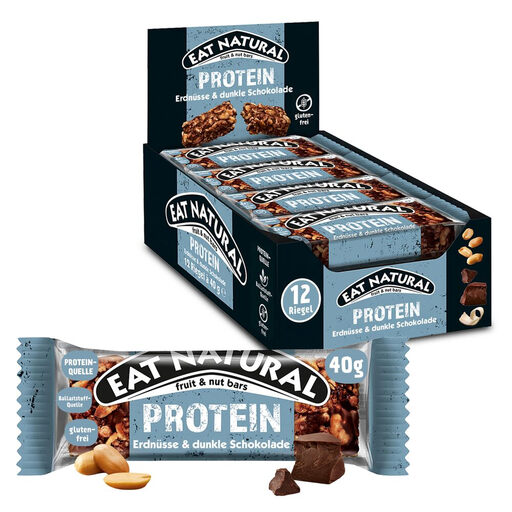 Image unavailable
Eat Natural Protein Bars Peanuts & Dark Chocolate, 12 × 40 g
An option if you’re looking for a protein bar specifically described as gluten-free, and peanuts and soya aren’t ingredients you need to avoid.
The product description states that it contains 19.5 g of protein per 100 g; each bar weighs 40 g. Check the nutrition information on the pack if the protein content per individual bar is important to your comparison.
The description mentions possible traces of milk and various nuts. If you need to avoid these, check the current labelling on the specific pack.
View at Joybuy
 Image unavailable
Barebells Vegan Protein Bar Peanut Caramel, 12 × 55 g
A plant-based snack option, as long as peanuts, soya and wheat protein aren’t ingredients you need to avoid.
Each bar weighs 55 g. To compare the protein content per bar, check the current nutrition table on the pack.
The vegan claim does not mean the bar is gluten-free, peanut-free or soya-free. If there are other allergens you need to avoid, check the current ‘may contain’ statements too.
View at Joybuy
Frequently asked questions
Is a vegan protein bar also allergen-free?
No. ‘Vegan’ refers to animal-derived ingredients, not to all allergens. For example, according to dm, the vegan-labelled PURYA! Salted Peanut Caramel contains peanuts and hazelnuts, so always check the specific ingredients list.
How can I tell if a protein bar is gluten-free?
Look for an explicit ‘gluten-free’ claim on the specific product. Under EU Implementing Regulation (EU) No 828/2014, this claim may only be used for foods containing no more than 20 mg/kg of gluten in the finished product. ‘Vegan’ or ‘lactose-free’ is not a substitute for a gluten-free claim.
Does ‘lactose-free’ also mean ‘dairy-free’ for a bar?
No. Lactose is milk sugar, but other milk components may still be relevant. The Verbraucherzentrale (German consumer advice centre) similarly distinguishes between a lactose claim and questions about milk components. Check the ingredients list and allergen labelling.
How should I store protein bars for a gaming session?
Follow the storage instructions on the individual pack. For the PURYA! Salted Peanut Caramel, dm recommends storing it in a dry place and protecting it from light and heat; don’t assume these instructions apply to other varieties without checking.


