
Lieferung heute & morgen

Qualitätsgarantie

Willkommens-Angebote freischalten: KOSTENLOSE Lieferung | Bis zu 80 % RABATT | Kostenlose 30-Tage-JoyPlus-Testphase
App herunterladen
It's a familiar problem: your desk is cluttered with different power adapters for your laptop, smartphone, and tablet. Your travel bag is a tangled mess of cables. Modern GaN chargers offer a practical solution. They pack high power into a compact design and can charge multiple devices at once.
This article serves as a guide. It explains the key features of GaN chargers and presents a selection of models for various use cases. The goal is to provide you with an objective basis for your purchasing decision.
To find the right model for your devices, a few technical aspects are crucial. The following points will help you better understand the specifications.
The advertised wattage (e.g., 65W charger) describes the maximum total output. However, what's more important is how this power is distributed among the individual ports when multiple devices are connected. A good multi-port charger adjusts the power dynamically. Check the manufacturer's specifications to ensure that the output for your most power-hungry device, like a laptop charger, is sufficient even when other ports are in use. For example, a 65-watt charger might provide 45 watts for a laptop and 20 watts for a smartphone.
Modern devices increasingly rely on the USB-C standard, as it enables high charging speeds via protocols like Power Delivery (PD). A future-proof USB-C power adapter should have at least one, and preferably two, USB-C ports. An additional USB-A port provides compatibility for older devices or accessories like smartwatches and headphones. The combination of both port types ensures maximum flexibility.
GaN (Gallium Nitride) technology makes it possible to house powerful electronics in significantly smaller casings than traditional silicon-based power adapters. This results in less heat generation and a more compact form factor. For people who travel a lot, a lightweight and small travel charger is a huge advantage. Pay attention to the dimensions and weight to find a solution that fits easily into any bag.
Based on the criteria above, we have compiled a selection of models suitable for different user groups.

What makes it stand out: This charger combines GaN technology with a compact design, allowing you to charge up to three devices simultaneously. With a maximum output of 65 watts from a single USB-C port, it can charge a 14-inch MacBook Pro to 50% in 50 minutes, according to the manufacturer. The power is distributed dynamically depending on how many ports are occupied.
Pros:
Who it's for: Users looking for a compact, all-in-one solution for their laptop, smartphone, and another device. Ideal for use in the office, at home, or as a travel charger.
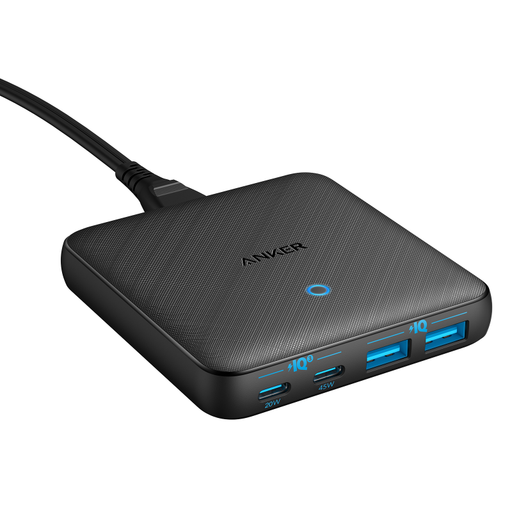
What makes it stand out: The Anker PowerPort Atom III is designed as a slim desktop charger. With two USB-C and two USB-A ports, it can power up to four devices at once. A detachable power cord allows for flexible placement on your desk. The primary USB-C port delivers up to 45 watts, which is sufficient for many laptops and tablets.
Pros:
Who it's for: Users who need a stationary charging solution for their desk to stay organized and centrally charge multiple devices like a laptop, tablet, smartphone, and accessories.
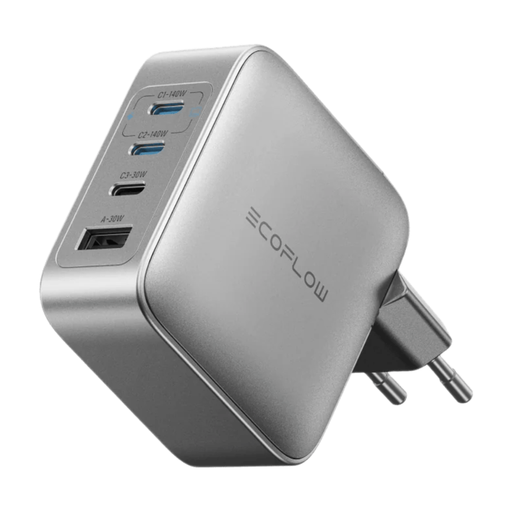
What makes it stand out: This fast charger is designed for maximum performance. With up to 140 watts from a single USB-C port, it can power even the most demanding laptops at full speed. It features three USB-C ports and one USB-A port, with intelligent power distribution for up to four devices. Safety features like temperature regulation and a flame-retardant casing complete the package.
Pros:
Who it's for: Power users and owners of high-end laptops (e.g., 16-inch MacBook Pro) who need the maximum available charging power and often have to charge multiple power-hungry devices at the same time.
If our selection doesn't include the perfect model for your specific needs, you can find a wider range of chargers with different power levels and port configurations in our High-Power USB Port category.
A GaN charger uses semiconductors made from Gallium Nitride (GaN) instead of traditional silicon. GaN can withstand higher voltages and temperatures and conducts electricity more efficiently. The main benefits for the user are:
No, when functioning correctly, a powerful charger will not harm modern devices. The charger and the device (e.g., a smartphone) communicate via protocols like USB Power Delivery (PD). The device tells the charger how much power it can safely accept. The charger then supplies only the requested amount of power. Therefore, a 140-watt charger will not charge a smartphone at 140 watts, but at the maximum speed intended for the smartphone (e.g., 25 watts).
Yes, the cable plays a crucial role. To take full advantage of a fast charger's power, especially for outputs above 60 watts, an appropriately certified USB-C cable is required. These cables contain an E-Marker chip that signals to the charger that the cable is rated for high currents. Using an unsuitable cable can limit the charging speed or, in the case of laptops, prevent charging altogether.